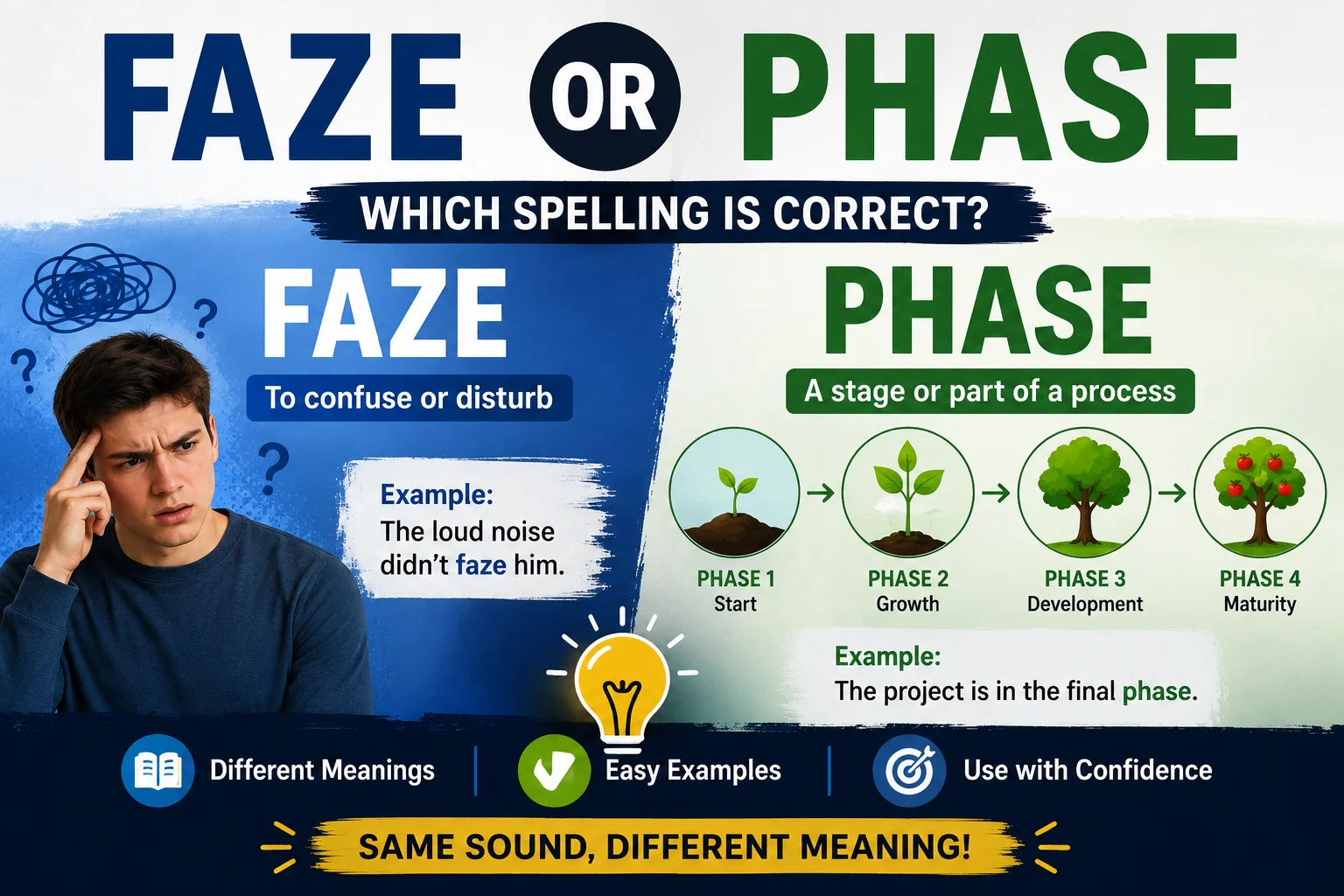
Faze means to disturb or unsettle someone, while phase refers to a stage in a process, development, or cycle.
Have you ever stopped while writing and wondered whether to use faze or phase? These two words sound exactly the same, but they have very different meanings. Because they are homophones, many students, writers, and English learners confuse them in emails, school assignments, and everyday conversations.
Understanding the difference between faze or phase will help you avoid common writing mistakes and make your sentences clearer. One word describes someone’s emotional reaction, while the other refers to a stage in a process or a gradual change. Choosing the wrong word can completely change the meaning of your sentence.
The good news is that both faze and phase are correct English words. The key is knowing when each one should be used. This guide explains their meanings, origins, common mistakes, and real-life examples in simple English so you can choose the right word with confidence.
Faze or Phase – Quick Answer
Both faze and phase are correct, but they have different meanings.
- Faze means to disturb, unsettle, or embarrass someone.
- Phase means a stage in a process, period, or development.
Real-life examples
- Loud noises don’t faze her.
- The project entered its final phase.
- His criticism didn’t faze me at all.
The Origin of Faze or Phase
Although faze and phase sound the same, they come from different origins.
The word faze appeared in English in the nineteenth century. It is believed to have developed from an older word meaning to frighten or disturb. Today, it is mainly used to describe someone remaining calm despite a difficult situation.
The word phase comes from the Greek word phasis, meaning “appearance,” which later entered Latin and French before becoming part of English. It refers to a stage, period, or step in a sequence.
Because both words are pronounced the same way, many writers accidentally choose the wrong spelling.
British English vs American English Spelling
There is no spelling difference between British English and American English.
Both countries use faze and phase with the same spellings. The difference is based entirely on meaning, not region.
| Version | Spelling | Region | Example Sentence |
|---|---|---|---|
| Standard English | Faze | UK & US | Nothing could faze the experienced teacher. |
| Standard English | Phase | UK & US | We are beginning the second phase of construction. |
Which Spelling Should You Use?
US audience
Use faze when talking about emotions or reactions. Use phase when referring to stages, periods, or gradual changes.
UK/Commonwealth audience
The same rule applies in the UK, Australia, Canada, New Zealand, and other Commonwealth countries.
Global/SEO audience
If your content answers the common search query “faze or phase,” mention both words early in the article. Then use each word correctly according to its meaning throughout the rest of your writing.
Common Mistakes with Faze or Phase
These words are often confused because they sound identical.
| Incorrect | Correct |
|---|---|
| The first faze of the project. | The first phase of the project. |
| The bad news didn’t phase me. | The bad news didn’t faze me. |
| We entered a new faze. | We entered a new phase. |
| Her comments never phase him. | Her comments never faze him. |
Quick tip
Remember this simple trick:
- Faze = Feelings (both begin with F)
- Phase = Period or Part of a process (both begin with P)
This memory trick makes it much easier to choose the correct word.
Faze or Phase in Everyday Examples
Seeing these words in real-life situations makes the difference much easier to remember.
Emails
- The recent changes should not faze our team.
- We will begin the next phase of the project on Monday.
News Headlines
- City Enters Final Phase of Road Construction
- Market Decline Does Not Faze Experienced Investors
Social Media
- Nothing can faze my best friend! 💪
- I’m finally in the last phase of my fitness journey.
Formal Writing
- The study moved into its second phase after the initial review.
- Unexpected questions did not faze the participants during the interview.
Faze or Phase – Google Trends & Usage
Many people search for faze or phase because the two words sound exactly alike but have different meanings. They are commonly confused in writing, especially by English learners and people relying on pronunciation instead of spelling.
The word phase appears more often in education, business, science, construction, technology, and project management because it describes stages or periods of development.
The word faze is less common but is regularly used in news articles, sports reporting, interviews, and everyday conversations to describe someone staying calm or unaffected by a difficult situation.
Search interest for both words remains steady because writers frequently want to confirm which spelling matches the meaning they intend.
Comparison Table
| Feature | Faze | Phase |
|---|---|---|
| Meaning | To disturb or unsettle someone | A stage or period in a process |
| Part of Speech | Verb | Noun (sometimes verb) |
| Common Use | Emotions and reactions | Stages, development, projects |
| Formal Writing | Yes | Yes |
| Everyday Writing | Yes | Yes |
| Correct English | Yes | Yes |
Frequently Asked Questions
1. Is faze or phase correct?
Both are correct English words. Faze relates to emotions or reactions, while phase refers to a stage or period.
2. What is the difference between faze and phase?
Faze means to disturb, worry, or unsettle someone. Phase means a step, stage, or period in a process or development.
3. Why do people confuse faze and phase?
They are homophones, meaning they sound the same but have different spellings and meanings.
4. Is there a British or American English difference?
No. Both British English and American English use the same spellings: faze and phase.
5. Can I use phase instead of faze?
No. Although they sound alike, they have different meanings. Using the wrong word changes the meaning of your sentence.
6. How can I remember the difference between faze and phase?
Think of Faze = Feelings and Phase = Part of a process. Matching the first letters makes the difference easy to remember.
Conclusion
Choosing between faze and phase is simple once you understand what each word means. Although they are pronounced the same way, they serve very different purposes in English. Faze is used when talking about someone’s emotional reaction or whether something disturbs them. Phase refers to a stage, period, or step in a process, project, or development.
Whether you are writing an email, a school assignment, a business report, or a social media post, selecting the correct word helps your message stay clear and professional. A simple memory trick can help: Faze starts with F for Feelings, while Phase starts with P for Period or Part of a process.
When in doubt, think about your sentence. If it describes emotions, choose faze. If it describes stages or progress, choose phase. Following this rule will help you write with confidence and avoid one of the most common homophone mistakes in English.