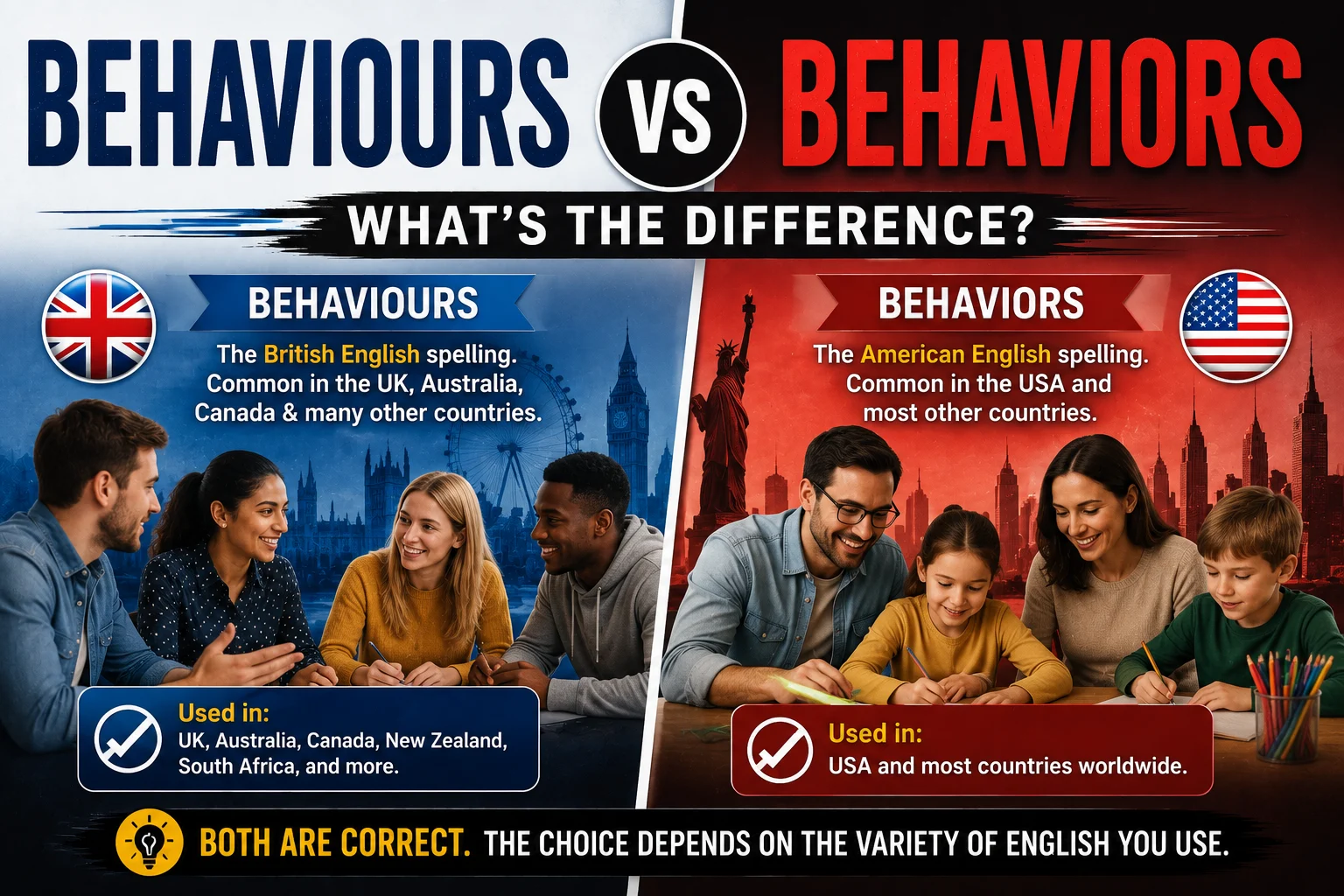
Behaviours and behaviors are both correct spellings. Behaviours is the standard British English spelling, while behaviors is the standard American English spelling.
Have you ever typed behaviours and then wondered if behaviors looks more correct? Or perhaps your spell checker changed one into the other?
This is a common problem for English learners because both spellings are correct. The difference is not about grammar or meaning. It is mainly about British and American English spelling.
As an English teacher, I often see learners worry when a word changes from -our to -or. Words such as colour/color, favour/favor, and honour/honor create the same question.
The rule is simple once you know it.
Behaviours is preferred in British English and in other varieties that follow British spelling. Behaviors is preferred in American English.
Both words have exactly the same meaning. They refer to the ways in which a person, animal, group, or thing acts or responds.
In this guide, you will learn when to use each spelling, why the difference exists, how to avoid common mistakes, and which form is best for school, work, websites, and international writing.
Behaviours or Behaviors – Quick Answer
Behaviours and behaviors are both correct.
The only major difference is the spelling convention:
- Behaviours → British English
- Behaviors → American English
Examples
British English:
Children’s behaviours can change as they grow.
American English:
Children’s behaviors can change as they grow.
The meaning does not change.
You should choose the spelling that matches your target audience and style guide.
The Origin / Background of Behaviours or Behaviors
The word behavior comes from the older verb behave, which means to act or conduct yourself in a certain way.
The noun developed from French and later became established in English.
The spelling difference between behavior and behaviour is part of a much larger pattern in English.
British English often keeps the -our ending found in words influenced by French spelling.
American English commonly uses the shorter -or form.
This gives us pairs such as:
| British English | American English |
|---|---|
| behaviour | behavior |
| colour | color |
| favour | favor |
| honour | honor |
| labour | labor |
| neighbour | neighbor |
The change became especially associated with American English spelling reforms.
One major influence was Noah Webster, an American lexicographer who supported simpler and more distinctive American spellings. His work helped establish many spelling forms used in the United States today.
Why Does English Have Two Spellings?
English developed across different regions.
British English continued using many traditional spellings. American English gradually adopted some shorter forms.
That is why both behaviour and behavior can be correct without one being a spelling mistake.
Behaviours or Behaviors Explained — Key Differences
The important point is that the meaning stays the same.
Only the spelling changes.
| Term | Meaning | When to Use | Region/Context |
|---|---|---|---|
| behaviours | Ways of acting or responding | British-style writing | UK and many British-English regions |
| behaviors | Ways of acting or responding | American-style writing | United States |
| behaviour | Singular form | British English | UK and related varieties |
| behavior | Singular form | American English | US |
Behaviours
Behaviours is the British English plural form.
Example:
The teacher noticed several unusual behaviours in the classroom.
You may see this spelling in British schools, universities, newspapers, and professional documents.
Behaviors
Behaviors is the American English plural form.
Example:
The teacher noticed several unusual behaviors in the classroom.
This is the standard spelling in American English.
The Singular Forms
The same pattern applies to the singular:
- British: behaviour
- American: behavior
So:
Her behaviour was polite.
is British English.
While:
Her behavior was polite.
is American English.
Which Version Should You Use?
The best spelling depends on who will read your writing.
For British English Readers
Use behaviours.
This is the better choice for audiences in:
- United Kingdom
- Ireland in contexts following British spelling
- Australia
- New Zealand
- Many Commonwealth settings
However, local style guides can vary, so always follow the rules of the organization you are writing for.
For American Readers
Use behaviors.
This is the standard form in the United States.
For example:
The study examined changes in children’s behaviors.
For Students
Follow your school’s required English variety.
If your teacher expects British English, write behaviours.
If your course uses American English, write behaviors.
Do not mix the two styles in the same piece without a good reason.
For Bloggers and Website Writers
Choose one spelling based on your main audience.
If your website targets American readers, use behaviors.
If your readers are mainly British, use behaviours.
Consistency is more important than choosing one form as “better.”
For Global English
If you write for an international audience, either spelling can work.
The safest approach is to choose a style and use it consistently throughout the page.
Common Mistakes with Behaviours or Behaviors
1. Thinking One Spelling Is Wrong
Mistake:
“Behaviours is incorrect.”
Correction:
Behaviours is correct in British English.
Likewise, behaviors is correct in American English.
2. Mixing British and American Spellings
You might write:
“The study examined children’s behaviors and their colours.”
This mixes American behaviors with British colours.
It may not make the sentence grammatically wrong, but it creates an inconsistent spelling style.
For American English, use:
“The study examined children’s behaviors and their colors.”
For British English, use:
“The study examined children’s behaviours and their colours.”
3. Using “Behaviour” for an American Audience
Mistake:
“The student’s behaviour was unusual.”
Better for American English:
“The student’s behavior was unusual.”
The first sentence is not grammatically wrong. It simply uses British spelling.
4. Forgetting the Singular Form
Some writers learn the plural first and then become unsure about the singular.
Remember:
British: behaviour → behaviours
American: behavior → behaviors
5. Changing the Meaning
The spelling does not change the meaning.
You should not treat behaviours and behaviors as different concepts.
They are spelling variants of the same word.
Behaviours or Behaviors in Real-World Examples
1. Professional Email
British English:
“We have noticed several changes in customer behaviours this quarter.”
American English:
“We have noticed several changes in customer behaviors this quarter.”
Both sentences are correct.
2. News Headline
British English:
New Study Examines Changing Consumer Behaviours
American English:
New Study Examines Changing Consumer Behaviors
The headline means the same thing.
3. Social Media Post
British style:
“What small behaviours help you stay productive?”
American style:
“What small behaviors help you stay productive?”
Again, the difference is spelling only.
4. Formal Document or Report
British English:
“The report identifies several behaviours that may affect workplace safety.”
American English:
“The report identifies several behaviors that may affect workplace safety.”
Both forms are suitable for formal writing when they match the document’s spelling style.
5. Academic Writing
British:
“The researchers studied social behaviours among young adults.”
American:
“The researchers studied social behaviors among young adults.”
Academic writing should follow the required style guide or institution’s preferred variety.
Behaviours or Behaviors — Data, Trends & Usage
The search intent behind behaviours or behaviors is mainly informational.
People usually search this spelling pair because they want to know:
- Which spelling is correct?
- Is behaviours British English?
- Is behaviors American English?
- Should I use behaviour or behavior?
- Which spelling should I use in an essay?
- Are both forms accepted?
The topic matters because English is used across many countries, and spelling standards differ.
Where Is “Behaviours” Used?
Behaviours is common in British English and other English varieties that generally follow British spelling conventions.
You may see it in:
- UK academic writing
- British newspapers
- Government documents
- Education
- Psychology
- Sociology
- Business writing
Where Is “Behaviors” Used?
Behaviors is standard in American English.
It is common in:
- US schools
- American newspapers
- Scientific writing
- Business documents
- Psychology
- Technology
- Marketing
Why This Matters Now
Online writing reaches readers from many countries.
A website may have readers in the UK, US, Canada, Australia, India, Pakistan, and many other places.
That makes spelling consistency important.
If your audience is mainly American, behaviors will feel natural.
If your audience is mainly British, behaviours will feel natural.
Standalone Comparison: Behaviours vs. Behaviors
| Term/Variant | Meaning | Region/Context | Best Used When |
|---|---|---|---|
| behaviours | Ways of acting or responding | British English | Writing for UK-style audiences |
| behaviors | Ways of acting or responding | American English | Writing for US audiences |
| behaviour | Singular form | British English | One type or pattern of behavior |
| behavior | Singular form | American English | One type or pattern of behavior |
| behavioural | Related to behavior | British English | British academic/professional writing |
| behavioral | Related to behavior | American English | American academic/professional writing |
A useful pattern is:
British: behaviour → behaviours → behavioural
American: behavior → behaviors → behavioral
Frequently Asked Questions About Behaviours or Behaviors
Q: What does behaviours mean?
A: Behaviours means ways of acting, responding, or conducting yourself. It is the British English plural spelling of behaviour.
Q: How do you use behaviours correctly?
A: Use behaviours when writing in British English and talking about more than one type or example of behavior. For example: “The teacher noticed several positive behaviours.”
Q: Behaviours vs. behaviors — what’s the difference?
A: The difference is spelling, not meaning. Behaviours is British English, while behaviors is American English.
Q: Is behaviours acceptable in formal writing?
A: Yes. Behaviours is fully acceptable in formal British English. It is common in academic, professional, government, and educational writing.
Q: Which version is correct — behaviours or behaviors?
A: Both are correct. Choose behaviours for British English and behaviors for American English.
Q: Where does the word behaviour come from?
A: Behaviour developed from the verb behave and has roots connected to French and older forms of English. The British -our spelling differs from the American -or spelling.
Q: Can behaviours be used in academic writing?
A: Yes. It is widely used in academic writing that follows British spelling. If your university or journal uses American English, use behaviors instead.
Q: Is behaviours British or American English?
A: Behaviours is British English. Behaviors is the standard American English spelling.
Q: Do Canada and Australia use behaviours or behaviors?
A: English spelling can vary by country and style guide. Behaviour/behaviours is widely used in Canadian and Australian English, although specific publications may have their own preferences.
Conclusion
The choice between behaviours or behaviors is easy once you know the spelling rule.
Behaviours is the standard British English spelling. Behaviors is the standard American English spelling. Both forms have the same meaning and are grammatically correct.
The main thing to remember is consistency.
If you are writing for a British audience, choose behaviours. If your audience is American, choose behaviors. For school, university, business, or academic work, follow the required style guide.
You should also remember the singular forms:
- British: behaviour
- American: behavior
Do not worry if you see the other spelling. It does not mean the writer made a mistake. It may simply reflect a different form of English.
Now you know exactly when to use behaviours or behaviors. Bookmark this guide and share it with someone who is still unsure which spelling to choose.