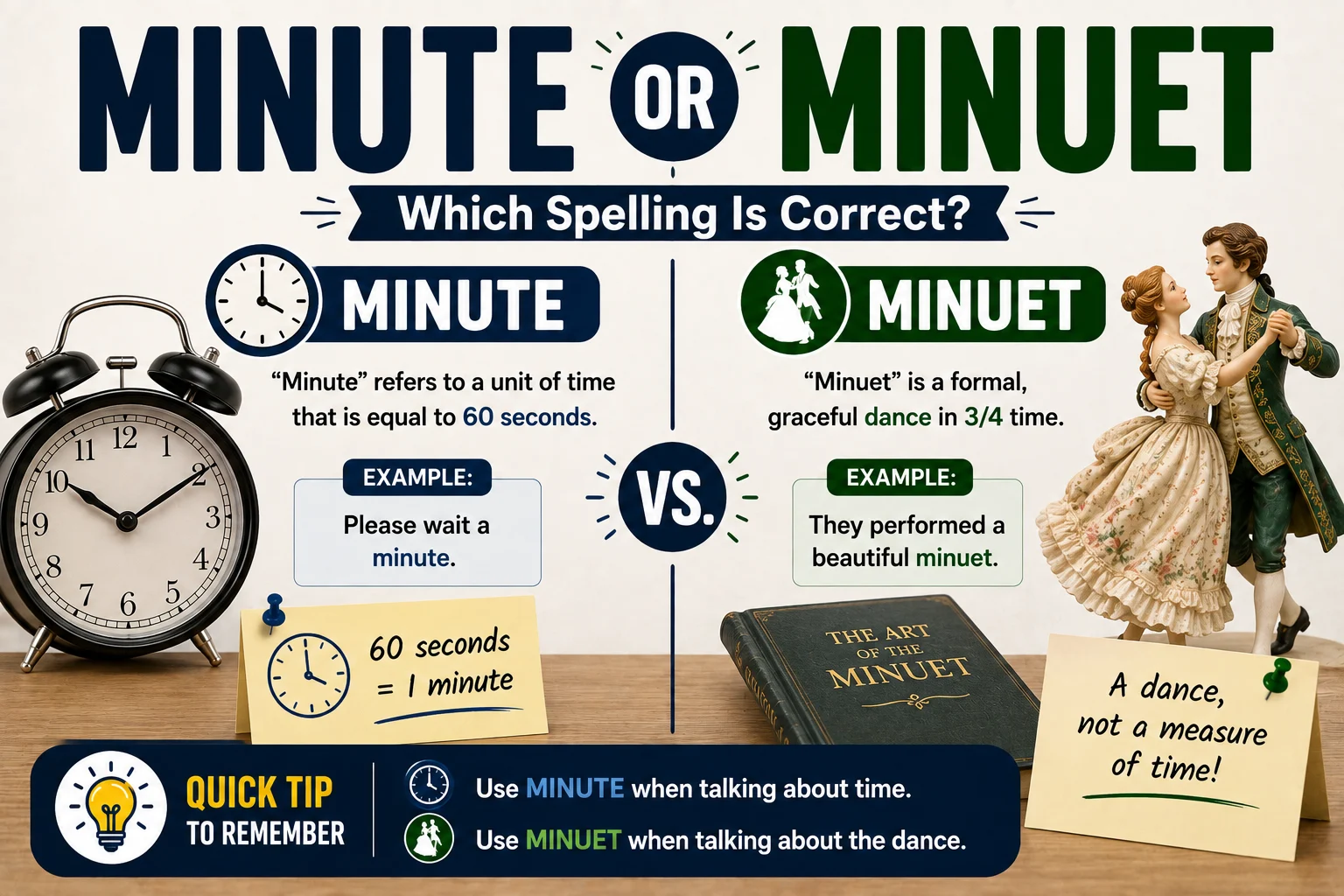
Minute means a unit of time or something very small, while minuet is a slow, graceful dance and a type of musical composition.
Have you ever typed a sentence and stopped because minute and minuet sound almost the same? This is a common problem for English learners. The two words are easy to mix up because they look similar and can sound alike in some contexts.
I have seen this confusion many times in student writing. A learner may want to write, “Wait one minute,” but choose minuet by mistake. Another writer may read about classical music and wonder why someone is talking about a “minute” dance.
The key is to remember that these words have completely different meanings. Minute is usually about time. It can also mean something very small. Minuet, on the other hand, is connected to dance and music.
This guide will show you the meaning, history, pronunciation, differences, common mistakes, and real-world use of minute or minuet. By the end, choosing the right word will feel easy.
minute or minuet – Quick Answer
Minute and minuet are different words with different meanings.
Minute
Minute can mean:
- A unit of time equal to 60 seconds.
- Something extremely small or detailed.
Examples:
- Please wait one minute.
- There was a minute change in the design.
Minuet
Minuet is a type of slow, graceful dance. It is also a piece of music written for this type of dance.
Example:
The musicians played a beautiful minuet.
The easiest way to remember
Think:
Minute = time or tiny
Minuet = dance or music
The Origin and Background of minute or minuet
These two words look alike, but they come from different language histories.
Understanding their origins can help you remember which word to use.
The history of “minute”
The word minute comes from Latin minuta, meaning a small part or small portion. It is related to the Latin word minutus, meaning small.
This idea of something small later became linked to small divisions of time.
A minute is a small division of an hour:
1 hour = 60 minutes
The word also developed another meaning: very small.
For example:
A minute amount of dust covered the table.
In this use, minute is pronounced differently from the time word.
The history of “minuet”
Minuet has a different history.
It comes from the French menuet, which referred to a slow, graceful dance. The French word is connected to menu, meaning small or fine, possibly linked to the small steps used in the dance.
The minuet became popular in European court culture and later became an important part of classical music.
Composers such as Mozart, Haydn, and Bach used minuets in their music.
So although minute and minuet look related, their modern meanings are quite different.
minute or minuet Explained — Key Differences
The best way to separate these words is to look at their meanings and pronunciation.
1. Minute = a unit of time
When minute means a unit of time, it refers to 60 seconds.
Example:
The train will arrive in five minutes.
Another example:
I only have one minute to finish this task.
This is by far the most common meaning of minute.
2. Minute = extremely small
Minute can also be an adjective meaning very small or tiny.
In this meaning, it is usually pronounced my-NOOT.
Example:
The scientist noticed a minute crack in the glass.
Another example:
There was a minute difference between the two samples.
This meaning is common in formal, scientific, and academic writing.
3. Minuet = a dance
A minuet is a traditional slow dance.
It was especially popular in European court society from the 17th and 18th centuries.
Example:
The dancers performed a graceful minuet.
4. Minuet = a musical composition
A minuet can also mean a piece of music written in the style of this dance.
Example:
The pianist played a famous minuet.
You are most likely to see this word when reading about:
- classical music
- orchestras
- composers
- historical dances
- music theory
Comparison Table: minute or minuet
| Term | Meaning | When to Use | Region/Context |
|---|---|---|---|
| minute | 60 seconds | Talking about time | General English |
| minute | Very small | Describing something tiny | Formal/general English |
| minuet | A graceful dance | Talking about traditional dance | Historical/cultural |
| minuet | A type of musical composition | Talking about classical music | Music |
The spelling difference is small, but the meanings are completely different.
Which Version Should You Use?
The correct word depends on what you want to say.
For time → use minute
If you are talking about 60 seconds, always use minute.
Give me a minute.
The meeting starts in ten minutes.
She waited for thirty minutes.
Do not use minuet in these sentences.
For something very small → use minute
When you mean tiny or extremely small, use minute.
The doctor found a minute change in the patient’s condition.
A minute amount of paint was left.
Remember that this meaning has a different pronunciation.
For dance → use minuet
If you are talking about the historical dance, use minuet.
The couple learned the minuet.
For classical music → use minuet
Use minuet when describing a musical work or movement based on the dance.
The orchestra performed a Mozart minuet.
For students
A simple memory rule can help:
Minute = time or tiny.
Minuet = dance or music.
This rule covers almost every situation you will meet.
Common Mistakes with minute or minuet
Mistake 1: Using “minuet” for time
Wrong:
Wait five minuets.
Correct:
Wait five minutes.
The mistake happens because the two words look and sound similar.
Mistake 2: Spelling “minute” as “minuet”
Wrong:
The class lasted forty minuets.
Correct:
The class lasted forty minutes.
The word for time is always spelled minute.
Mistake 3: Using “minute” for a dance
Wrong:
The dancers performed a beautiful minute.
Correct:
The dancers performed a beautiful minuet.
When you mean the traditional dance, choose minuet.
Mistake 4: Confusing the adjective “minute”
The adjective minute means very small.
Example:
The scientist found a minute particle.
Do not assume every use of minute refers to time.
Mistake 5: Ignoring pronunciation
The two words can sound confusing.
Minute meaning a unit of time is pronounced:
MIN-it
Minute meaning very small is pronounced:
my-NOOT
Minuet is usually pronounced:
min-yoo-ET
Learning the sounds can make the spelling easier to remember.
minute or minuet in Real-World Examples
Context makes the difference clear.
1. Professional Email
Please give me one minute to review the document before our meeting.
Here, minute means a unit of time.
2. News Article
Emergency crews arrived within ten minutes of the call.
Again, minute refers to time.
3. Social Media Post
I will be there in five minutes! Please wait for me.
This is a normal everyday use of minute.
4. Music Article
The orchestra performed a lively minuet during the concert.
Here, minuet refers to music.
5. Historical Article
Guests at the royal event learned how to perform the minuet.
Here, the word refers to the traditional dance.
6. Scientific Writing
The test detected a minute change in temperature.
Here, minute means extremely small.
Notice that the same spelling can have two different meanings.
Pronunciation: minute vs minuet
Pronunciation is one of the most useful ways to remember these words.
Minute meaning time
IPA: /ˈmɪnɪt/
Sounds like:
MIN-it
Example:
Wait a minute.
Minute meaning very small
IPA: /maɪˈnjuːt/
Sounds like:
my-NOOT
Example:
The machine made a minute adjustment.
Minuet
IPA: /ˌmɪnjuˈet/
Sounds roughly like:
min-yoo-ET
Example:
They performed a minuet.
Quick pronunciation trick
If you can replace the word with 60 seconds, say MIN-it.
If you can replace it with tiny, say my-NOOT.
If you mean a dance, think min-yoo-ET.
minute or minuet — Data, Trends & Usage
The search intent behind “minute or minuet” is strongly informational. People usually search for the pair because they have seen or heard the words and are unsure which spelling fits their sentence.
Minute is extremely common in everyday English because people often talk about time:
- one minute
- five minutes
- a few minutes
- ten minutes ago
- in a minute
Minuet is much less common. It appears mainly in discussions of classical music, dance, history, and culture.
The interesting part is that minute has two very different pronunciations. This makes it especially tricky for English learners.
The best strategy is not to memorize spelling alone. Connect each word to its meaning.
Standalone Comparison Table
| Term/Variant | Meaning | Region/Context | Best Used When |
|---|---|---|---|
| minute /MIN-it/ | 60 seconds | All English varieties | Talking about time |
| minute /my-NOOT/ | Extremely small | All English varieties | Describing something tiny |
| minuet /min-yoo-ET/ | Traditional dance | Historical/cultural | Talking about dance |
| minuet | Musical composition | Classical music | Discussing music |
Frequently Asked Questions
Q: What does “minute” mean?
Minute usually means a unit of time equal to 60 seconds. It can also mean very small, as in “a minute detail.”
Q: What does “minuet” mean?
A minuet is a slow, graceful dance that was popular in European court culture. The word can also describe a piece of music based on that dance.
Q: Is it one minute or one minuet?
It is one minute when you mean a period of 60 seconds.
Please wait one minute.
Minuet is only correct when you mean the dance or musical form.
Q: Is “minute” the same as “minuet”?
No. They are different words. Minute usually refers to time or something very small, while minuet refers to a dance or type of classical music.
Q: How do you pronounce “minute” and “minuet”?
For time, minute is pronounced MIN-it. When it means very small, it is pronounced my-NOOT. Minuet is pronounced roughly min-yoo-ET.
Q: Can “minute” mean very small?
Yes. As an adjective, minute means extremely small.
The scientist observed a minute particle.
This meaning has a different pronunciation from the time word.
Q: Is “minuet” used in classical music?
Yes. A minuet can be a musical composition based on the traditional dance. It appears in many works from the classical music tradition.
Q: Why are minute and minuet confused?
They are confused because their spellings are similar and their sounds can be close. English learners may also hear minuet and minute without enough context to know which word is intended.
Conclusion
The difference between minute or minuet becomes easy once you connect each word to its meaning.
Use minute when you mean 60 seconds:
I will be there in five minutes.
Use minute when you mean very small:
The scientist found a minute crack.
Use minuet when you mean a traditional dance or a piece of classical music:
The dancers performed a minuet.
There is also an important pronunciation point. The two meanings of minute are pronounced differently. That can feel tricky at first, but the meaning usually gives you the answer.
For everyday writing, minute is the word you will use far more often. Minuet belongs mainly to music, dance, and history.
Now you know exactly when to use minute or minuet. Bookmark this guide so you never second-guess these two words again.