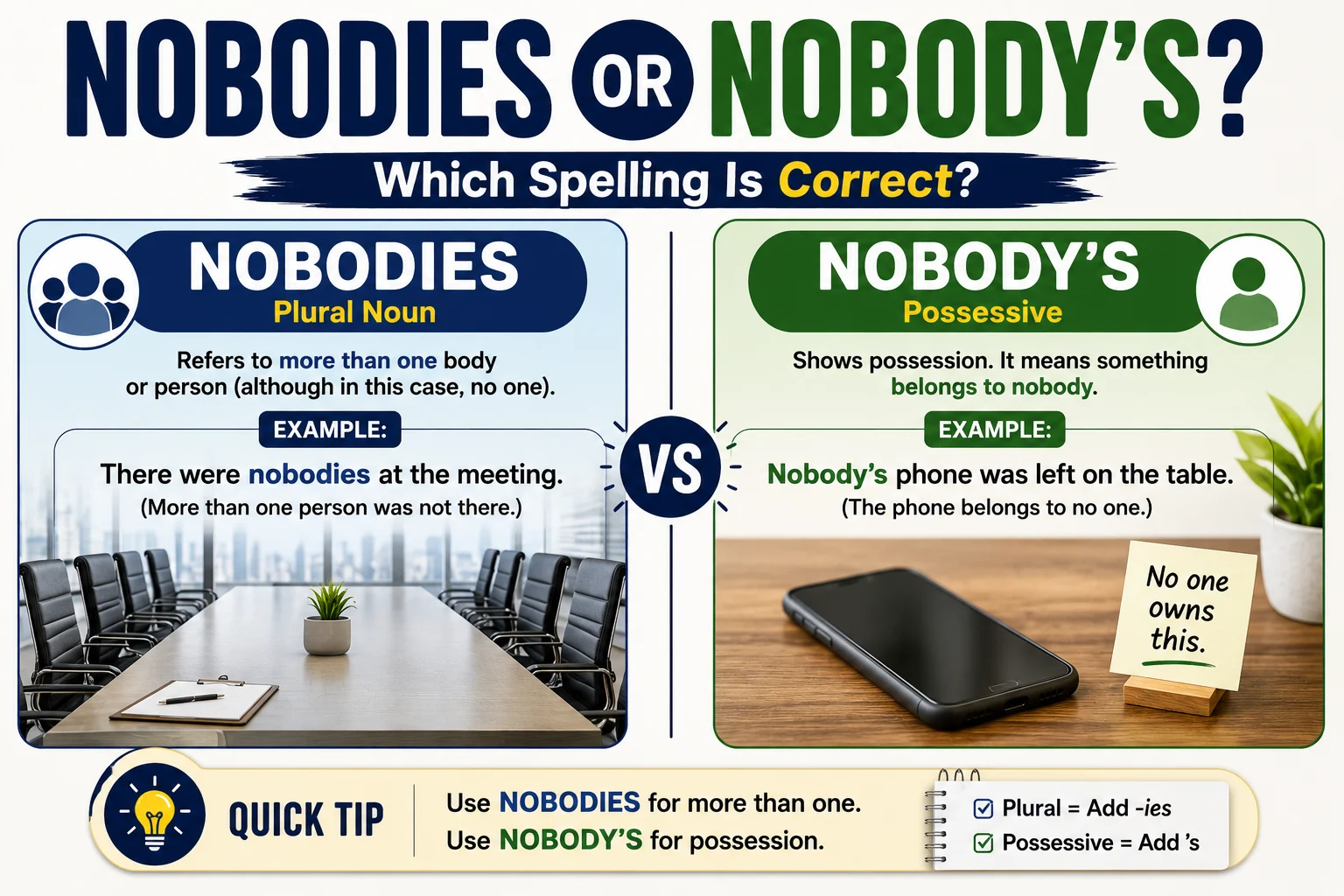
Nobodies is the plural of nobody, while nobody’s is usually the possessive form of nobody or a contraction of nobody is/has.
A tiny apostrophe can completely change the meaning of a sentence. That is why nobodies or nobody’s causes trouble for many English learners and writers.
I have seen this confusion in student work, online posts, and everyday messages. A writer may want to say that several people are unimportant and write nobody’s instead of nobodies. In another sentence, the writer may need a contraction such as “nobody is” but leave out the apostrophe.
The good news is that the difference is simple once you know what the apostrophe does. Nobodies refers to more than one person described as a “nobody.” Nobody’s has two main jobs. It can show possession, as in “nobody’s phone,” or it can shorten “nobody is” or “nobody has,” as in “nobody’s coming.”
This guide explains each form, shows real examples, covers common mistakes, and gives you a simple rule to remember.
nobodies or nobody’s – Quick Answer
Nobodies and nobody’s are not interchangeable.
- Nobodies = the plural of nobody.
- Nobody’s = possessive nobody or a contraction of nobody is/has.
Examples
The two men were treated like nobodies.
Here, nobodies means people who were treated as unimportant.
Nobody’s perfect.
Here, nobody’s means nobody is.
Nobody’s phone was left on the table.
Here, nobody’s shows possession. It means the phone belonged to nobody.
The fastest way to remember
Ask yourself what you mean:
- Do you mean more than one nobody? → nobodies
- Do you mean nobody is? → nobody’s
- Do you mean nobody has? → nobody’s
- Do you mean something belongs to nobody? → nobody’s
The Origin / Background of nobodies or nobody’s
To understand these forms, start with nobody.
Nobody is made from two simple parts:
- no = not any
- body = a person
Together, nobody means no person or not anyone.
The word has been used in English for centuries. It became a common way to refer to no person without repeating a longer phrase such as “not any person.”
The word nobody is normally treated as a singular pronoun:
Nobody is ready.
It does not mean “many people.” It means no person.
The confusion starts when writers want to talk about several people who are called “nobodies.” English normally forms the plural by adding -s:
nobody → nobodies
The y changes to ie before the plural s.
The apostrophe in nobody’s has a different job. It does not create a plural. Apostrophes can show possession or mark missing letters in contractions.
That gives us three different ideas:
nobody → no person
nobodies → more than one “nobody”
nobody’s → possessive or contraction
nobodies or nobody’s Explained — Key Differences
| Term | Meaning | When to Use | Region/Context |
|---|---|---|---|
| nobody | No person | Referring to no one | Standard English |
| nobodies | More than one “nobody” | Referring to several people viewed as unimportant | Standard English |
| nobody’s | Possessive form | Showing that something belongs to nobody | Standard English |
| nobody’s | Nobody is | Contraction | Informal and general writing |
| nobody’s | Nobody has | Contraction | Informal and general writing |
Nobodies
Use nobodies when you need a plural noun.
The actors were once nobodies, but they later became famous.
The word refers to several people.
Another example:
The powerful leaders ignored the young nobodies.
Here, nobodies is a plural noun.
Nobody’s as a possessive
Use nobody’s when you mean that something belongs to nobody.
Nobody’s responsibility was clear.
This means the responsibility did not belong to any person.
A more natural example is:
Nobody’s phone is ringing.
The apostrophe shows possession.
Nobody’s as a contraction of nobody is
You can use nobody’s to mean nobody is.
Nobody’s home.
Expand it:
Nobody is home.
The sentence still makes sense.
Another example:
Nobody’s listening.
Expand it:
Nobody is listening.
This is one of the most common uses of nobody’s.
Nobody’s as a contraction of nobody has
Nobody’s can also mean nobody has when has is part of the perfect tense.
Nobody’s told me the answer.
Expand it:
Nobody has told me the answer.
Here, nobody’s does not show possession.
Which Version / Approach Should You Use?
The correct choice depends on what you want to say.
For students
Use nobodies when you mean several people described as “nobodies.”
Use nobody’s when you can replace it with nobody is or nobody has, or when it shows possession.
A useful test is to expand the contraction.
Nobody’s here.
→ Nobody is here.
If that works, nobody’s is correct.
For formal writing
Both forms can be correct, but contractions are often less formal.
Instead of:
Nobody’s responsible.
A formal document may use:
Nobody is responsible.
However, nobodies is fine when the meaning calls for the plural noun.
For global or neutral English
Use the form that matches your meaning rather than choosing by sound.
Never use an apostrophe just because you want to make a word plural.
That is the key rule.
Common Mistakes with nobodies or nobody’s
1. Using nobody’s as a plural
Mistake:
The two men were nobody’s.
Correction:
The two men were nobodies.
Why? You are talking about more than one person.
2. Writing nobodies when you mean nobody is
Mistake:
Nobodies coming to the meeting.
Correction:
Nobody’s coming to the meeting.
Why? Nobody’s means nobody is.
3. Adding an apostrophe to make a plural
Mistake:
The actors were once nobody’s.
Correction:
The actors were once nobodies.
Why? Regular plurals do not normally need an apostrophe.
4. Confusing possessive and contraction forms
Consider:
Nobody’s keys are here.
This can mean the keys belong to nobody.
But:
Nobody’s coming.
means:
Nobody is coming.
The spelling is the same, but the grammar is different.
5. Using nobodies for the pronoun nobody
Mistake:
Nobodies knows the answer.
Correction:
Nobody knows the answer.
Why? Nobody is already a singular pronoun. You do not make it plural when you mean “no person.”
nobodies or nobody’s in Real-World Examples
Professional Email
Nobody’s available to approve the request today.
Here, nobody’s means nobody is.
For a more formal email:
Nobody is available to approve the request today.
Both are grammatically correct.
News Headline or Article
Former Nobodies Become National Stars
Here, nobodies is a plural noun. It refers to several people who were once unknown or unimportant.
Social Media Post
Nobody’s perfect, so give yourself some room to learn.
Here, nobody’s means nobody is.
Formal Document
Nobody’s property may be removed without permission.
Here, nobody’s is possessive. It means property belonging to nobody.
However, formal writing could make the meaning clearer by rewriting the sentence:
Property that belongs to no individual may not be removed without permission.
Everyday Conversation
Nobody’s answering the phone.
This means:
Nobody is answering the phone.
Storytelling
They were once nobodies, struggling to get noticed.
Here, nobodies is a plural noun.
nobodies or nobody’s — Data, Trends & Usage
The search intent behind nobodies or nobody’s is strongly informational. People usually search this phrase when they are unsure whether an apostrophe is needed.
The confusion is understandable because nobody’s can have several grammatical meanings. The same spelling can represent possession, nobody is, or nobody has.
Nobodies creates a different problem. It looks unusual because the word changes from nobody to nobodies rather than simply adding s.
This topic is especially useful for:
- English learners
- School and university students
- ESL writers
- Bloggers
- Copywriters
- Editors
- Social media writers
The main lesson is useful far beyond this one word. Apostrophes do not normally make nouns plural. They usually show possession or missing letters in contractions.
That rule can help you avoid many similar errors, such as confusing its and it’s or whose and who’s.
Standalone Comparison Table
| Term/Variant | Meaning | Region/Context | Best Used When |
|---|---|---|---|
| nobody | No person | Standard English | You mean “no one” |
| nobodies | Several “nobodies” | Standard English | You mean more than one person |
| nobody’s | Belonging to nobody | Standard English | Showing possession |
| nobody’s | Nobody is | Standard English | Using a contraction |
| nobody’s | Nobody has | Standard English | Using a perfect-tense contraction |
FAQs About nobodies or nobody’s
Q: What does nobodies mean?
A: Nobodies is the plural of nobody when nobody is being used as a noun. It usually describes two or more people who are seen as unknown, unimportant, or without influence.
Q: How do you use nobodies correctly?
A: Use nobodies when you mean several people who are called “nobodies.” For example: “The young musicians were once nobodies.”
Q: What is the difference between nobodies and nobody’s?
A: Nobodies is a plural noun. Nobody’s is either possessive or a contraction of nobody is or nobody has.
Q: Is nobody’s acceptable in formal writing?
A: Yes. Nobody’s is grammatically correct when it shows possession or forms a contraction. In very formal writing, you may choose nobody is or nobody has instead of the contraction.
Q: Which is correct, nobodies or nobody’s?
A: Both are correct, but they have different meanings. Use nobodies for a plural noun and nobody’s for possession or a contraction.
Q: Where does nobody come from?
A: Nobody combines no and body. It developed as a word meaning “no person” or “not anyone.”
Q: Can nobody’s mean nobody has?
A: Yes. For example, “Nobody’s finished the work” can mean “Nobody has finished the work.” The surrounding sentence tells you which meaning is intended.
Conclusion
The difference between nobodies or nobody’s comes down to one small mark and one important grammar rule.
Nobodies is the plural form used when you are talking about several people described as “nobodies.” For example, “The performers were once nobodies.”
Nobody’s has three possible uses. It can show possession, as in “Nobody’s phone is here.” It can mean nobody is, as in “Nobody’s ready.” It can also mean nobody has, as in “Nobody’s finished.”
The easiest rule is this: do not use an apostrophe just to make nobody plural. If you mean more than one “nobody,” write nobodies. If you can replace nobody’s with nobody is or nobody has, the apostrophe belongs there.