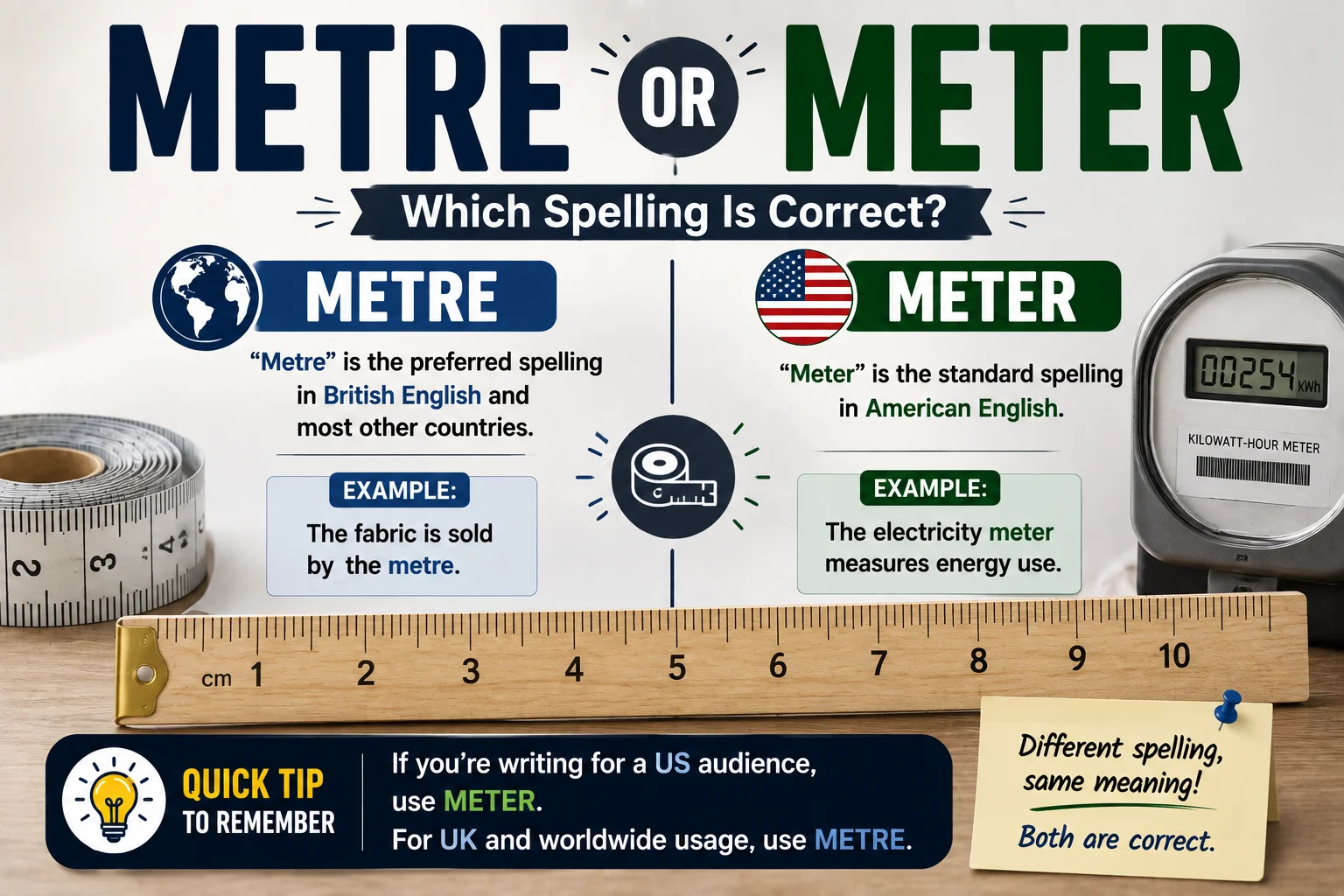
Metre and meter are both correct spellings, but they are used differently by region and meaning. Metre is mainly British English for the unit of length, while meter is standard American English.
Have you ever written metre and wondered if you should use meter instead? You are not alone. This small spelling difference can cause real confusion, especially when you read both British and American English.
I have often seen English learners stop while writing a sentence such as, “The road is 500 metres long.” Then comes the doubt: Should it be metres or meters?
The answer depends on where you are writing and what you mean.
In British English, metre is the usual spelling for the unit of length. In American English, meter is used. There is another important difference, too. A meter can mean a device that measures something, such as an electricity meter or a parking meter. In both British and American English, that device is normally spelled meter.
This guide makes the difference simple. You will learn the history, correct usage, common mistakes, real examples, and the best spelling for your audience.
metre or meter – Quick Answer
Metre and meter can refer to the same unit of length.
- British English: metre
- American English: meter
Examples
- British: The pool is 25 metres long.
- American: The pool is 25 meters long.
However, meter has another meaning.
A meter is also a device used to measure something:
- The electricity meter is outside the house.
- The parking meter needs more money.
So, the spelling depends on meaning and English variety.
The Origin and Background of metre or meter
The story of metre/meter goes back many centuries.
Both spellings come from the same word family. The word traces back to the Greek metron, meaning “measure.”
It later passed into Latin and French before entering English.
From Greek to English
The Greek word metron was connected with measuring and proportion. This idea is still visible in modern words such as metric, metre, and meter.
Over time, European languages developed different forms of the word.
English eventually adopted the word in more than one form. The spelling metre became common in British English, while meter became the standard spelling in American English.
Why are there two spellings?
The difference is largely a result of the development of British and American spelling conventions.
American English often prefers shorter or simpler spellings in some word groups. For example:
- British centre → American center
- British theatre → American theater
- British metre → American meter
This does not mean one spelling is wrong.
It means the spelling follows a particular English variety.
metre or meter Explained — Key Differences
The easiest way to understand these words is to separate the unit of length from the measuring device.
1. Metre
Metre is the standard British English spelling for the unit of length equal to 100 centimetres.
Example:
The table is two metres long.
It is also widely used in other varieties that follow British spelling, including many educational and official contexts around the world.
2. Meter
Meter is the American English spelling for the same unit.
Example:
The table is two meters long.
American writers should normally use meter when talking about the metric unit.
3. Meter as a measuring device
Meter also means a device that measures something.
This meaning is not normally written as metre, even in British English.
For example:
The electricity meter needs to be checked.
You may also see:
- water meter
- gas meter
- parking meter
- speed meter
- fuel meter
4. Metre or meter in poetry
The word also has a meaning related to poetry and rhythm.
It describes the pattern of stressed and unstressed sounds in a line of verse.
British English often uses metre:
The poem has a regular metre.
American English commonly uses meter:
The poem has a regular meter.
Here again, the difference is mainly regional spelling.
Comparison Table: metre or meter
| Term | Meaning | When to Use | Region/Context |
|---|---|---|---|
| metre | Unit of length | For metric measurement | British English |
| meter | Unit of length | For metric measurement | American English |
| meter | Measuring device | Electricity, water, parking, etc. | British & American English |
| metre | Rhythm in poetry | To discuss poetic rhythm | British English |
| meter | Rhythm in poetry | To discuss poetic rhythm | American English |
The key point is simple: metre is usually British, while meter is usually American.
Which Version Should You Use?
Your choice should depend on your audience.
For British English readers
Use metre when you mean the unit of length.
Correct:
The bridge is 300 metres long.
Use meter when you mean a measuring device.
Correct:
The electricity meter is broken.
For American English readers
Use meter for the unit of length.
Correct:
The bridge is 300 meters long.
Use meter for a measuring device, too.
Correct:
The electricity meter is broken.
This makes American English easy in this case because the same spelling works for both meanings.
For students
Follow the spelling system taught by your school, textbook, or teacher.
If your course uses British English, metre is usually the right choice for the unit.
If your course uses American English, use meter.
For bloggers and content writers
Think about your target readers.
- Writing for a US audience? Use meter.
- Writing for a UK audience? Use metre.
- Writing for an international audience? Choose one style and use it consistently.
Consistency matters more than mixing styles.
Common Mistakes with metre or meter
Small spelling differences can create big problems when they appear many times in an article.
Mistake 1: Mixing British and American spelling
Wrong style:
The building is 20 metres tall, and the next one is 30 meters tall.
The sentence may be understood, but the spelling is inconsistent.
Better British English:
The building is 20 metres tall, and the next one is 30 metres tall.
Better American English:
The building is 20 meters tall, and the next one is 30 meters tall.
Mistake 2: Using metre for a measuring device
Incorrect:
The electric metre is outside.
Correct:
The electric meter is outside.
Remember that meter is the standard spelling for a measuring device in both British and American English.
Mistake 3: Thinking meter is always wrong
Some British English learners see meter and assume it is an American mistake.
That is not true.
Meter is correct when it means a measuring device:
The parking meter has stopped working.
It is also correct for the unit of length in American English.
Mistake 4: Changing the spelling in quotations
If you quote an American source, keep its original spelling.
For example:
The American report says the road is 500 meters long.
Do not change it to metres unless you are adapting the text to your own style.
Mistake 5: Mixing metre and meter in formal documents
Formal writing should have a clear style.
If your document follows British English, use metre for the unit of length throughout.
If it follows American English, use meter.
metre or meter in Real-World Examples
Seeing the words in context makes the difference much easier to remember.
1. Professional Email
British English:
The new cable is approximately 50 metres long.
American English:
The new cable is approximately 50 meters long.
Both sentences are correct. The choice depends on the audience.
2. News Headline
British style:
New 100-metre Track Opens in London
American style:
New 100-meter Track Opens in Chicago
Notice the hyphen. When the measurement comes before a noun as a compound adjective, the singular form is normally used.
So we write:
- a 100-metre race
- a 100-meter race
Not:
- a 100-metres race
- a 100-meters race
3. Social Media Post
British English:
We walked nearly five kilometres today!
If you specifically use metres:
The trail has a 500-metre climb.
American English:
We walked nearly five kilometers today!
Or:
The trail has a 500-meter climb.
4. Formal Report
British English:
The survey found that the wall measured 12 metres in length.
American English:
The survey found that the wall measured 12 meters in length.
The grammar stays the same. Only the spelling changes.
5. Measuring Device
This meaning uses meter in both varieties.
The technician checked the water meter.
Please record the electricity meter reading.
The parking meter expired.
Here, metre would be incorrect.
metre or meter — Data, Trends & Usage
The search intent behind “metre or meter” is mainly informational. People are usually trying to solve a spelling or usage problem.
The question often comes from students, teachers, editors, writers, and people working with British or American English.
The topic also matters because English is used across many countries. A writer may read metre in a British textbook and meter in an American website. Both forms can look correct because both are legitimate English spellings.
The main pattern is:
- UK and British-style English: metre
- US English: meter
- Measuring device: meter in both
- Poetic rhythm: metre in British English; meter in American English
This makes the word a good example of why English spelling is not always universal.
Standalone Comparison Table
| Term/Variant | Meaning | Region/Context | Best Used When |
|---|---|---|---|
| metre | Metric unit of length | British English | Writing for UK readers |
| meter | Metric unit of length | American English | Writing for US readers |
| meter | Measuring device | British & American English | Talking about a device |
| metre | Poetic rhythm | British English | Discussing British-style poetry |
| meter | Poetic rhythm | American English | Discussing American-style poetry |
Easy memory trick
Think of the word centre.
British English uses:
centre → metre
American English changes the ending:
center → meter
This is not a perfect rule for every English word, but it is a useful memory aid.
Frequently Asked Questions
Q: Which is correct, metre or meter?
Both are correct. Metre is the usual British English spelling for the unit of length, while meter is the American English spelling.
Q: Is metre British or American?
Metre is mainly British English. It is used for the metric unit of length and, in British English, for poetic rhythm.
Q: Is meter American English?
Yes. Meter is the standard American spelling for the metric unit of length. It is also the standard spelling for a measuring device.
Q: Is meter correct in British English?
Yes, but the meaning matters. British English uses meter for a measuring device, such as a parking meter or electricity meter. For the unit of length, British English normally uses metre.
Q: Should I write 10 metre or 10 meters?
It depends on the sentence.
For a normal measurement, write 10 metres in British English or 10 meters in American English.
Before a noun, use the singular form:
a 10-metre wall
a 10-meter wall
Q: Where does the word metre come from?
The word comes from Greek metron, meaning “measure.” It passed through other languages before becoming part of English.
Q: Is metre used in poetry?
Yes. Metre can describe the pattern of rhythm in poetry, especially in British English. American English usually spells this meaning meter.
Q: Can I use metre in an American English article?
You can, but it may look inconsistent if the rest of your article uses American spelling. For a US audience, meter is the better choice for the unit of length.
Q: Is “meter” always an American spelling?
No. Meter is used in both British and American English when it means a measuring device. The regional difference is most noticeable when meter/metre means the unit of length.
Conclusion
The choice between metre or meter is simple once you know the main rule.
Use metre for the unit of length in British English. Use meter for the same unit in American English. When you mean a measuring device, use meter in both varieties.
There is also a poetry meaning. British English commonly uses metre, while American English usually uses meter for poetic rhythm.
The biggest writing tip is to choose one English style and stay consistent. If your readers are in the UK, metre is usually the natural choice. If your readers are in the US, meter is usually better.
Do not worry if you have used the other form before. The difference is mainly about regional spelling and meaning.
Now you know exactly when to use metre or meter. Bookmark this guide, and you will not need to second-guess this spelling again.