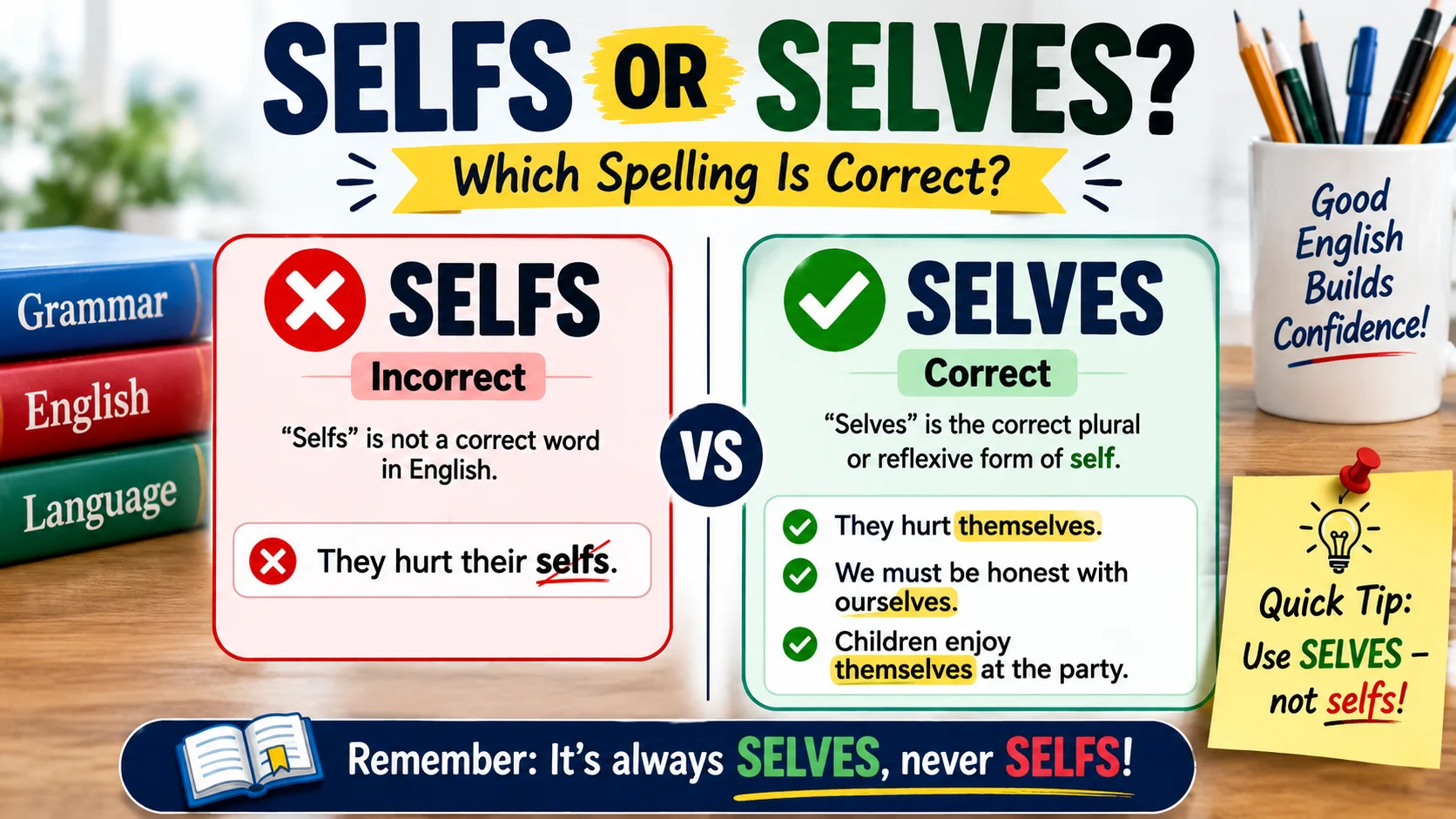
Selves is the correct plural form of self. Selfs is not standard English and should not be used in normal writing.
Have you ever written a word, looked at it twice, and suddenly wondered if it looks right? Selfs or selves is a good example. Many English learners know the word self, but they are unsure how to make it plural.
The confusion often comes from a simple spelling rule. Most nouns form their plural by adding -s. So, at first glance, selfs may seem correct. But English has several nouns that change their spelling when they become plural. Self is one of them.
The correct plural is selves. You will see it in words such as ourselves, yourselves, themselves, oneself, and themselves. Learning this form helps you write more clearly and avoid a common spelling mistake.
As an English language guide, I often find that the easiest way to remember a tricky spelling is to connect it with real examples. So, let us look at selfs or selves, why the change happens, and how to use selves with confidence.
selfs or selves – Quick Answer
The correct plural form of self is selves.
Self → selves
The spelling changes from -f to -ves.
Simple examples
We should take care of our selves.
This sentence is normally written as:
We should take care of ourselves.
Another example:
The two selves seemed very different.
Here, selves is the plural of self.
You may also see the word inside reflexive pronouns:
- myself
- yourself
- himself
- herself
- itself
- ourselves
- yourselves
- themselves
The simple rule
If you need the plural of self, use selves, not selfs.
❌ selfs
✅ selves
This is a spelling change, not a difference between British and American English.
The Origin / Background of selfs or selves
The reason selves looks different from selfs comes from the history of English.
The word self has very old Germanic roots. It has been used in English for many centuries to refer to a person as an individual or to that person’s own identity.
Over time, English changed the way some words formed their plurals. Not every plural was created by simply adding -s.
For example:
- wife → wives
- knife → knives
- life → lives
- leaf → leaves
- wolf → wolves
- self → selves
These words show a similar spelling pattern.
The change developed through earlier forms of English and sound changes. In many words ending in -f or -fe, the plural developed with a v sound. Modern English keeps this pattern in several common words.
That is why selfs may look logical but is not the standard plural.
Why does the spelling change?
English has many irregular or partly irregular plurals.
Some are easy:
book → books
Others change their spelling:
wife → wives
And some change completely:
person → people
Self → selves belongs to the group where the final f changes to v before the plural ending.
You do not need to memorize the history to use the word correctly. Just remember:
One self, two selves.
selfs or selves Explained — Key Differences
The main difference is simple: selves is a real standard English word, while selfs is generally considered incorrect as the plural of self.
| Term | Meaning | When to Use | Region/Context |
|---|---|---|---|
| self | One person’s identity or nature | When talking about one self | Standard English |
| selves | More than one self | When referring to multiple selves | Standard English |
| selfs | Nonstandard plural form | Avoid in normal English | Generally incorrect |
| myself | Reflexive form of “I” | When the subject and object are the same | Standard English |
| ourselves | Reflexive form of “we” | When referring back to “we” | Standard English |
| themselves | Reflexive form of “they” | When referring back to “they” | Standard English |
Self
Self is a singular noun.
He wanted to understand his self better.
However, in normal modern English, we more often say:
He wanted to understand himself better.
The noun self is common in phrases such as:
- inner self
- true self
- public self
- private self
- better self
Selves
Selves is the plural form.
Our different selves can appear in different situations.
Another example:
The characters have two very different selves.
The word can refer to different identities, personalities, or versions of a person.
Selfs
Selfs is not the standard plural of self.
❌ We all have different selfs.
Use:
✅ We all have different selves.
For most school, professional, academic, and online writing, avoid selfs.
Which Version / Approach Should You Use?
The answer does not depend on your country.
For students
Always use selves as the plural of self.
One self → several selves
This is the form expected in schoolwork, exams, and standard English.
For English learners
Do not apply the simple “add -s” rule to every noun.
English has many irregular plural forms. Learning common pairs can help:
- self → selves
- wife → wives
- knife → knives
- life → lives
- leaf → leaves
For professional writers
Use selves in formal and professional writing.
The researchers compared the participants’ past and present selves.
Avoid selfs unless you are deliberately reproducing a nonstandard spelling, quoting someone, or discussing the spelling itself.
For global English
Selves is the safe choice.
It is standard English and works across British, American, Australian, Canadian, and other major English varieties.
There is no standard British-versus-American spelling difference here.
Common Mistakes with selfs or selves
1. Adding only -s
Mistake:
We discovered our different selfs.
Correction:
We discovered our different selves.
The plural changes f to v.
2. Thinking selves is a different word
Some learners think self and selves have unrelated meanings.
They do not.
self = one
selves = more than one
The spelling changes because of the plural form.
3. Confusing selves with ourselves
Selves and ourselves are related, but they are not always interchangeable.
We must be true to our selves.
This is possible in special contexts, but the normal reflexive form is:
We must be true to ourselves.
Ourselves is a reflexive pronoun. Selves is the plural noun.
4. Using selfs in reflexive expressions
Mistake:
We should trust our selfs.
Correction:
We should trust ourselves.
The word ourselves is written as one word.
5. Confusing selves with selfs in compound words
The plural selves appears inside some compound forms:
- ourselves
- yourselves
- themselves
You should not write:
❌ our selfs
❌ your selfs
❌ their selfs
Use:
✅ ourselves
✅ yourselves
✅ themselves
selfs or selves in Real-World Examples
Knowing the rule is useful, but seeing the word in context makes it easier to remember.
Professional Email
We should give ourselves more time to review the report.
Here, ourselves is the correct reflexive pronoun.
You would not write:
❌ We should give our selfs more time.
News Article
The players described their younger selves after the final match.
Here, selves is a plural noun.
The article is talking about more than one version or stage of the players’ identities.
Social Media Post
Sometimes our past selves teach us the biggest lessons.
Here, selves means earlier versions of ourselves.
Formal Report
The study examined how participants viewed their past and present selves.
This is a natural use of the plural noun.
Everyday Conversation
We are not always the same selves at work and at home.
This means people may behave or feel differently in different settings.
Creative Writing
The two characters seemed like completely different selves.
The writer is using selves to describe different identities or personalities.
selfs or selves — Data, Trends & Usage
The search intent for selfs or selves is strongly informational. People usually search the phrase because they want to check the correct plural spelling.
The confusion is common because selfs follows a familiar English pattern. Many nouns simply take -s:
car → cars
book → books
idea → ideas
But English also contains many nouns with special plural forms.
The -f to -ves pattern is especially common in words that learners meet often:
- self → selves
- life → lives
- wife → wives
- knife → knives
- wolf → wolves
This makes selves an important spelling form for students and ESL learners.
The word also appears often in psychology, personal development, literature, philosophy, and everyday speech. Phrases such as inner selves, future selves, past selves, and true selves are common.
Why does this matter?
A spelling error can make otherwise clear writing look careless.
Compare:
❌ We need to understand our true selfs.
with:
✅ We need to understand our true selves.
The second version immediately looks natural to a fluent English reader.
Standalone Comparison Table
| Term/Variant | Meaning | Region/Context | Best Used When |
|---|---|---|---|
| self | One individual identity | All major English varieties | Referring to one |
| selves | Plural of self | All major English varieties | Referring to two or more |
| selfs | Nonstandard plural | Generally avoided | Do not use in standard writing |
| myself | Reflexive form of I | Standard English | Referring back to “I” |
| ourselves | Reflexive form of we | Standard English | Referring back to “we” |
| yourselves | Reflexive form of you | Standard English | Referring back to plural “you” |
| themselves | Reflexive form of they | Standard English | Referring back to “they” |
FAQs About selfs or selves
Q: What does selves mean?
A: Selves is the plural form of self. It refers to two or more identities, personalities, or versions of a person.
Q: How do you use selves correctly?
A: Use selves when self is plural. For example: “Our past and present selves can be very different.”
Q: What is the difference between selfs and selves?
A: Selves is the correct standard plural of self. Selfs is generally considered a spelling error.
Q: Is selfs acceptable in formal writing?
A: No. In standard formal English, use selves. Avoid selfs in essays, reports, applications, and professional documents.
Q: Which is correct, selfs or selves?
A: Selves is correct. The plural changes from self to selves, not selfs.
Q: Where does the word selves come from?
A: Selves comes from the older English word self and developed through historical plural and sound changes. Modern English keeps the -f → -v spelling pattern.
Q: Can selves be used in everyday English?
A: Yes. Selves is common in phrases such as our true selves, our past selves, and our future selves. It is also common in academic and formal writing.
Conclusion
The choice between selfs or selves is easy once you know the rule: selves is correct, and selfs is not the standard plural form.
The singular word is self. When you talk about more than one self, the spelling changes:
self → selves
This pattern is similar to other common English words such as life → lives, wife → wives, and knife → knives.
It is also useful to remember that selves and words such as ourselves are related but have different grammatical roles. Selves is a plural noun, while ourselves, yourselves, and themselves are reflexive pronouns.
For students, ESL learners, and professional writers, the safest choice is simple: always use selves when you need the plural of self.
Do not let the familiar -s plural rule trick you. Once you remember one self, many selves, the spelling becomes much easier.
Bookmark this guide and use the simple self → selves rule whenever you need to check this spelling.