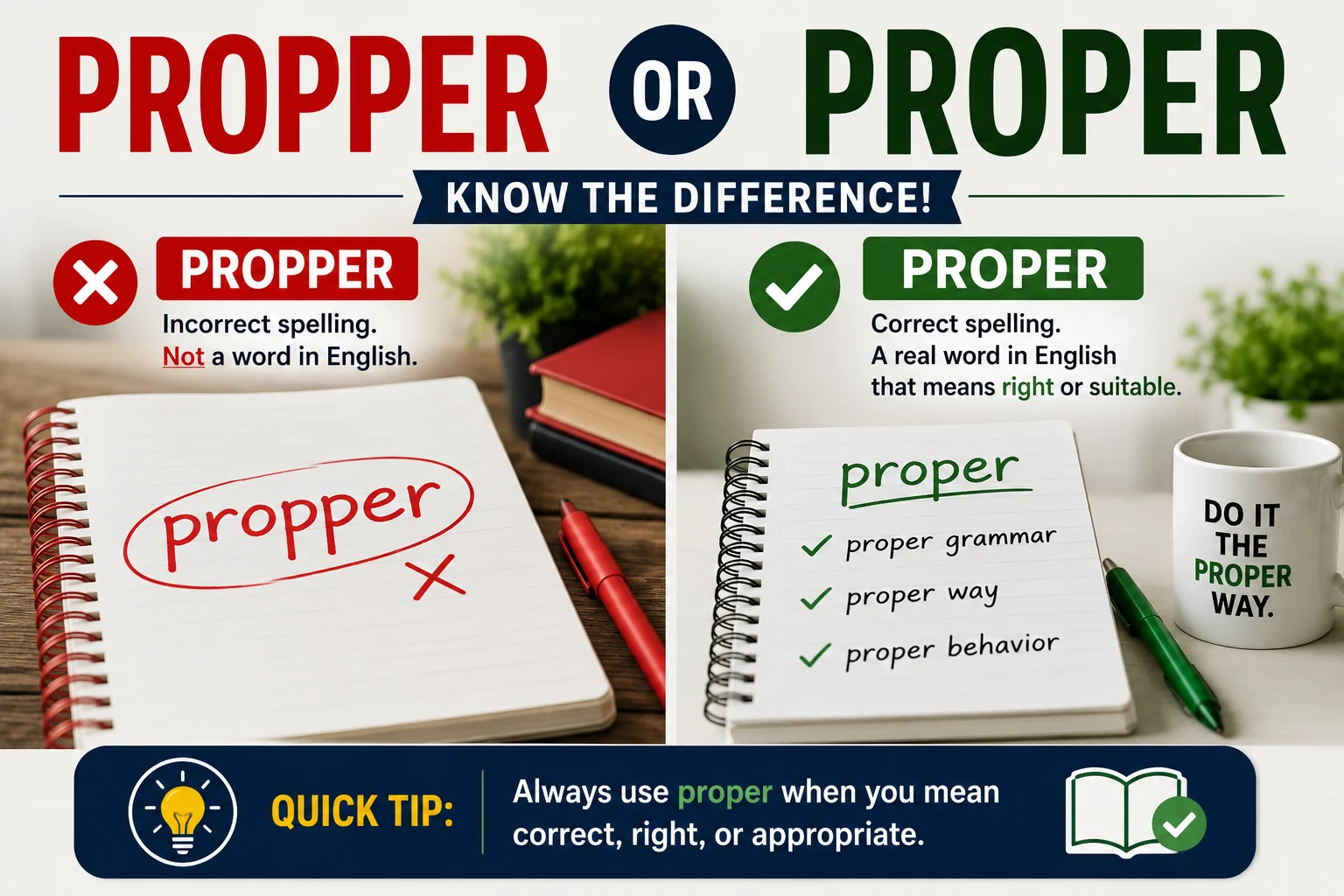
Proper is the correct spelling meaning appropriate, correct, or suitable, while propper is a misspelling.
One small spelling mistake can change how clear and professional your writing looks. If you have ever wondered about propper or proper, you are not alone. These words look very similar, but only one is the standard spelling used in modern English.
The correct spelling is proper. Propper is generally a misspelling when you mean something correct, suitable, appropriate, or well-behaved. This mistake often happens because some English words use double consonants, so it may seem natural to write propper. However, proper has only one p in the middle.
Knowing the difference is useful when writing emails, school assignments, business documents, social media posts, and formal content. Using the correct form can make your writing look more polished and easier to understand.
In this guide, we will explain propper or proper, including the meaning, word origin, British and American English usage, common mistakes, everyday examples, and simple tips for remembering the correct spelling.
Propper or Proper – Quick Answer
Proper is the correct spelling in standard English.
Propper is a common spelling mistake when referring to something correct, suitable, or appropriate.
Examples
- Please use the proper tools for the job.
- She wore proper clothing for the interview.
- We need to follow the proper procedure.
Easy Tip:
Remember: proper has only one p in the middle.
The Origin of Propper or Proper
The word proper has a long history in English. It came through Old French from the Latin word proprius, meaning one’s own, special, or particular.
Over time, proper developed several related meanings. It can describe something suitable, correct, appropriate, or belonging to a particular person or thing.
The spelling propper is not a standard variation of the word. It usually appears because writers incorrectly apply English spelling patterns that double consonants in some words.
For example, English has words such as happy, running, and stopped, where letters may be doubled for grammatical or spelling reasons. However, that rule does not apply to proper.
British English vs American English Spelling
There is no British-American spelling difference for this word.
| Version | Spelling | Region | Example Sentence |
|---|---|---|---|
| Standard English | Proper | US & UK | Please follow the proper procedure. |
| Common misspelling | Propper | US & UK | ❌ This is not the standard spelling. |
Both British and American English use proper.
Which Spelling Should You Use?
US Audience
Use proper. It is the standard spelling in American English.
UK/Commonwealth Audience
Use proper. British English also uses the same spelling.
Global/SEO Audience
Always use proper when you mean correct, suitable, appropriate, or acceptable.
If your article targets the search phrase propper or proper, you can mention the incorrect form naturally when explaining the spelling difference.
Common Mistakes with Propper or Proper
Here are some common mistakes.
❌ Please use the propper format.
✅ Please use the proper format.
❌ He did not follow the propper procedure.
✅ He did not follow the proper procedure.
❌ We need propper documentation.
✅ We need proper documentation.
❌ The correct British spelling is propper.
✅ British English also uses proper.
Propper or Proper in Everyday Examples
Emails
- Please send the proper documents before Friday.
- Make sure the form is completed in the proper way.
News Headlines
- Officials call for proper safety measures.
- New rules require proper training.
Social Media
- Finally learned the proper way to do it!
- Everyone deserves proper support.
Formal Writing
- Employees must follow the proper safety procedures.
- The research was conducted using proper scientific methods.
Propper or Proper – Google Trends & Usage
Searches for proper are far more common because it is the correct standard spelling and is widely used in everyday English.
People who search for propper or proper are often checking whether the double p spelling is correct. The incorrect form may appear because of typing errors, spelling mistakes, or confusion with words that contain doubled consonants.
The word proper is used across many contexts, including education, business, law, formal writing, everyday conversation, and professional communication.
For SEO content, use proper naturally throughout the article while mentioning propper only when discussing the spelling mistake. This keeps the content useful without unnecessary repetition.
Comparison Table
| Feature | Proper | Propper |
|---|---|---|
| Standard spelling | ✅ Yes | ❌ No |
| Dictionary word | ✅ Yes | ❌ No |
| British English | ✅ Yes | ❌ No |
| American English | ✅ Yes | ❌ No |
| Formal writing | ✅ Yes | ❌ No |
| Means correct/suitable | ✅ Yes | ❌ No |
| Recommended for SEO | ✅ Yes | ❌ No |
FAQs
Is it propper or proper?
Proper is the correct spelling. Propper is a common misspelling.
Why is proper spelled with one p?
The standard English spelling is proper, with one p in the middle. There is no rule that requires another p.
Is propper a real word?
In standard English, propper is generally not the correct spelling of proper. It may appear as a surname, name, or other proper noun, but that is different from the standard adjective.
Is proper spelled the same in British and American English?
Yes. Both British and American English use proper.
What does proper mean?
Proper can mean correct, suitable, appropriate, or acceptable. It can also mean something belonging to a particular person or thing.
How can I remember the correct spelling?
Remember the simple form: proper, not propper.
Should I use propper in formal writing?
No. Use proper in formal, academic, business, and professional writing.
Conclusion
When choosing between propper or proper, the answer is simple: proper is the correct standard spelling. The word can mean correct, suitable, appropriate, or acceptable, depending on the sentence. Propper is generally a spelling mistake when it is used as a replacement for proper.
There is no difference between British and American English in this case. Both varieties use proper with one p in the middle. This makes the choice easy for writers around the world.
If you are writing an email, school assignment, business document, social media post, or formal article, always choose proper. Avoid propper unless it is being used as a specific name or proper noun.
The easiest way to remember the spelling is to keep it simple: proper has one p in the middle. Once you remember this, you can confidently use the correct form whenever you need to describe something as correct, suitable, or appropriate.