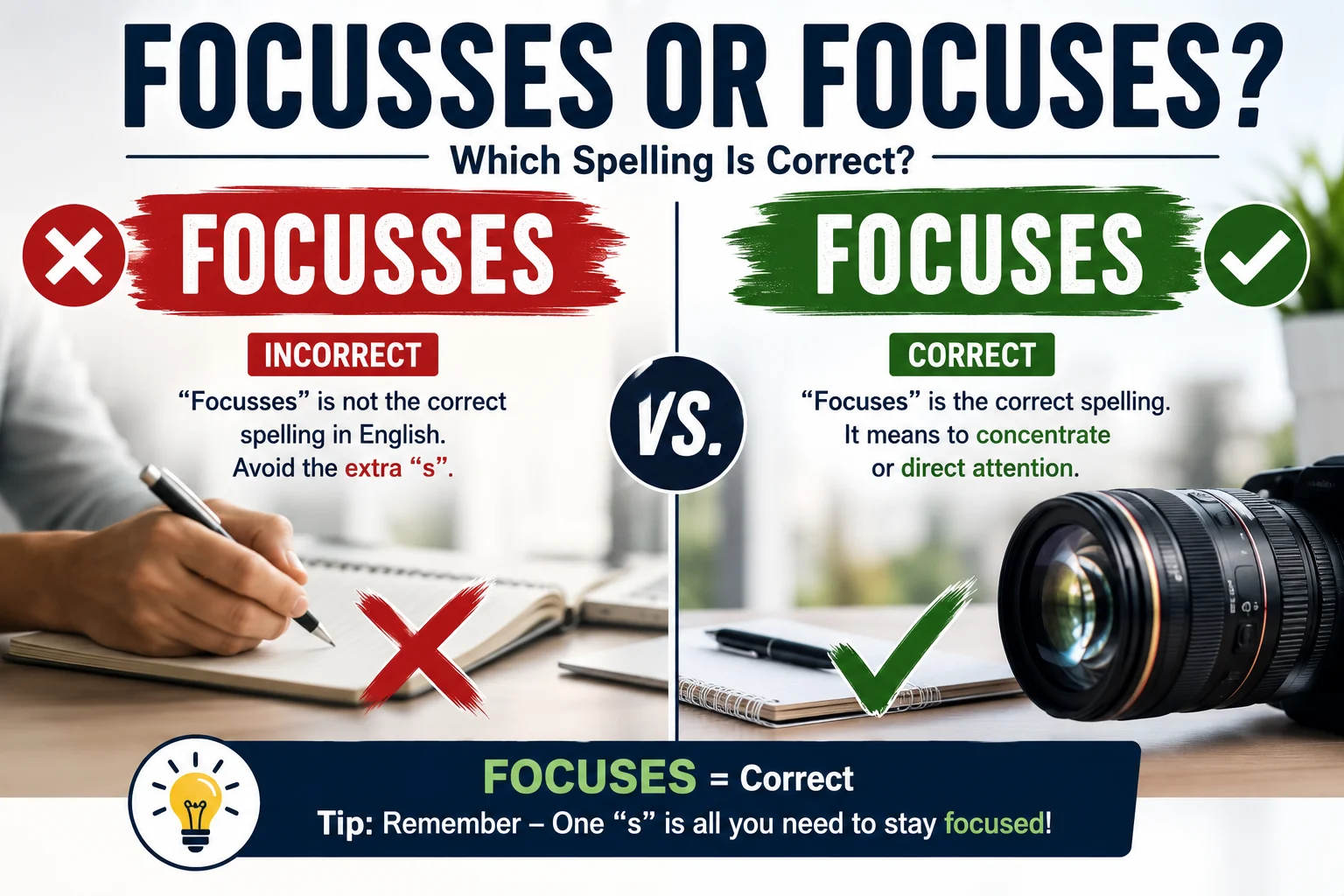
Focusses and focuses are both correct forms of the verb focus. Focuses is the more common choice, especially in American English, while focusses is also accepted in British English.
Have you ever typed focusses and wondered whether your spelling checker was right to question it? This small spelling difference can make even confident writers stop and check.
I often see this problem in student essays, business writing, and online content. The confusion comes from the verb focus and the way English handles words ending in a single consonant. Some writers add another s, giving focusses. Others use focuses.
The good news is simple: both forms are acceptable. The choice mainly depends on the variety of English you use and the style you want to follow. Oxford lists both focuses and focusses as present-tense forms of focus.
In this guide, you will learn the difference between focusses or focuses, see clear examples, understand the spelling pattern, and learn which form is best for school, work, websites, and formal writing.
focusses or focuses – Quick Answer
Focuses and focusses are both correct spellings of the third-person singular present form of focus.
For example:
- The report focuses on climate change.
- The report focusses on climate change.
Both sentences are grammatically correct. Oxford lists both spellings for the verb.
However, focuses is usually the safer choice for a broad international audience. It is especially common in American English, while focusses is a recognized British English variant. Cambridge also lists the verb with both -s- and -ss- forms.
What does focus mean?
As a verb, focus means to give attention to a particular person, subject, or activity. It can also mean adjusting a camera, eye, or other device so that something can be seen clearly.
For example:
The lesson focuses on basic grammar.
Here, focuses means “gives attention to.”
The Origin / Background of focusses or focuses
The spelling difference is not caused by a difference in meaning. Both forms come from the same verb: focus.
The word focus comes from Latin focus, meaning “hearth” or “fireplace.” Over time, the word developed a more specialized meaning connected with a central point. English later used focus for a central point of attention and for the point where light rays meet.
Today, focus has several common meanings. It can describe attention, a central subject, or the adjustment of a camera or optical device. Cambridge gives examples of all these uses.
The spelling issue appears when English speakers form the third-person singular:
focus → focuses
Some varieties and style traditions also use:
focus → focusses
Oxford records both forms, along with focused/focussed and focusing/focussing.
So, focusses is not simply a misspelling. It is a valid variant.
focusses or focuses Explained — Key Differences
The main difference is spelling preference, not meaning.
| Term | Meaning | When to Use | Region/Context |
|---|---|---|---|
| focuses | Gives attention to something | General writing | American English; also widely used in British English |
| focusses | Gives attention to something | When following a style that uses double s | British English variant |
| focused | Gave attention or had attention directed | Past tense/adjective | Widely used |
| focussed | Same meaning as focused | Alternative past form | Especially associated with British usage |
| focusing | Giving attention | Present participle/gerund | Widely used |
| focussing | Same meaning as focusing | Alternative spelling | British English variant |
Cambridge lists focuses and focusses for the verb, while Oxford gives both forms for the present, past, and -ing forms.
Focuses
Focuses is the most straightforward form for most readers.
- The article focuses on healthy eating.
- The company focuses on customer service.
- This chapter focuses on English grammar.
Focusses
Focusses means exactly the same thing.
- The article focusses on healthy eating.
- The company focusses on customer service.
- This chapter focusses on English grammar.
If you are writing for British readers and your publication uses British spelling, focusses can be a perfectly reasonable choice.
Which Version Should You Use?
Your audience should guide your choice.
For American English
Use focuses.
American English normally favors the shorter spelling:
- focuses
- focused
- focusing
If you are writing for American schools, businesses, newspapers, or websites, focuses is the safest choice.
For British English
You can use focuses or focusses.
Both are accepted. Oxford lists both forms.
If your organization or publisher follows a style guide that prefers focusses, use it consistently.
For beginners and students
Choose focuses.
It is simple, widely recognized, and easy to remember.
For global SEO content
Focuses is usually the better default.
It is familiar to readers across many English-speaking markets. More importantly, the spelling should match the style of the rest of your website.
Do not switch randomly between focuses and focusses. Consistency makes your writing look more polished.
Common Mistakes with focusses or focuses
1. Thinking focusses is always wrong
Mistake:
The article focusses on grammar.
Correction:
The article focusses on grammar.
Why: Focusses is an accepted spelling. Oxford lists it as a present-tense form of focus.
2. Thinking focuses is only American
Mistake:
British writers must use focusses.
Correction:
British writers can use focuses or focusses.
Why: Both forms are recognized in British English.
3. Using the wrong subject
Mistake:
They focuses on the problem.
Correction:
They focus on the problem.
Why: Focuses is used with he, she, it, or a singular noun.
- He focuses.
- She focuses.
- The report focuses.
- They focus.
- We focus.
4. Confusing focuses with focused
Mistake:
The report focuses on the issue yesterday.
Better:
The report focused on the issue yesterday.
Why: Focuses is present tense. Focused is the usual past-tense form.
5. Mixing spelling styles
You may see:
The report focusses on safety but was focused on cost.
This is not necessarily grammatically wrong, but it may look inconsistent if your style guide prefers one spelling pattern.
For a clean document, choose a style and follow it consistently.
focusses or focuses in Real-World Examples
Professional Email
Subject: Project Update
The revised plan focuses on reducing costs and improving delivery times.
This is a clear choice for international business communication.
News Headline
New Policy Focuses on Better Public Transport
News writing often favors short, familiar forms. Focuses works well in this headline.
Social Media Post
Our new campaign focuses on simple ways to save energy.
The shorter form is easy to read and works naturally on social platforms.
Formal Report
The study focuses on the effects of online learning among university students.
Focuses is fully suitable for formal and academic writing.
British-Style Example
The report focusses on the need for better public services.
This spelling is also acceptable when following a British style that uses the double s form.
focusses or focuses — Data, Trends & Usage
The search intent behind focusses or focuses is mainly informational and spelling-related. People usually search the two forms because they have seen one spelling and want to know whether it is correct.
The question appears especially useful for English learners, students, editors, teachers, and writers working across British and American English.
The biggest practical point is that focuses has broad international usefulness. It is also the form shown prominently in many learner-facing dictionary resources, while focusses remains a recognized alternative. Cambridge’s Business English entry explicitly lists both -s- and -ss- forms.
This matters more now because many people write for readers from several countries. A spelling that feels normal in one region can look unusual in another.
For SEO content, the best approach is not to force both spellings into every paragraph. Use the form that matches your target audience, mention the alternative once, and focus on giving the reader a clear answer.
Standalone Comparison: focusses or focuses
| Term/Variant | Meaning | Region/Context | Best Used When |
|---|---|---|---|
| focuses | Gives attention to | General English | Best default for most readers |
| focusses | Gives attention to | British English variant | When following a double-s style |
| focused | Gave attention to / concentrated | General English | Past tense or adjective |
| focussed | Same as focused | British variant | When maintaining a British spelling style |
| focusing | Giving attention to | General English | Present participle or gerund |
| focussing | Same as focusing | British variant | When following the double-s pattern |
FAQs About focusses or focuses
Q: What does focusses mean?
A: Focusses means “gives attention to” or “concentrates on.” It is a valid spelling of the third-person singular form of focus.
Q: Is focusses correct English?
A: Yes. Focusses is correct English. It is recognized as an alternative spelling, especially in British English.
Q: Is focuses or focusses better?
A: Focuses is usually the safest choice for general and international writing. Focusses is also correct, so choose it when your style guide or audience prefers it.
Q: Is focusses British English?
A: It is strongly associated with British English, but the important point is that British English also uses focuses. Oxford lists both forms.
Q: Is focusses acceptable in formal writing?
A: Yes. It is acceptable in formal writing when it matches your chosen English variety and style guide. Focuses is equally acceptable.
Q: Where does the word focus come from?
A: Focus comes from Latin focus, meaning “hearth” or “fireplace.” English later developed its modern meanings connected with a central point and attention.
Q: Can I use focuses in academic writing?
A: Yes. Focuses is completely acceptable in academic writing. For example: “This study focuses on language development.” Oxford lists it as a standard present-tense form.
Conclusion
The choice between focusses or focuses is easier than it first appears. Both forms are correct, and both have the same meaning. The main difference is spelling preference.
Focuses is the best general choice for most writers. It is widely used in American English and is also accepted in British English. Focusses is a valid alternative, especially for writers following a British spelling style.
Remember the grammar, too. Use focuses or focusses with a singular subject:
- The report focuses on safety.
- The article focusses on grammar.
With they, we, and you, use focus:
- They focus on safety.
- We focus on grammar.
For students, global websites, and most everyday writing, focuses is the easiest form to choose. If your publisher or organization uses focusses, keep that spelling consistent.
Now you know exactly when to use focusses or focuses. Bookmark this guide so you never have to second-guess the spelling again.