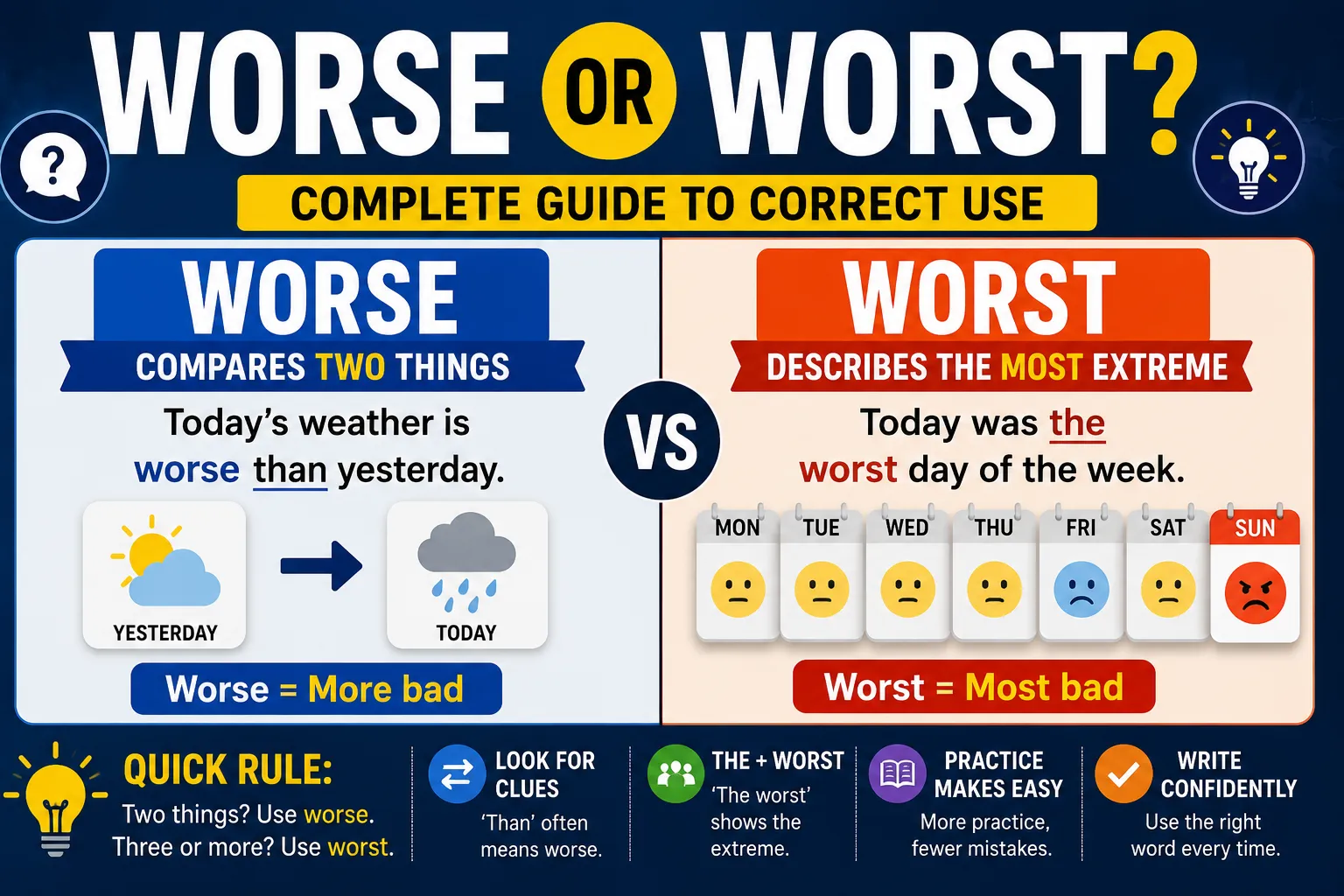
Worse compares two things that are bad, while worst describes the most bad thing in a group. Use worse for comparison and worst for the extreme case
Should you write worse or worst? If you’ve ever paused while writing because you weren’t sure which one is correct, you’re not alone. The confusion between worst or worse is common because both words describe something negative but are used in different situations.
I still remember checking homework from a student years ago. One sentence caught my eye immediately:
“This is the worse day of my life.”
The student looked confident. The sentence felt almost right. Almost.
I asked why that word was used. The answer made me smile.
“Because the day was really bad.”
That mistake happens all the time. You hear worse and worst in conversations, movies, social media posts, and school work. Since both words talk about something bad, they sound very similar. That is where confusion starts.
Maybe you are writing an essay. Maybe you are sending an email. You might even be posting something online and suddenly stop because you are unsure.
Should you write worse?
Or should it be worst?
The good news is that the difference is easier than many people think. Once you learn one simple rule, you will stop second-guessing yourself.
Let’s make it easy.
Worse or Worst – Quick Answer
Worse compares two things.
Worst talks about the most extreme case among several things.
Real-world examples
Worse
“Today’s weather is worse than yesterday’s.”
You compare two days.
Worst
“Today was the worst day of the week.”
You compare many days.
A simple trick helps:
- Worse = compare
- Worst = final level
The Origin / Background of Worse or Worst
These words have been around for a very long time.
They come from old English language roots.
The base word is:
Bad
English changes it in an unusual way.
Most words simply add -er and -est:
- Small → Smaller → Smallest
- Fast → Faster → Fastest
But bad changes differently:
- Bad → Worse → Worst
This pattern is called an irregular comparison.
That unusual change creates confusion because people expect regular spelling rules.
Worse or Worst Explained : Key Differences or Variations
Both words describe something negative.
The difference is how many things you compare.
| Term | Meaning | When to Use | Region/Context |
| Bad | Negative quality | Starting description | Global |
| Worse | More bad | Compare two things | Global |
| Worst | Most bad | Compare three or more things | Global |
Examples
Bad
“The movie was bad.”
Worse
“Part two was worse than part one.”
Worst
“Part three was the worst movie of all.”
Notice something important.
Worst often appears with the.
Example:
“The worst meal I ever had.”
Difference Between Worse and Worst
Many people ask about the difference between worse and worst because both words come from bad and describe something negative. The key difference is how they are used in comparisons.
- Worse is the comparative form of bad. Use it when comparing two people, things, or situations.
- Worst is the superlative form of bad. Use it when describing the most negative person, thing, or situation in a group of three or more.
For example:
- This phone is worse than my old one.
- This is the worst phone I have ever owned.
A simple way to remember the difference is:
- Worse = Compare two
- Worst = The most extreme
Which Version or Approach Should You Use?
The answer depends on what you compare.
- For students → use worse when comparing two things.
- For students → use worst when choosing the most extreme thing in a group.
- For writers → look for words like than because they often signal worse.
- For general writing → ask one question:
“Am I comparing two things or many things?”
Simple rule:
- Two things → worse
- Three or more → worst
Common Mistakes with Worse or Worst
People often repeat these mistakes.
Mistake 1
❌ This is the worse movie.
✅ This is the worst movie.
Why it happens: People use comparison words incorrectly.
Mistake 2
❌ My cold became worst today.
✅ My cold became worse today.
Why it happens: The sentence compares today with before.
Mistake 3
❌ She had the worse grades in class.
✅ She had the worst grades in class.
Why it happens: The class includes many students.
Mistake 4
❌ Ignore the word than
✅ Watch for comparison clues
Why it happens: Readers move too quickly.
Mistake 5
❌ Choose based on sound
✅ Choose based on meaning
Why it happens: Both words sound similar.
Worse or Worst in Real-World Examples
You hear these words almost daily.
Professional email
“Sales performance was worse this month than last month.”
News headline
“Storm becomes the worst weather event this year.”
Social media post
“Monday mornings feel worse after a holiday weekend.”
Formal document or report
“The fourth quarter showed the worst results of the year.”
Worse or Worst : Data, Trends & Usage
Many people search worse or worst because grammar mistakes happen often.
Search intent category
Informational
People want help choosing the correct word.
Main audiences
- Students
- Teachers
- Content writers
- Bloggers
- English learners
- Professionals
Popular regions
- United States
- United Kingdom
- Canada
- Australia
- Countries with English learners
Why this matters now
People write online every day.
Messages move fast.
One small grammar mistake can affect confidence and clarity.
Standalone Comparison Table
| Term/Variant | Meaning | Region/Context | Best Used When |
| Bad | Negative description | General English | Describe one thing |
| Worse | More bad | Comparison | Compare two things |
| Worst | Most bad | General comparison | Compare three or more things |
| Better | Improved quality | Positive comparison | Opposite comparison |
Frequently Asked Questions
Q: What does worse or worst mean?
A: Both words describe something negative. Worse compares two things, while worst identifies the most negative thing in a group.
Q: How do you use worse correctly?
A: Use worse when comparing one thing with another thing. Words like than often appear with it.
Q: Worse vs worst : what is the difference?
A: Worse compares two items. Worst shows the highest level of something bad among several items.
Q: Is worse acceptable in formal writing?
A: Yes. Both worse and worst work in formal and informal writing.
Q: Which version is correct : worse or worst?
A: Both are correct. The right choice depends on how many things you compare.
Q: Where do worse and worst come from?
A: They developed from older English language forms connected to the word bad.
Q: Can worse and worst be used in business writing?
A: Yes. Reports and emails often use these words to compare performance or results.
Q: Which is correct: worst or worse?
A: Both are correct, but they are used differently. Use worse when comparing two things, and use worst when referring to the most negative thing in a group of three or more.
Conclusion
The difference between worse or worst becomes easy once you remember one simple rule. Worse compares two things. Worst points to the most extreme thing in a larger group.
You also learned some useful clues. The word than often points toward worse. The word the often appears with worst.
Keep these ideas in mind:
- Two things → worse
- Three or more things → worst
- Read the full sentence
- Look for comparison clues
Small grammar changes create big improvements in writing. One word can completely change the meaning of a sentence.
Now you know exactly how to use worse or worst with confidence. Bookmark this guide so you never hesitate again. Share it with someone who keeps mixing these words up.