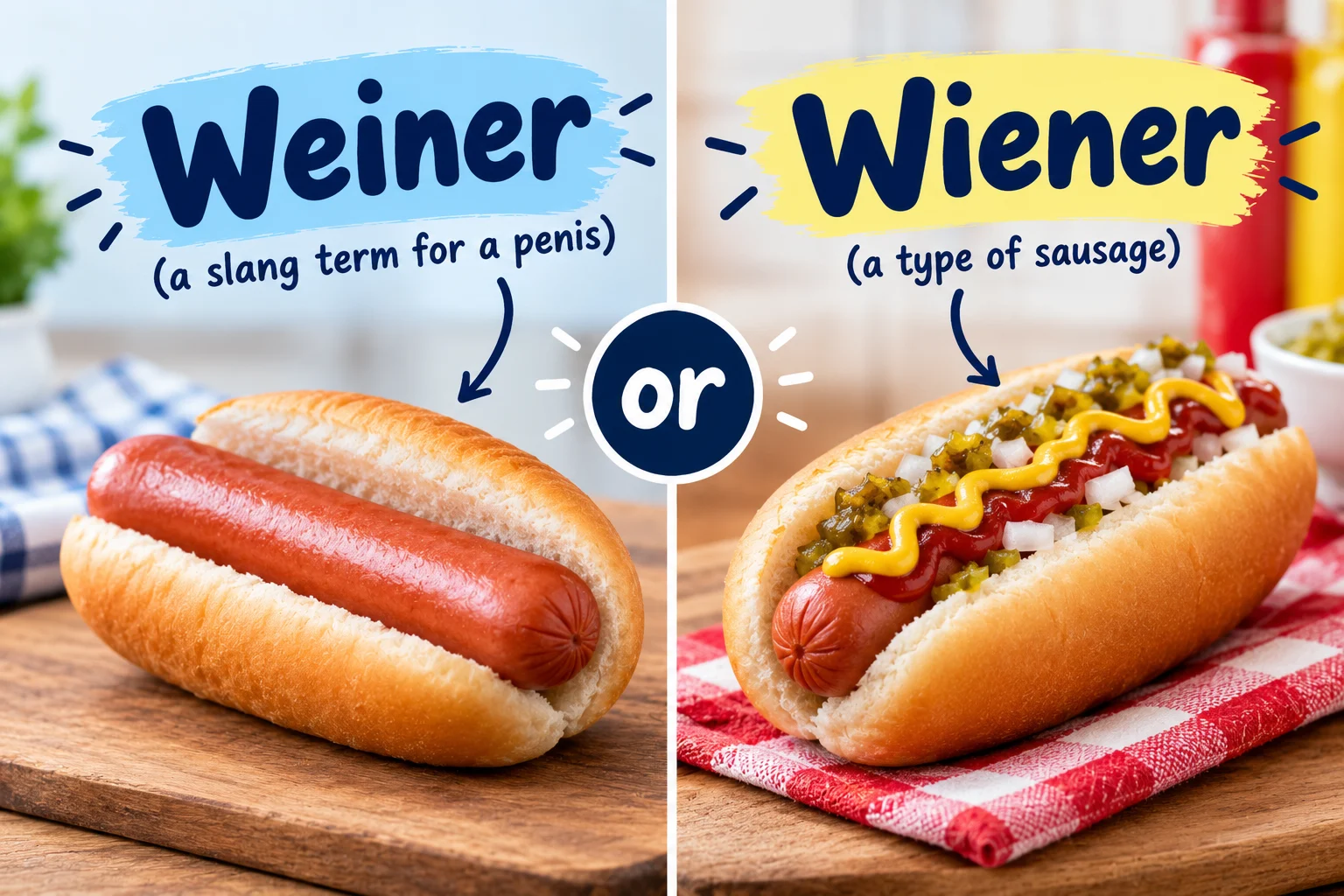
Wiener is the standard spelling for a sausage or something related to Vienna. Weiner is usually a surname, so the correct spelling depends on context.
Have you ever typed “weiner” when you meant a hot dog or sausage? You are not alone. Weiner or wiener is a common spelling confusion because the two words look almost identical and sound very similar in English.
The correct choice depends on what you mean. If you are talking about a sausage, the standard spelling is wiener. If you are referring to a person’s family name, Weiner can be perfectly correct.
I have seen this mistake often in casual writing, food discussions, social media posts, and even searches for famous names. One small letter can change the meaning of the word.
The good news is that the difference is easy to remember. In this guide, you will learn what wiener means, when Weiner is correct, where both words come from, and how to use them naturally in real sentences.
Weiner or Wiener – Quick Answer
Wiener is the standard English spelling when you mean a type of sausage, especially a Vienna-style sausage or hot dog.
Weiner is mainly used as a surname. It can be the correct spelling of someone’s family name and should not automatically be treated as a misspelling.
Examples
- We ordered a wiener with mustard.
- The restaurant serves grilled wieners.
- Mr. Weiner spoke at the meeting.
- I met someone named Weiner yesterday.
So, the easiest rule is:
Food = wiener
Family name = Weiner
Context always matters.
The Origin and Background of Wiener
The word wiener comes from German. The German word Wiener means “from Vienna” or “of Vienna.”
Vienna is called Wien in German. Therefore, Wiener originally described something associated with the city.
The food term developed from Wiener Wurst, meaning a Vienna-style sausage. The word later became established in English as wiener, especially in North American English.
Over time, wiener became a familiar informal word for a sausage or hot dog.
You may also see the word in expressions such as:
- wiener sausage
- wiener dog
- Wiener schnitzel
- Vienna wiener
The surname Weiner, however, should not automatically be treated as another spelling of the food word. It is a family name with its own history and usage.
Weiner or Wiener Explained — Key Differences
The biggest difference is meaning and context.
| Term | Meaning | When to Use | Region/Context |
|---|---|---|---|
| wiener | A type of sausage or hot dog | When discussing food | Common in English, especially North America |
| Wiener | Something associated with Vienna; also used in names such as Wiener schnitzel | Food, culture, or proper names | German/English contexts |
| Weiner | Usually a surname | When referring to a person’s family name | Personal names |
Wiener as a Food Word
When talking about a sausage or hot dog, use wiener.
Examples:
- We grilled several wieners for lunch.
- He ordered a chili wiener.
- The children wanted hot dogs and wieners.
Weiner as a Surname
If Weiner is someone’s actual surname, keep the spelling exactly as it is.
Examples:
- Sarah Weiner joined the company.
- Dr. Weiner published a new study.
- The article quoted Mr. Weiner.
Changing a person’s surname because it looks like a spelling mistake would be incorrect.
Which Version Should You Use?
The best choice depends on your intended meaning.
Use “wiener” for food
If you mean a sausage or hot dog, write:
wiener
For example:
We bought six wieners for the barbecue.
Do not normally write:
We bought six weiners for the barbecue.
Use “Weiner” for a surname
If someone’s family name is Weiner, use the spelling they use.
For example:
Professor Weiner gave a lecture.
A person’s name is a proper noun, so it is normally capitalized.
Use the original spelling in proper names
Some dishes, organizations, businesses, books, or other names may contain Wiener or Weiner. When writing a proper name, preserve its official spelling.
Common Mistakes With Weiner or Wiener
1. Writing “weiner” for the sausage
Incorrect:
I ordered a grilled weiner.
Correct:
I ordered a grilled wiener.
The food word is normally spelled wiener.
2. Changing a person’s surname
Incorrect:
The speaker’s name is Wiener.
(when the person’s actual surname is Weiner)
Correct:
The speaker’s name is Weiner.
Names should be written according to the person’s actual spelling.
3. Assuming Weiner is always wrong
Incorrect idea:
“Weiner” is never a real word.
Better understanding:
Weiner can be a legitimate surname.
4. Mixing the two in the same sentence
Be careful when a sentence contains both a food term and a person’s name.
For example:
Mr. Weiner ordered a wiener.
Here, both spellings are correct because they have different meanings.
5. Changing capitalization without reason
A person’s surname is normally capitalized:
Weiner
The common food noun is normally lowercase:
wiener
However, Wiener may be capitalized when it appears in a proper name or German expression.
Weiner or Wiener in Real-World Examples
1. Professional Email
Hi Mr. Weiner,
Thank you for joining our meeting yesterday. We enjoyed discussing the project with you.
Best regards,
James
Here, Weiner is a person’s surname.
2. News Headline
Weiner Announces New Research Project
If Weiner is the person’s surname, the spelling must remain Weiner.
A food-related headline could instead say:
Local Restaurant Adds Grilled Wiener to Menu
Here, wiener refers to food.
3. Social Media Post
Nothing beats a grilled wiener at a summer barbecue!
Here, wiener is being used as a food word.
Another example:
Great meeting Mr. Weiner at today’s event!
Here, Weiner is a surname.
4. Formal Document or Report
The report was prepared by Dr. Weiner.
The capitalized spelling identifies a surname.
For food writing:
The menu includes a traditional wiener served with mustard.
The lowercase spelling identifies the common noun.
Wiener in Other Common Expressions
You may encounter wiener in several expressions.
Wiener sausage
A wiener sausage is a type of sausage associated with the Vienna-style sausage tradition.
Wiener dog
Wiener dog is an informal name for a dachshund.
For example:
My neighbor has a friendly wiener dog.
The formal breed name is dachshund, while wiener dog is a common informal term.
Wiener schnitzel
Wiener Schnitzel is a famous Austrian dish. The German word Wiener means “Viennese” or “from Vienna.”
It is traditionally made with a breaded and fried veal cutlet.
Weiner or Wiener — Data, Trends & Usage
The spelling confusion exists because Weiner and wiener differ by only one letter. They can also sound similar to many English speakers.
Searches for these terms generally fall into different intent groups.
People searching wiener may be looking for:
- A sausage or hot dog
- The meaning of the word
- Wiener dog
- Wiener schnitzel
- Vienna-related food terms
- The pronunciation or spelling
People searching Weiner may be looking for:
- A person with the surname Weiner
- Information about a specific individual
- The origin or meaning of the surname
- A proper name appearing in an article or document
This makes context especially important.
If your topic is food, wiener is usually the spelling you need. If you are writing someone’s name, use Weiner if that is the person’s actual surname.
Weiner vs. Wiener: Quick Comparison
| Term/Variant | Meaning | Region/Context | Best Used When |
|---|---|---|---|
| wiener | Sausage or hot dog | English, especially North American usage | Talking about food |
| Wiener | Related to Vienna; appears in German names and expressions | German/Austrian contexts | Vienna-related terms or proper names |
| Weiner | Family surname | Personal names | Referring to someone whose surname is Weiner |
Easy Memory Trick
Think of Wien.
Wien = Vienna in German
So:
Wien → Wiener
This connection can help you remember why the food-related word is spelled wiener.
For a surname, simply use the spelling that belongs to the person:
Weiner = surname
Frequently Asked Questions
1. Is it “weiner” or “wiener”?
For the sausage, the standard spelling is wiener. Weiner is commonly a surname and can be correct when referring to a person with that family name.
2. Is “weiner” a correct word?
Weiner can be a correct proper name, especially as a surname. It is not normally the standard spelling for the sausage.
3. Why is a sausage called a wiener?
The word comes from German Wiener, meaning “from Vienna.” It became associated with Vienna-style sausage and later entered English food vocabulary.
4. Is Wiener a German word?
Yes. In German, Wiener generally means “Viennese” or “from Vienna.” English also uses wiener as a food term for a type of sausage.
5. Is Wiener the same as a hot dog?
In many English-speaking contexts, wiener can refer to a hot dog or sausage. However, the exact food meaning can vary by region and product.
6. Is Weiner always a surname?
Not necessarily in every linguistic or historical context, but in modern English spelling questions, Weiner is most commonly encountered as a surname. Do not change it if it is someone’s established family name.
7. How do you remember Wiener vs. Weiner?
Remember Wien, the German name for Vienna. Wiener means something connected with Vienna and is the standard spelling of the food term.
Conclusion
The difference between weiner or wiener is simple once you focus on meaning.
Use wiener when you are talking about a sausage or hot dog. The word comes from German Wiener, meaning something associated with Vienna. You may also see it in expressions such as Wiener schnitzel and wiener dog.
Use Weiner when it is someone’s surname. A family name should keep its established spelling, even if it looks similar to another word.
The easiest memory trick is Wien → Wiener. Since Wien is the German name for Vienna, Wiener is the spelling connected with Vienna and the traditional food term.
Before you choose a spelling, ask one simple question: Am I talking about food, or am I writing a person’s name? That quick check will help you choose the right form every time.
If you found this spelling guide helpful, keep it nearby when writing, editing, or checking confusing English words.