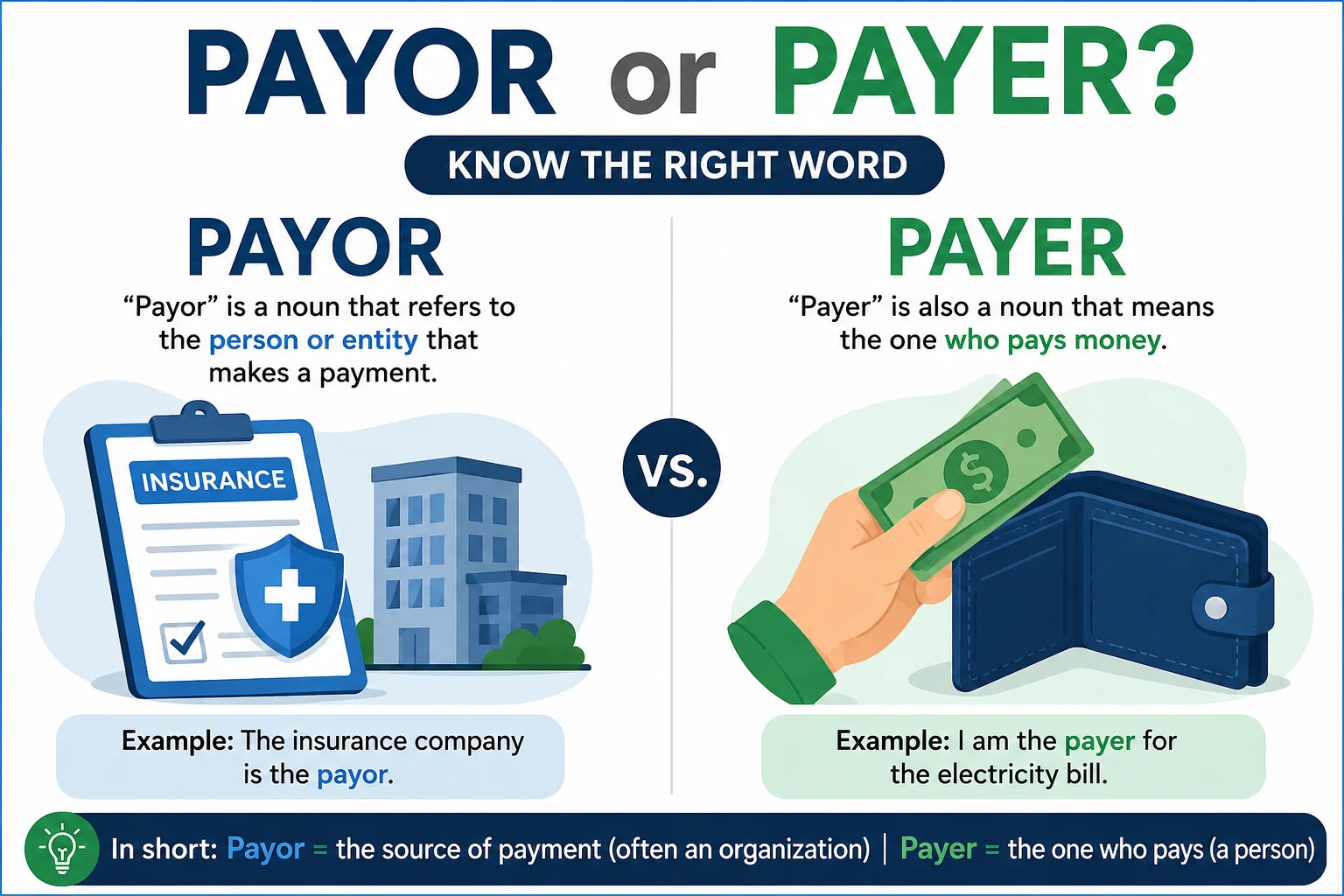
Payer is the standard and more common spelling for someone who pays, while payor is a legal variant often used in contracts and insurance documents.
Have you ever wondered whether you should write payor or payer? These two words have the same pronunciation and nearly the same meaning, which makes them easy to confuse. You may see payer in everyday English, while payor often appears in legal contracts, insurance documents, and financial agreements. Because both spellings exist, many writers are unsure which one to choose.
If you’ve searched for payor or payer, you’re probably writing a business document, completing insurance paperwork, or preparing a legal contract. The good news is that both spellings are correct, but they are used in different contexts. In modern standard English, payer is the preferred spelling. Payor is mainly used in legal and financial documents where specific terminology is required.
This guide explains the difference between payor and payer in simple English. You’ll learn their meanings, origins, regional usage, common mistakes, practical examples, and when each spelling is the better choice.
Payor or Payer – Quick Answer
Both payor and payer are correct.
- Payer is the standard English spelling for a person or organization that pays money.
- Payor is a legal and financial spelling commonly found in contracts, insurance policies, and government documents.
Examples
- The payer must complete the payment before Friday.
- The insurance payor approved the medical claim.
- The payer received an electronic receipt.
Easy Tip:
Payer = Everyday English
Payor = Legal or insurance documents
The Origin of Payor or Payer
Both words come from the verb pay, which entered English through Old French and Latin.
The spelling payer became the standard English noun for someone who pays money.
The spelling payor developed later in legal and commercial writing to provide consistency with legal terminology. Many lawyers, insurers, and government agencies continue using payor because it matches established legal language.
Although both words mean the same thing, payer is far more common in general English.
British English vs American English Spelling
This is not mainly a British-versus-American spelling difference.
| Version | Spelling | Region | Example Sentence |
|---|---|---|---|
| Standard English | Payer | US & UK | The payer completed the transaction. |
| Legal/Insurance Usage | Payor | Mostly US legal and insurance documents | The payor is responsible for reimbursement. |
Both countries understand payer, while payor is mostly a legal or technical term.
Which Spelling Should You Use?
US Audience
Use payer in everyday writing. Use payor only if you’re following legal, medical, or insurance terminology.
UK/Commonwealth Audience
Use payer. It is the standard spelling in general English.
Global/SEO Audience
Choose payer unless your content specifically discusses legal contracts, healthcare billing, or insurance documents where payor is the accepted technical term.
Common Mistakes with Payor or Payer
Here are common mistakes people make.
❌ Payor is the only correct spelling.
✅ Both spellings are correct.
❌ Always use payor in business emails.
✅ Payer is preferred for normal business writing.
❌ Payer is incorrect in legal contracts.
✅ Many legal documents intentionally use payor.
❌ British English prefers payor.
✅ British English generally uses payer.
Payor or Payer in Everyday Examples
Emails
- The payer will receive an invoice tomorrow.
- Please confirm the payer’s billing address.
News Headlines
- Health insurance payor announces policy updates.
- Digital payer services continue to grow.
Social Media
- The payer covered the entire restaurant bill!
- New rules affect every insurance payor.
Formal Writing
- The payer is responsible for all outstanding fees.
- The payor shall reimburse approved medical expenses under the agreement.
Payor or Payer – Google Trends & Usage
Searches for payer are much more common because it is used in everyday English, banking, education, accounting, and business communication.
The spelling payor appears mainly in healthcare, insurance, finance, and legal industries. People often search this word after reading contracts or insurance forms.
Searches for payor or payer usually come from users trying to understand whether the legal spelling is also correct in standard English.
Comparison Table
| Feature | Payer | Payor |
|---|---|---|
| Correct spelling | ✅ Yes | ✅ Yes |
| Everyday English | ✅ Yes | Rare |
| Legal documents | Sometimes | ✅ Common |
| Insurance industry | Sometimes | ✅ Very Common |
| Business writing | ✅ Preferred | Sometimes |
| British English | ✅ Standard | Rare |
| Best for SEO | ✅ Yes | Niche Topics |
FAQs
Is it payor or payer?
Both are correct, but they are used in different contexts.
Which spelling is more common?
Payer is much more common in everyday English.
Why do legal documents use payor?
Many legal and insurance documents follow traditional terminology that uses payor.
Is payor incorrect?
No. It is a recognized legal and financial spelling.
Which spelling should I use in business writing?
Use payer unless you’re following legal or insurance terminology.
Do British and American English spell it differently?
Not really. Both generally use payer, while payor is mainly a technical legal term in the United States.
Conclusion
Understanding the difference between payor or payer is simple once you know the context. Both words describe a person or organization that pays money. However, payer is the standard spelling used in everyday English, business communication, education, banking, and most professional writing. It is the spelling most readers expect to see.
Payor, on the other hand, is a specialized spelling commonly used in legal contracts, insurance policies, healthcare billing, and certain financial documents. Although it looks unusual, it is not incorrect. It simply belongs to a more technical vocabulary.
If you’re writing for a general audience, choose payer. If you’re working with legal, medical, or insurance documents that already use payor, keep that spelling for consistency. Understanding this distinction will help you write accurately, meet your audience’s expectations, and avoid unnecessary confusion.