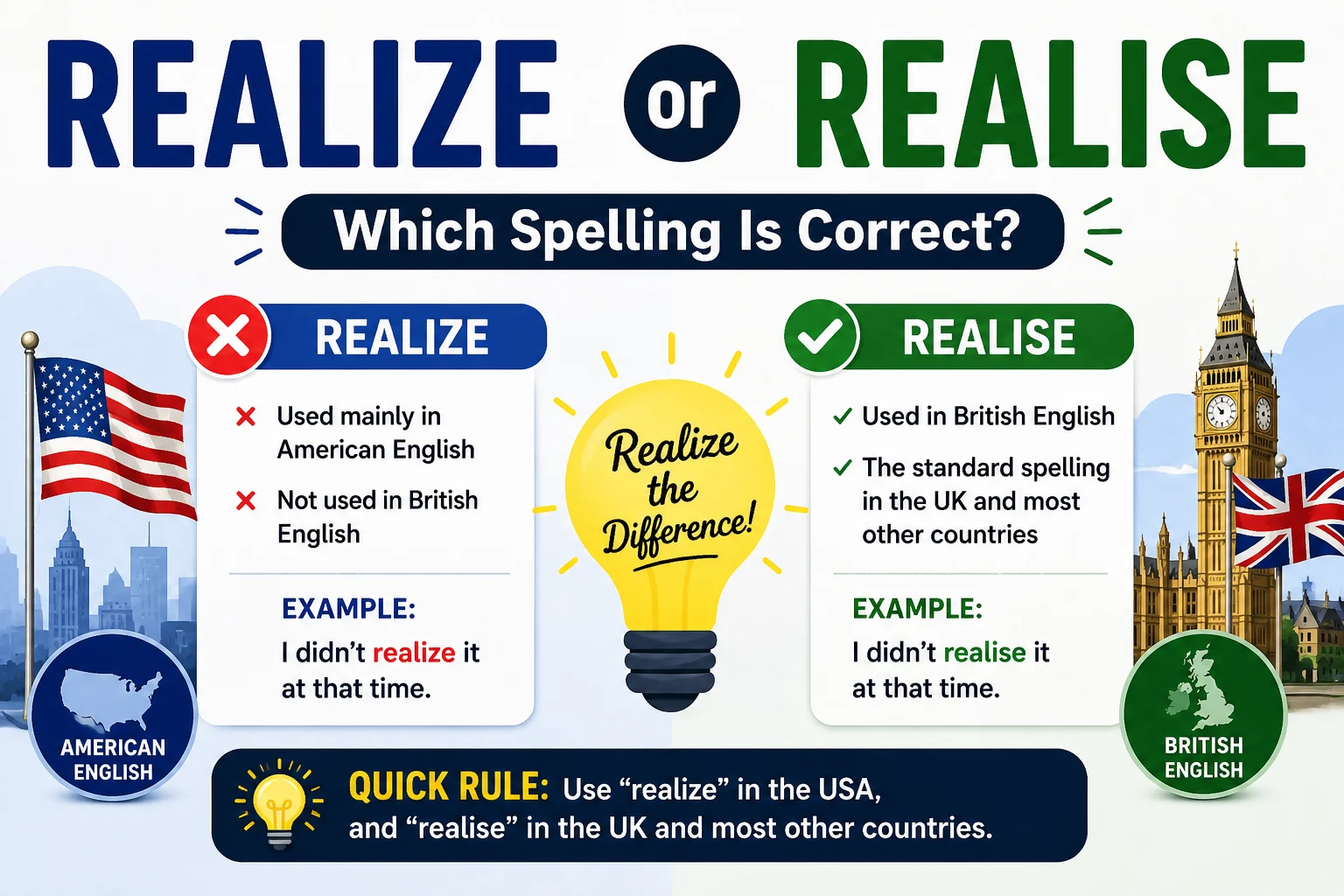
Realize is the preferred American English spelling, while realise is the standard spelling in British English—both are correct depending on your regional style.
Have you ever stopped while writing and wondered, realize or realise — which spelling is correct? This is a common question for English learners, writers, and people creating content for different countries. The confusion happens because both spellings are correct, but they are used in different types of English.
The word means to understand something clearly, become aware of something, or make something happen. The only difference is the spelling style used in different regions. Realize or realise often appears in searches because people want to avoid spelling mistakes in emails, school work, professional documents, and online content.
This guide explains the meaning, history, and spelling rules behind both forms. You will learn when to use “realize” and when to use “realise,” depending on your audience. By the end, choosing the right spelling will be simple and clear.
realize or realise – Quick Answer
Realize or realise means to understand something, become aware of something, or achieve something.
- Realize is the American English spelling.
- Realise is the British English spelling.
Both words have the same meaning.
Real-life examples:
- “I finally realized that I forgot my keys.”
- “She realised her mistake after reading the message.”
- “He hopes to realize his dream of becoming a writer.”
The Origin of realize or realise
The word comes from the Latin word realis, meaning “real” or “actual.” It entered English through French and developed from the idea of making something real or understanding something as true.
The spelling difference appeared because British and American English developed different spelling styles over time. American English often simplified some spellings, while British English kept traditional forms influenced by French and other languages.
The difference between realize and realise is not about meaning. It is only a regional spelling preference.
British English vs American English Spelling
The main difference is the ending -ize and -ise.
American English usually prefers -ize spellings, while British English often uses -ise spellings. However, some British dictionaries also accept the -ize form.
| Version | Spelling | Region | Example Sentence |
|---|---|---|---|
| American English | realize | United States | “I realized the answer was simple.” |
| British English | realise | United Kingdom | “I realised the answer was simple.” |
| Commonwealth English | realise | Australia, Canada, New Zealand (commonly used) | “She realised the importance of the decision.” |
| International English | realize/realise | Depends on audience | “They realized/realised their goal.” |
Which Spelling Should You Use?
The correct spelling depends on who will read your writing.
- US audience: Use realize. It follows common American English spelling rules.
- UK/Commonwealth audience: Use realise. It is the common spelling style in British English and many Commonwealth countries.
- Global/SEO audience: Choose one spelling style and use it consistently. For websites, consider your main audience and use related variations naturally.
Consistency is more important than choosing one form over the other.
Common Mistakes with realize or realise
Many learners make mistakes because they mix spelling styles.
Incorrect: “I realise that this is true.” (for a US-focused document)
Correct: “I realize that this is true.”
Incorrect: “I realize my mistake.” (for a UK-focused document)
Correct: “I realise my mistake.”
Incorrect: “I realizeded the problem.”
Correct: “I realized the problem.”
Incorrect: “I realise my dream yesterday.”
Correct: “I realised my dream yesterday.”
realize or realise in Everyday Examples
Emails
- “I realize there was a mistake in the report.”
- “I realised I sent the wrong attachment.”
News Headlines
- “Company leaders realize the need for change.”
- “Experts realise the importance of better planning.”
Social Media
- “I just realized how much I learned this year.”
- “I finally realised my goals were closer than I thought.”
Formal Writing
- “The study helps readers realize the importance of education.”
- “The report aims to help people realise new opportunities.”
realize or realise – Google Trends & Usage
Search interest for realize or realise is often linked to spelling questions, language learning, and writing accuracy. People from countries using different English styles frequently search this phrase when checking grammar or editing content.
American websites and users usually prefer “realize,” while British, Australian, and some other international users commonly search for “realise.” Both forms remain widely understood around the world.
For online content, writers often choose the spelling that matches their target readers. Clear language and consistent spelling help users trust and understand the information.
realize or realise Comparison Table
| Feature | Realize | Realise |
|---|---|---|
| English Style | American English | British English |
| Meaning | Understand or make something real | Understand or make something real |
| Ending | -ize | -ise |
| Common Region | United States | United Kingdom and many Commonwealth countries |
| Example | “I realize the truth.” | “I realise the truth.” |
FAQs
Is realize or realise the correct spelling?
Both are correct. The choice depends on whether you use American or British English.
What is the difference between realize and realise?
There is no difference in meaning. The difference is only spelling style.
Do Americans use realize or realise?
Americans usually use realize.
Do British people use realize or realise?
British English commonly uses realise, although some dictionaries also accept realize.
Which spelling should I use for SEO content?
Use the spelling that matches your target audience. You can mention both forms when explaining the difference.
Is realize with “z” wrong?
No. “Realize” is the standard American English spelling and is also accepted in some other English varieties.
Can I use realize and realise in the same article?
It is better to choose one main spelling style and use it consistently.
Conclusion
The choice between realize or realise depends on the type of English you are using. Both spellings have the same meaning: to understand something, become aware of something, or achieve something.
Use realize when writing for an American audience. Use realise when writing for a British or Commonwealth audience. For global readers, choose one style and keep it consistent throughout your content.
Spelling differences like this are common in English because the language has developed in different regions over time. Neither form is wrong, and both are easily understood by English speakers worldwide.
When writing emails, articles, school assignments, or professional documents, the best choice is the one that matches your readers. Understanding this small difference helps you write more clearly and confidently.