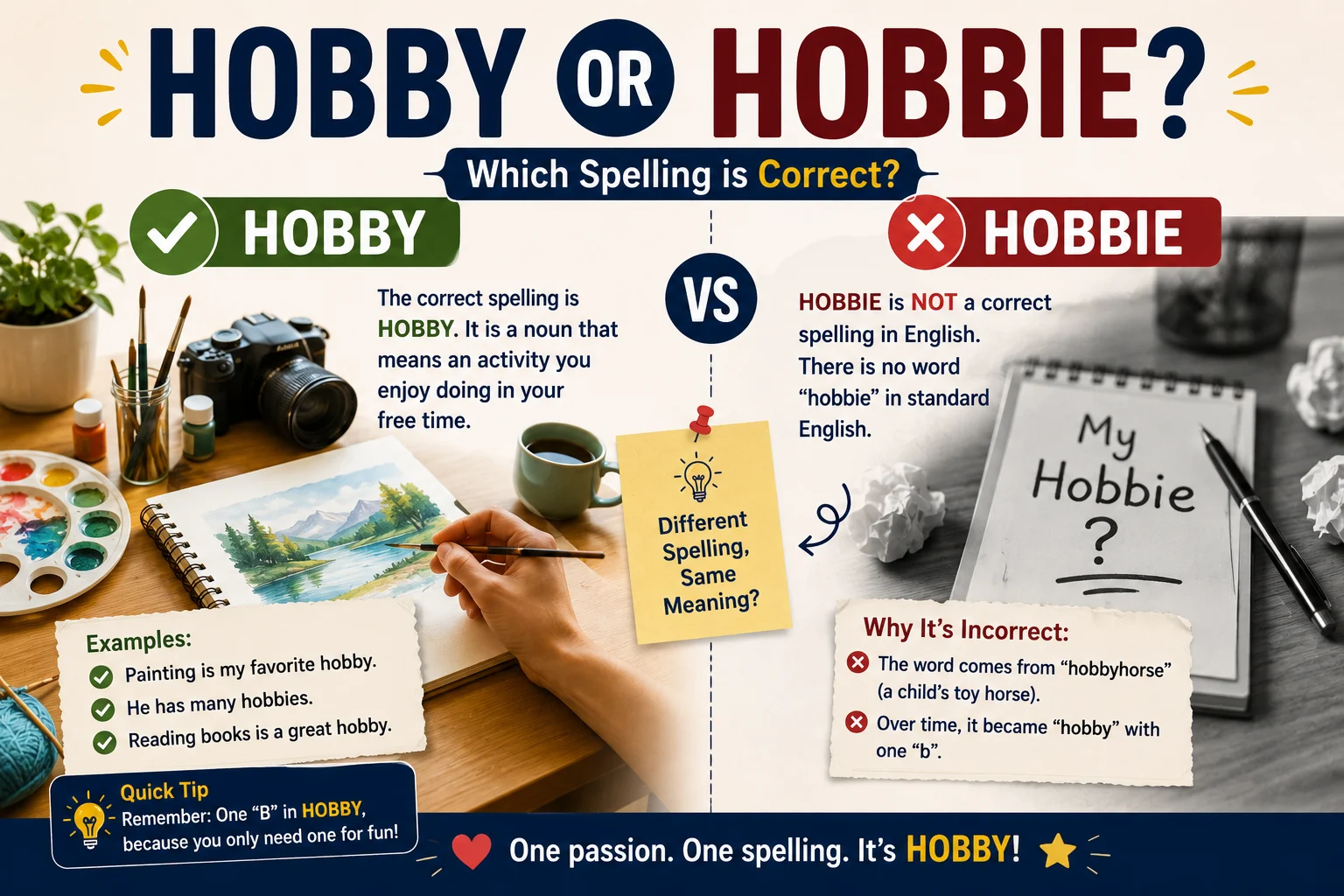
Hobby is the correct spelling for an activity you enjoy in your free time. Hobbie is a common spelling mistake and should not be used in standard English.
Have you ever typed hobbie and wondered if you had spelled it correctly? You are not alone. This is one of those small English spelling questions that can make even a simple sentence feel uncertain.
I have seen this mistake many times in student work, online profiles, forms, and casual messages. The confusion makes sense because English has many words that change their spelling when they become plural. For example, baby becomes babies, and city becomes cities. So, it is easy to think that hobby might become hobbie.
That is where the mistake begins.
The singular form is hobby. The plural form is hobbies. There is no standard English word hobbie with this meaning.
This guide will show you the difference between hobby or hobbie, explain where the word comes from, and give you simple examples. You will also learn how to use hobby, hobbies, and related words correctly. By the end, this spelling choice should feel automatic.
Hobby or Hobbie – Quick Answer
Hobby is the correct spelling.
A hobby is an activity that you enjoy doing during your free time. It is usually something you do for pleasure rather than as your main job.
Examples:
Reading is my favorite hobby.
Photography is one of her hobbies.
Hobbie is not the standard spelling of this word.
So, remember:
Hobby ✅
Hobbie ❌
There is one important detail, though. Hobbies is the correct plural form.
For example:
My hobbies include cooking and painting.
You do not write:
My hobbies include cooking and painting. ❌
The correct singular-to-plural change is:
hobby → hobbies
The Origin / Background of Hobby
The word hobby has an interesting history.
It comes from the older word hobby-horse. A hobby-horse was a small toy horse or a horse-shaped object used for riding or play.
The word was later shortened to hobby.
Over time, its meaning changed. Instead of simply referring to a toy horse, hobby became associated with an activity that someone enjoys in their spare time.
By the modern period, the word had developed its familiar meaning:
an activity done regularly for pleasure during free time
Today, hobbies can take many forms.
You might enjoy:
- reading
- gardening
- drawing
- cooking
- photography
- fishing
- cycling
- collecting things
- playing music
- writing
- playing sports
The meaning has stayed broad, which is one reason the word is so common.
Why Does “Hobbie” Look Correct to Some People?
The main problem comes from plural spelling rules.
Many English nouns ending in consonant + y change the y to ies in the plural.
For example:
- baby → babies
- city → cities
- party → parties
- country → countries
Because hobby ends in -y, learners may remember this rule and accidentally create hobbie.
But the rule applies when making the plural, not the singular.
So:
hobby = one
hobbies = more than one
The spelling hobbie is not the standard singular form.
Hobby or Hobbie Explained — Key Differences
The difference is simple.
Hobby
Hobby is the standard singular noun.
Use it when you are talking about one activity.
Examples:
My main hobby is reading.
His favorite hobby is fishing.
Photography is an expensive hobby.
Hobbies
Hobbies is the plural form.
Use it when you are talking about two or more activities.
Examples:
My hobbies are reading and painting.
She has several hobbies.
His hobbies include cycling and photography.
Hobbie
Hobbie is not the standard spelling for the noun meaning a leisure activity.
If you see hobbie online, it may be:
- a spelling mistake
- a name or surname
- a username
- a brand or title
- a deliberately altered spelling
Those special uses do not change the standard English spelling.
Comparison Table
| Term | Meaning | When to Use | Region/Context |
|---|---|---|---|
| Hobby | One leisure activity | Talking about one activity | Standard English |
| Hobbies | More than one leisure activity | Talking about several activities | Standard English |
| Hobbie | Not the standard spelling of hobby | Avoid in normal English writing | Usually a spelling error or special name |
| Hobbyist | A person who enjoys a particular activity | Describing someone who practices a hobby | Standard English |
| Hobbying | The act of engaging in a hobby | Less common than “having a hobby” | Informal/general use |
Hobby vs Hobbies: The Important Spelling Rule
This is where many learners make mistakes.
The word hobby becomes hobbies in the plural.
Why?
Because hobby ends with a consonant followed by y.
The spelling changes like this:
hobby → hobbies
The y changes to ie, and then s is added.
Here are more examples:
| Singular | Plural |
|---|---|
| hobby | hobbies |
| baby | babies |
| city | cities |
| family | families |
| story | stories |
| party | parties |
But words ending in a vowel + y usually keep the y.
For example:
toy → toys
boy → boys
day → days
This is why English spelling can feel tricky. The final letter alone does not always tell you what to do.
Which Version or Approach Should You Use?
Your choice depends on whether you mean one activity or several.
For Students
Use hobby when discussing one activity.
My hobby is reading.
Use hobbies when discussing several.
My hobbies are reading, drawing, and cycling.
For school assignments, always avoid hobbie unless you are talking about a specific name.
For Job Applications
Hobbies may appear on a résumé or application, especially when the employer asks about interests.
You could write:
Hobbies: Reading, photography, and hiking.
Use hobbies because you are listing several interests.
If you have only one:
Hobby: Photography.
For Social Media Profiles
You can use either hobby or hobbies, depending on your meaning.
For example:
My hobby: photography.
Or:
My hobbies: reading, travel, and cooking.
Both are correct.
For Professional Writing
Hobby and hobbies are standard words, but choose them based on the context.
A formal report might use a more specific term such as leisure activity or recreational activity when appropriate.
For example:
The survey asked participants about their favorite recreational activities.
Still, hobby is perfectly acceptable when the context is suitable.
For Global or Neutral English
Use hobby for one and hobbies for more than one.
These forms are standard in both British and American English.
There is no British-American spelling difference between them.
Common Mistakes with Hobby or Hobbie
1. Writing “Hobbie” as the Singular
Mistake:
My favorite hobbie is reading.
Correction:
My favorite hobby is reading.
The singular form ends in -by, not -bie.
2. Writing “Hobbys” as the Plural
Mistake:
My hobbys are cooking and painting.
Correction:
My hobbies are cooking and painting.
The y changes to ie before the plural s.
3. Using “Hobbie” Because of the Plural Rule
Mistake:
I have one hobbie.
Correction:
I have one hobby.
The spelling change happens only when you make the word plural.
Remember:
one hobby
two hobbies
4. Confusing Hobby With Job
A hobby is usually something you do for enjoyment.
A job is work you do as a profession or to earn money.
For example:
Photography is my hobby.
But:
Photography is my job.
Someone can have the same activity as both a hobby and a job. The difference is the purpose and context.
5. Using “Hobby” for Several Activities
Mistake:
My hobby is reading, cooking, and hiking.
This sentence is possible if you are using hobby as a general idea, but hobbies is clearer when you mean separate activities.
Better:
My hobbies are reading, cooking, and hiking.
Hobby or Hobbie in Real-World Examples
Professional Email
Thank you for asking about my interests. One of my main hobbies is photography, and I often take photos during my free time.
This sounds natural in a friendly professional conversation.
News Headline
Reading Remains a Popular Hobby Among Young Adults
Here, hobby is singular because the headline discusses the general activity of reading.
Social Media Post
Looking for a new hobby this weekend. Maybe I should try painting!
This is a natural use of hobby in casual writing.
Another example:
My hobbies include hiking, cooking, and photography.
Formal Document
Participants were asked to list their main hobbies and recreational interests.
This is suitable for a form, survey, or report.
School Assignment
My favorite hobby is reading. I enjoy reading mystery novels in my free time.
This is simple and correct.
If you discuss several activities:
My hobbies include reading, drawing, and playing football.
Hobby — Data, Trends & Usage
The search for hobby or hobbie has a clear informational and spelling-check intent.
People usually search for the phrase because they want to know:
- Is hobby spelled correctly?
- Is hobbie a word?
- What is the plural of hobby?
- Is it hobby or hobbies?
- How do you spell hobby?
- Why does hobby become hobbies?
The confusion is especially common among English learners because of the spelling pattern for words ending in consonant + y.
The word is also common in everyday English. You will see it in school forms, job applications, profiles, conversations, blogs, and social media.
A useful insight is that hobby is not only a spelling question. It is also part of a wider group of words about free-time activities, such as interest, pastime, recreation, leisure activity, and avocation.
Still, these words are not always exact synonyms.
For simple everyday English, hobby is usually the best choice.
Hobby vs Interest vs Pastime
These words are related, but there are small differences.
Hobby
A hobby is usually an activity you actively do for pleasure.
Painting is my hobby.
Interest
An interest is something you like, care about, or want to learn more about.
I have an interest in history.
You may have an interest without actively practicing it.
Pastime
A pastime is an activity you do to pass the time.
Reading is a relaxing pastime.
Hobby is the most common everyday word when talking about a regular activity you enjoy.
How to Use Hobby in a Sentence
Here are some easy sentence patterns.
Pattern 1: My hobby is + activity
My hobby is gardening.
Pattern 2: I enjoy + activity
I enjoy gardening.
Pattern 3: My hobbies are + activities
My hobbies are gardening and cooking.
Pattern 4: My hobbies include + activities
My hobbies include gardening, cooking, and reading.
Pattern 5: I have a hobby of + activity
This is grammatically possible but often less natural.
Instead of:
I have a hobby of reading.
A more natural sentence is:
Reading is my hobby.
Or:
I enjoy reading as a hobby.
Standalone Comparison Table
| Term/Variant | Meaning | Region/Context | Best Used When |
|---|---|---|---|
| Hobby | One activity done for pleasure | British and American English | Talking about one leisure activity |
| Hobbies | Two or more activities done for pleasure | British and American English | Talking about several activities |
| Hobbie | Nonstandard spelling of hobby | Informal errors or special names | Generally avoid it |
| Hobbyist | A person who enjoys a hobby | General English | Describing someone who practices an activity |
| Pastime | An activity used to pass free time | Formal and general English | Describing leisure activities |
| Interest | Something you care about or enjoy learning about | General English | Talking about subjects or activities you like |
FAQ: Hobby or Hobbie
Q: Which is correct, hobby or hobbie?
A: Hobby is the correct standard spelling. Hobbie is usually a spelling mistake when it is intended to mean a leisure activity.
Q: What does hobby mean?
A: A hobby is an activity you enjoy doing in your free time. Examples include reading, gardening, painting, cooking, and photography.
Q: What is the plural of hobby?
A: The plural of hobby is hobbies. The y changes to ie before the plural s.
Q: Is “hobbys” correct?
A: No. The correct plural is hobbies, not hobbys. For example, My hobbies include reading and cycling.
Q: Is hobby acceptable in formal writing?
A: Yes. Hobby is a standard English word and can be used in formal writing when the context is suitable. However, terms such as recreational activity may be more suitable in some formal reports.
Q: Why does hobby become hobbies?
A: Hobby ends in a consonant followed by y. When making it plural, the y changes to ie, and s is added: hobby → hobbies.
Q: Can hobby mean more than one activity?
A: Usually, hobby refers to one activity. When you mean several separate activities, use hobbies. For example, My hobbies are reading, cooking, and hiking.
Conclusion
When choosing between hobby or hobbie, the answer is clear: hobby is the correct spelling.
Use hobby when you mean one activity that you enjoy in your free time. For example, Reading is my hobby. When you talk about more than one activity, use hobbies: My hobbies are reading and painting.
The spelling hobbie is not the standard form of this word. It often appears because people confuse the singular form with the plural spelling rule. Remember that the change happens only when you make hobby plural.
The key pattern is:
One hobby → two hobbies
You can use hobby and hobbies in everyday conversation, schoolwork, applications, profiles, and most other types of writing. Both are standard in British and American English.
So, the next time you stop and wonder whether to write hobby or hobbie, choose hobby. If you mean more than one, choose hobbies.
Now you know the correct spelling. Bookmark this guide and share it with someone who often gets this word wrong.