Finally is the correct spelling. Finaly is a misspelling. Use finally when you mean “at last,” “in the end,” or “after a long wait.”
Have you ever typed a word, looked at it twice, and suddenly wondered if it looks right? Finally is one of those words. The extra l can be easy to miss, especially when you type quickly.
As an English teacher and language writer, I often see learners pause over words that end in -ly. The word final seems simple, so it can feel natural to write finaly. But English spelling does not always work that way.
If you are searching for finally or finaly, you likely want one simple answer: Which spelling is correct? You may also want to know what the word means, how to use it, and why it has two ls.
This guide clears up all of that. You will learn the correct spelling, its history, common mistakes, real examples, and a simple trick to remember it. By the end, you should never need to guess between finally and finaly again.
Finally or Finaly – Quick Answer
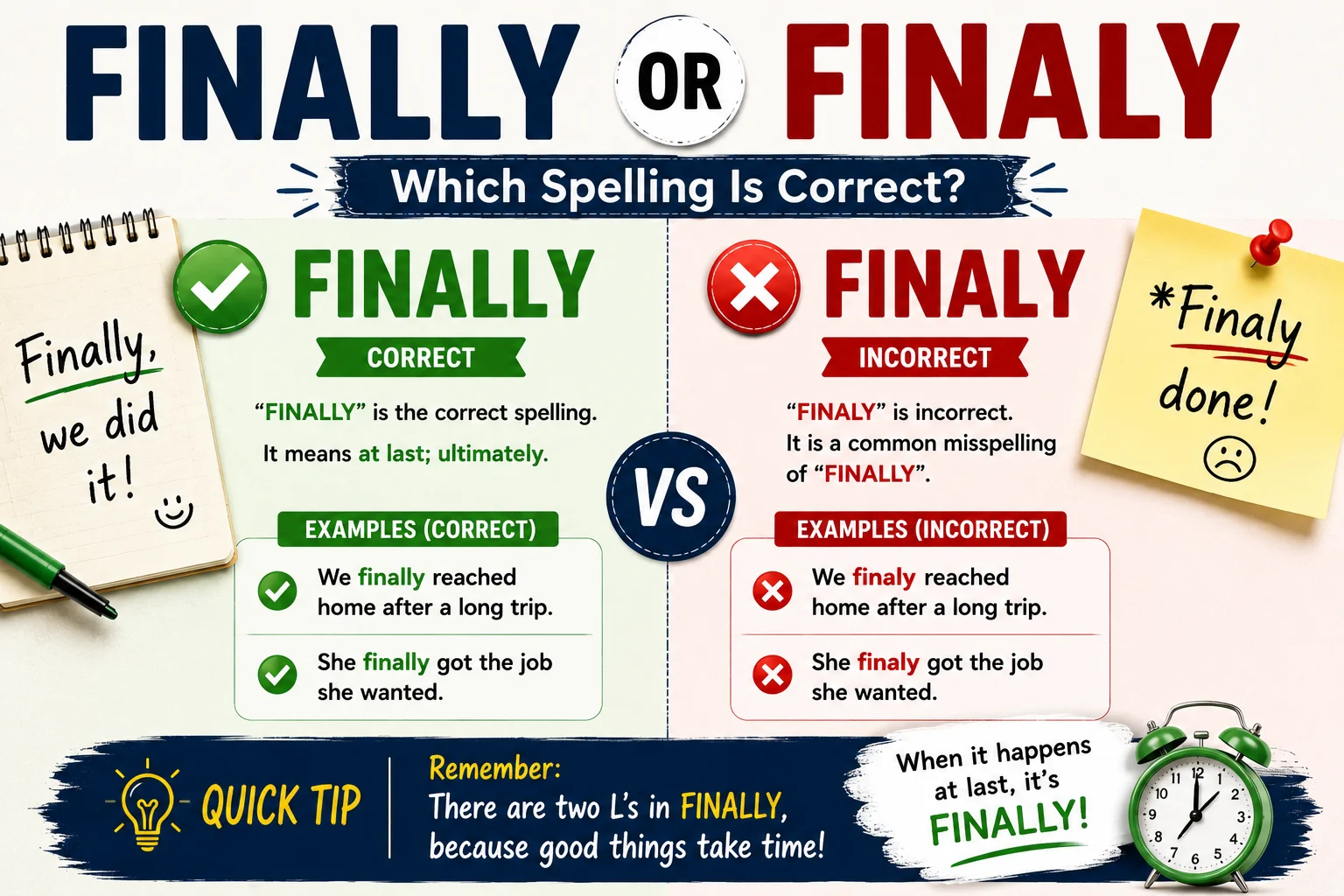
The correct spelling is finally.
Finaly is incorrect in standard English and should not be used in formal or academic writing.
Examples
- Finally, the bus arrived.
- I finally finished my homework.
- She finally understood the question.
In each sentence, finally tells us that something happened at last or after some delay.
A simple way to remember it
Think of the word like this:
final + ly = finally
But there is one key spelling point. The word keeps the double l:
final → finally
So:
❌ finaly
✅ finally
The Origin and Background of Finally
To understand the spelling, it helps to look at the word final.
The word final comes from Latin finalis, meaning “last” or “ending.” It entered English through French and developed into the word we use today.
Over time, English speakers began using final with the suffix -ly to form the adverb finally.
The basic idea is:
final + -ly → finally
The word finally can mean something happens at the end of a process. It can also show that something took a long time.
For example:
We waited for two hours. Finally, the doctor called my name.
Here, finally means at last.
It can also introduce the last point in a list:
First, wash the vegetables. Next, cut them. Finally, cook them.
Here, finally means as the last step.
Why does “finaly” look tempting?
The mistake happens because final has only one l at the end:
final
When people add -ly, they may simply write:
final + ly = finaly
That looks logical at first.
However, the standard spelling is:
finally
The second l is part of the correct spelling.
Finally Explained — Key Differences and Uses
There is actually no meaning difference between finally and finaly.
Only one is a standard English word.
| Term | Meaning | When to Use | Region/Context |
|---|---|---|---|
| finally | At last; eventually; as the last point | Use in normal English | All major English varieties |
| finaly | No standard English meaning | Do not use | Misspelling |
The important point is simple:
Finally is correct. Finaly is not.
1. Finally means “at last”
Use finally when something happens after waiting or after a long process.
We finally reached the hotel.
He finally called me back.
The rain finally stopped.
In these examples, something happened later than expected.
2. Finally means “in the end”
You can use finally when describing the result of a process.
She tried several solutions and finally found the answer.
They discussed the problem and finally reached an agreement.
The word shows the point where the process ends.
3. Finally means “as the last point”
You can also use finally when listing ideas or steps.
First, read the instructions. Second, check your work. Finally, submit the form.
This use is common in essays, presentations, instructions, and reports.
Which Version Should You Use?
The answer depends very little on your audience because there is only one correct standard spelling.
For students
Use finally in:
- School assignments
- Essays
- Exams
- Homework
- Class presentations
Example:
Finally, the experiment produced the expected result.
For professional writers
Use finally in:
- Emails
- Reports
- Business documents
- Articles
- Presentations
Example:
We finally completed the project on schedule.
For formal or academic writing
Always choose finally.
Finaly may look like a simple typing mistake, but it can reduce the quality of your writing.
For casual messages
You may see spelling mistakes in texts and social media posts. However, finally is still the correct spelling.
There is no reason to choose finaly in casual writing when the correct form is easy to remember.
Common Mistakes with Finally
Even strong English writers can make small spelling mistakes. Here are the most common ones.
Mistake 1: Writing “finaly”
❌ We finaly finished the project.
✅ We finally finished the project.
Why it happens:
The writer sees final and adds -ly without noticing the extra l.
Mistake 2: Confusing “final” and “finally”
❌ The finally exam is tomorrow.
✅ The final exam is tomorrow.
Why?
Final is an adjective.
This is the final exam.
Finally is an adverb.
I finally finished the exam.
The two words are related, but they do different jobs.
Mistake 3: Using “finally” when you mean “final”
❌ This is the finally version.
✅ This is the final version.
Use final to describe something that is last or complete.
Use finally to describe how or when something happens.
Mistake 4: Forgetting the second “l”
❌ finaly
❌ finallly
✅ finally
The correct word has two l’s and only one y:
f i n a l l y
Mistake 5: Confusing “finally” with “lastly”
These words can sometimes have similar meanings.
Finally, check your answer.
Lastly, check your answer.
Both can introduce the last point. However, finally has another common meaning: after a long wait or delay.
I finally got home.
You cannot always replace finally with lastly.
Finally in Real-World Examples
Seeing the word in real sentences makes the spelling easier to remember.
1. Professional Email
Finally, we have received approval for the new project.
Here, finally shows that the approval came after waiting.
Another example:
We finally completed the requested changes.
2. News Headline or Article
Finally, the team returns to its home stadium.
The word can show that something is happening after a long period.
In a news article, you might see:
The company finally announced its new plans on Monday.
3. Social Media Post
Finally! My vacation starts tomorrow! 🎉
Here, finally expresses relief or excitement.
It suggests the person has been waiting for the vacation.
4. Formal Report
Finally, the results were compared with the original data.
This use introduces the final point in a sequence.
5. Everyday Conversation
“Did you finish the book?”
“Yes, I finally finished it last night.”
This is one of the most common uses of finally.
Finally — Data, Trends & Usage
The search “finally or finaly” has clear informational and spelling-check intent. People who search this phrase usually want a quick answer about which spelling is correct.
The confusion is understandable because English has many words where adding -ly creates an adverb. Learners may try to build finally directly from final and accidentally leave out one l.
The word is used across major varieties of English, including:
- American English
- British English
- Canadian English
- Australian English
- Other international forms of English
There is no British-versus-American spelling difference here.
That makes the answer especially easy:
British English: finally
American English: finally
Both use the same spelling.
Why this matters
Spelling questions like this often appear when you are writing quickly. A single missing letter can make a correct sentence look careless.
Learning the word as a complete unit is better than trying to rebuild it each time.
Remember:
finally = f-i-n-a-l-l-y
Finally vs. Final: Do Not Mix Them Up
One of the best ways to master finally is to understand its relationship with final.
Final
Final is usually an adjective. It describes something that comes last.
Examples:
This is the final decision.
We are waiting for the final results.
The final exam starts tomorrow.
Finally
Finally is an adverb. It tells us that something happens at last or introduces the last point.
Examples:
We finally made a decision.
The results were finally released.
Finally, we checked all the answers.
A quick test can help:
Can you put “the” before it?
the final answer ✅
But:
the finally answer ❌
That tells you that final and finally have different grammatical roles.
Standalone Comparison Table
| Term/Variant | Meaning | Region/Context | Best Used When |
|---|---|---|---|
| finally | At last; eventually; lastly | Standard English | Describing an ending or delayed event |
| final | Last or complete | Standard English | Describing a noun |
| finaly | Misspelling | Nonstandard | Never in careful writing |
The key difference is that finally is an adverb, while final is usually an adjective.
A Simple Memory Trick for Finally
Here is an easy trick.
Think:
FINAL has one L. FINALLY has two Ls.
You can picture the spelling like this:
FINAL → FINALLY
When -ly is added, remember the double l in the finished word.
Another memory sentence is:
Finally, I will always remember the two Ls.
The word finally itself can remind you.
Frequently Asked Questions About Finally or Finaly
Q: Is “finally” or “finaly” correct?
A: Finally is correct. Finaly is a spelling mistake and should not be used in standard English.
Q: What does “finally” mean?
A: Finally can mean “at last,” “eventually,” or “as the last point.” For example, “I finally finished my work” means the work was completed after some delay.
Q: How do you spell finally correctly?
A: Spell it f-i-n-a-l-l-y. The word has two l’s before the final y.
Q: Is “finaly” acceptable in formal writing?
A: No. Finaly is not the standard spelling. Use finally in essays, reports, emails, applications, and other formal writing.
Q: What is the difference between final and finally?
A: Final usually describes a noun, as in “the final exam.” Finally is an adverb, as in “I finally passed the exam.”
Q: Is “finally” the same in British and American English?
A: Yes. Both British and American English use finally. There is no spelling difference between these varieties.
Q: Where does the word “finally” come from?
A: Finally comes from final, which traces back through French to Latin finalis, meaning “last” or “ending.” The English adverb developed with the suffix -ly.
Conclusion
When choosing between finally or finaly, there is a clear winner: finally.
The spelling finaly is incorrect. It is usually caused by forgetting the second l when adding -ly to final.
Remember these three points:
- Finally is the correct spelling.
- Finaly is a misspelling.
- Finally can mean “at last,” “eventually,” or “as the last point.”
You should also remember that final and finally are not interchangeable. Final usually describes a noun, while finally tells us how or when something happens.
The easiest memory trick is simple: finally has two l’s.
Now you have a quick rule you can use whenever you see this spelling question. Bookmark this guide so you never second-guess “finally” again, and use the correct spelling in your next piece of writing.