Have you ever wondered whether you should write began or begun? You’re not alone. Many English learners, students, and even native speakers confuse these two words because they both come from the verb begin. They look similar, but they are not interchangeable.
The good news is that the difference is easy to understand. The choice between began or begun depends on the grammar of your sentence, not on American or British spelling. Once you know a simple rule, you’ll be able to use both words correctly every time.
Whether you’re writing an email, an essay, a report, or a social media post, using the right form makes your writing sound natural and professional. In this guide, you’ll learn the meaning of each word, where they came from, how to use them correctly, common mistakes to avoid, and plenty of real-life examples. By the end, you’ll confidently know when to use began and when begun is the right choice.
Began or Begun – Quick Answer
Began and begun are both correct, but they are used differently.
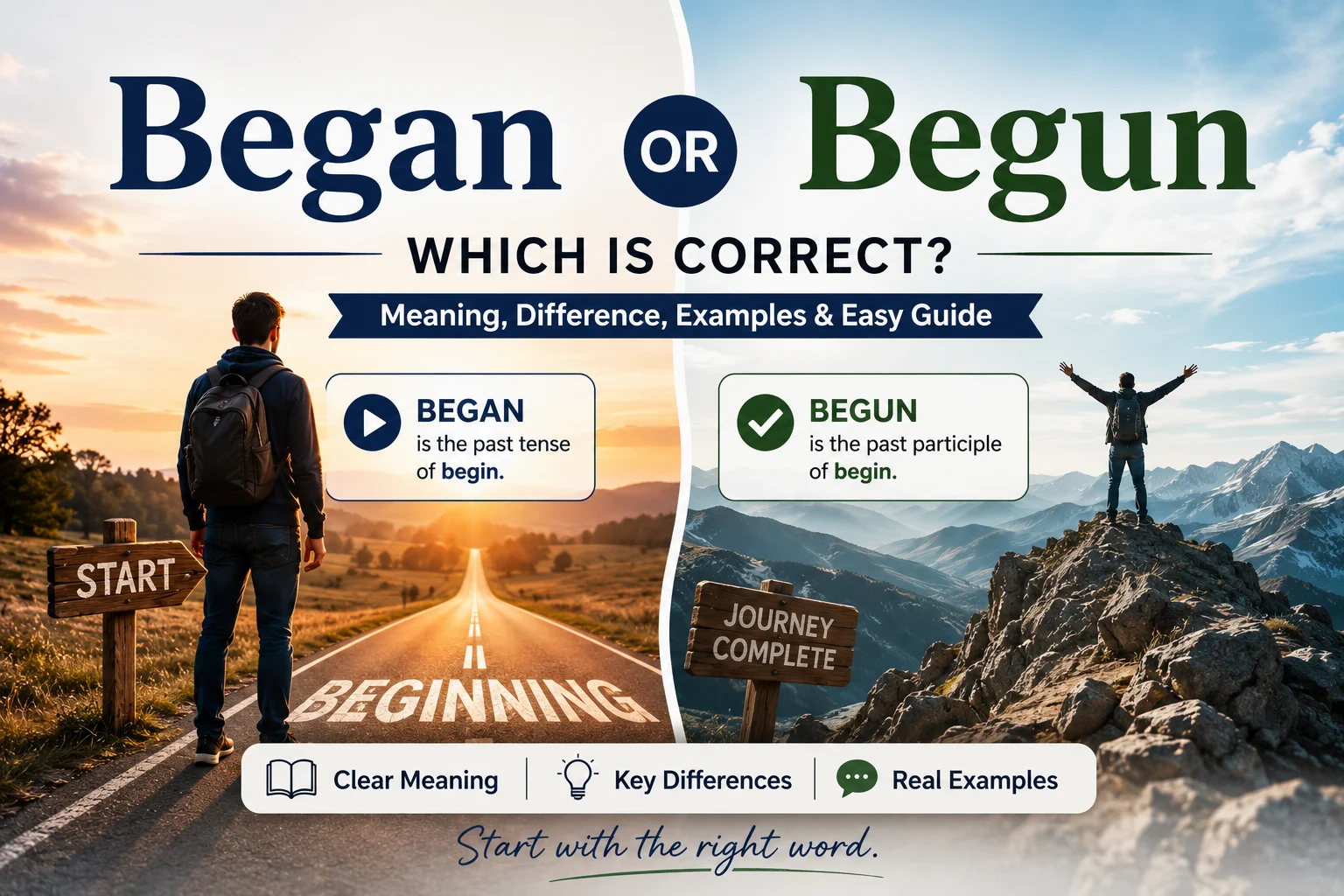
- Began is the simple past tense of begin.
- Begun is the past participle and must be used with helping verbs like has, have, had, or was.
Simple Examples
- She began her homework after dinner.
- The meeting has begun.
- They had begun building the new school before winter.
Easy Rule:
- Yesterday → Began
- Has/Have/Had → Begun
The Origin of Began or Begun
Both words come from the Old English verb beginnan, which means to start or commence.
Like many English verbs, begin has different forms:
- Base form: begin
- Simple past: began
- Past participle: begun
These different forms developed over hundreds of years as English grammar evolved. Today, they remain part of standard English and follow the same grammar rules in both British and American English.
British English vs American English Spelling
Unlike words such as color/colour or center/centre, began and begun are not different spellings. They are different verb forms.
Both British and American English use the same grammar.
| Version | Word | Region | Example Sentence |
|---|---|---|---|
| American English | Began | United States | The class began at 9 a.m. |
| American English | Begun | United States | The class has begun. |
| British English | Began | United Kingdom | The match began on time. |
| British English | Begun | United Kingdom | The match has begun. |
There is no regional spelling difference.
Which Spelling Should You Use?
Since began and begun are grammar forms rather than spelling variations, choose the one that matches your sentence.
For a US Audience
Use the correct grammar:
- Began for simple past.
- Begun after helping verbs.
For a UK/Commonwealth Audience
The same grammar rules apply.
There is no difference between British and American English.
For Global/SEO Audience
Use the correct verb form based on the sentence.
Search engines and readers expect proper grammar, so choose began or begun according to the tense.
Common Mistakes with Began or Begun
Many people mix these words because they look similar.
| Incorrect | Correct |
|---|---|
| I have began my project. | I have begun my project. |
| The game begun yesterday. | The game began yesterday. |
| She has began cooking. | She has begun cooking. |
| They begun the meeting at noon. | They began the meeting at noon. |
| We had began early. | We had begun early. |
Easy Memory Trick
- Began = Past action
- Begun = Used with has, have, had, or other helping verbs
Began or Begun in Everyday Examples
Emails
“The meeting began at 10 a.m.”
“The project has begun successfully.”
News Headlines
“Construction Began Earlier This Week”
“Festival Has Begun Across the City”
Social Media
“Our vacation has finally begun!”
“The concert began with a fantastic performance.”
Formal Writing
“The research began in January.”
“The investigation has begun following the incident.”
Began or Begun – Google Trends & Usage
People around the world frequently search for began or begun because they are unsure which grammar form is correct.
Students often search before exams or while completing homework. Writers check the difference when editing reports, emails, or articles. English learners also look for quick grammar explanations because the two words appear similar.
Search interest stays strong because this is a common grammar question rather than a spelling difference. Educational websites, grammar blogs, and language learning platforms regularly explain the correct usage of both words.
Comparison Table
| Feature | Began | Begun |
|---|---|---|
| Part of Speech | Verb (Simple Past) | Past Participle |
| Meaning | Started | Started |
| Used Alone | Yes | No |
| Needs Helping Verb | No | Yes |
| Example | She began reading. | She has begun reading. |
| British English | Same | Same |
| American English | Same | Same |
Frequently Asked Questions
Is began or begun correct?
Both are correct. They are different forms of the verb begin.
When should I use began?
Use began for actions that happened in the past without a helping verb.
When should I use begun?
Use begun after helping verbs like has, have, had, or was.
Is begun a past tense?
No. Begun is the past participle, not the simple past tense.
Why can’t I say “has began”?
Because has must be followed by the past participle. The correct phrase is has begun.
Is there a British and American difference?
No. Both countries use began and begun in exactly the same way.
How can I remember the difference?
Think of this simple rule:
- Yesterday → Began
- Has/Have/Had → Begun
Conclusion
Understanding began or begun is easier once you know that they are different verb forms, not different spellings. Began is the simple past tense and describes an action that happened in the past. Begun is the past participle and must be used with a helping verb such as has, have, or had. This rule is the same in American English, British English, and every other form of standard English.
Whenever you write, first look at your sentence. If there is no helping verb, began is usually the correct choice. If you see has, have, or had, then begun is almost always the right answer. Remembering this simple pattern will help you avoid one of the most common English grammar mistakes.
With regular practice and the examples in this guide, you’ll be able to choose between began and begun confidently in emails, essays, conversations, and professional writing.