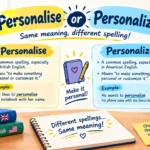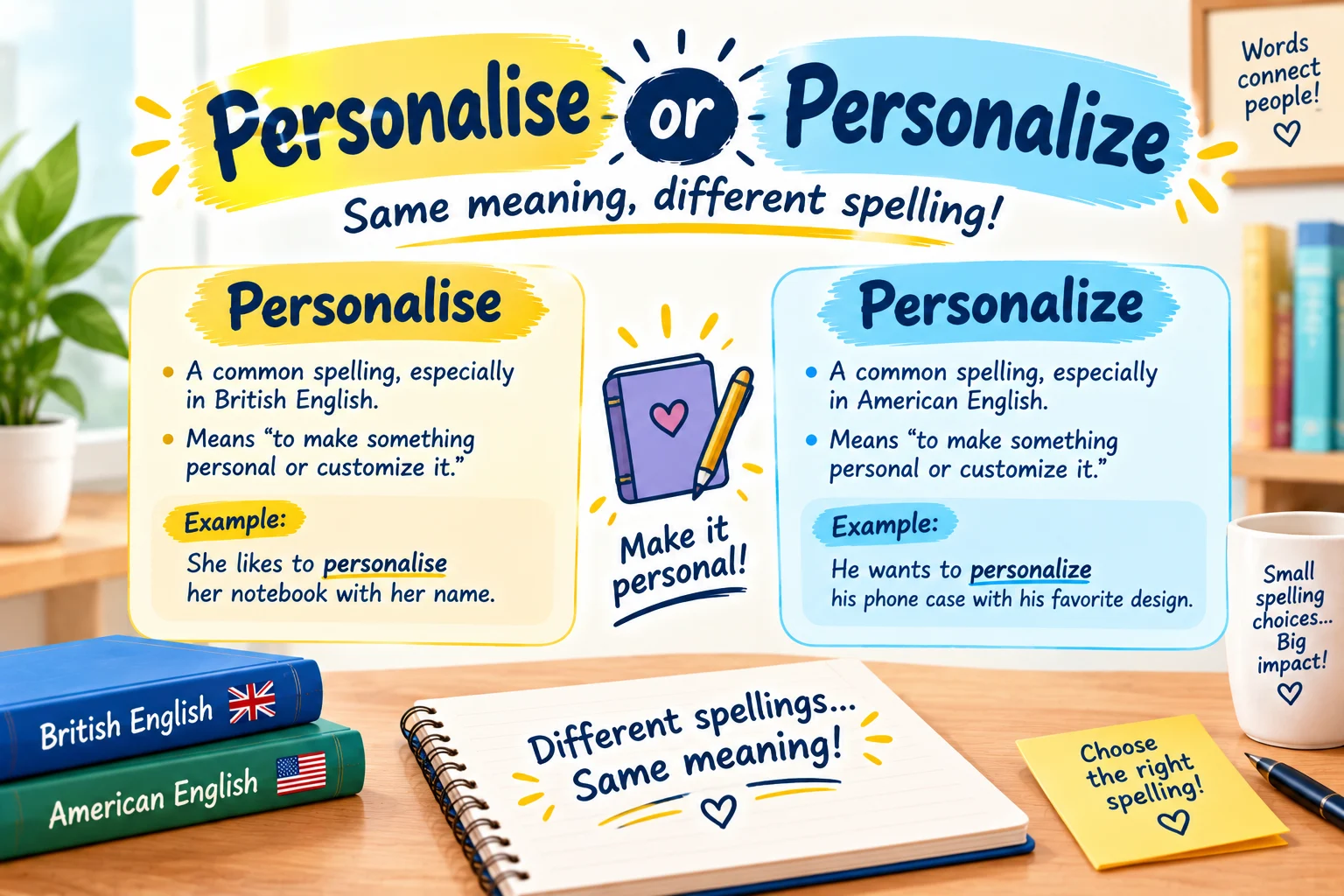
Personalise and personalize are both correct spellings. Personalise is mainly British English, while personalize is standard American English.
Have you ever typed personalise and then wondered if it should be personalize? You may have seen both spellings in emails, websites, schoolwork, and software settings. That can make a simple word feel surprisingly difficult.
In my years of helping English learners with spelling, I have noticed that this confusion often happens when people read both British and American English online. The words look different, but they have exactly the same basic meaning.
The only real difference is the spelling style.
Personalise is the usual British English spelling. Personalize is the usual American English spelling. Both mean to make something suited to a particular person or to add personal details to something.
The choice matters most when you want your writing to look consistent. A British-style article should normally use personalise. An American-style article should normally use personalize.
So, which one should you choose? The answer becomes easy once you understand the spelling rule, regional difference, related words, and common uses.
personalise or personalize – Quick Answer
Personalise and personalize have the same meaning. The difference is mainly regional spelling.
- Personalise → British English
- Personalize → American English
Both mean to make something more suitable for a particular person.
Simple examples
You can personalise your profile with a photo.
British English
You can personalize your profile with a photo.
American English
There is no difference in meaning between the two forms.
A simple rule
If your writing follows British English, choose personalise.
If your writing follows American English, choose personalize.
The same difference appears in related words:
- personalise / personalize
- personalised / personalized
- personalisation / personalization
The Origin and Background of Personalise and Personalize
The word personalise/personalize comes from personal, which relates to a particular person.
The word is built around the idea of making something personal.
For example, a company may personalise a message by using your name.
Hello, Sarah. Welcome back!
The message feels more personal than a general message such as:
Hello, customer. Welcome back!
The spelling difference developed from wider British and American spelling traditions.
British English often uses -ise in words such as:
- organise
- recognise
- apologise
- personalise
American English commonly uses -ize:
- organize
- recognize
- apologize
- personalize
Why does British English use “-ise”?
This point can be slightly tricky.
The -ize ending has a long history in English and is not simply an “American” invention. British English also uses -ize in some styles and dictionaries. However, -ise is very common in standard British writing.
For everyday writing, the safest rule is to follow the style used by your school, employer, publisher, or target audience.
The key idea
Do not think:
❌ One spelling is correct and the other is wrong.
Think:
✅ Personalise = British spelling
✅ Personalize = American spelling
That small change makes the whole issue much easier.
personalise or personalize Explained — Key Differences
The two words have the same definition.
The main difference is the spelling convention used by different varieties of English.
| Term | Meaning | When to Use | Region/Context |
|---|---|---|---|
| Personalise | Make something personal or suited to someone | British-style writing | UK and other British English contexts |
| Personalize | Make something personal or suited to someone | American-style writing | US and American English contexts |
| Personalised | Made personal or customized | British English | UK-style writing |
| Personalized | Made personal or customized | American English | US-style writing |
| Personalisation | The act of making something personal | British English | UK-style writing |
| Personalization | The act of making something personal | American English | US-style writing |
Personalise in British English
Use personalise when your writing follows British spelling.
You can personalise your account settings.
We allow customers to personalise their orders.
The teacher asked students to personalise their presentations.
These sentences are natural in British English.
Personalize in American English
Use personalize when your writing follows American spelling.
You can personalize your account settings.
We allow customers to personalize their orders.
The teacher asked students to personalize their presentations.
The meaning stays exactly the same.
Personalise vs. Personalize in Technology
You may see both spellings in websites, apps, and software.
A British website may say:
Personalise your experience
An American website may say:
Personalize your experience
Both messages tell you to change settings or content to match your preferences.
You may also see phrases such as:
- personalize your dashboard
- personalise your profile
- personalized recommendations
- personalised content
- personalization settings
- personalisation options
Technology companies often choose spelling based on the country or audience they target.
Personalise vs. Customize
Another common question is whether personalise means the same thing as customize.
They are often close in meaning, but there can be a small difference.
Personalise
Personalise often means making something suitable for a particular person.
The website personalises recommendations based on your interests.
Customize
Customize often means changing something according to your own choices.
You can customize the colors and layout.
In many situations, the words can be used almost interchangeably.
For example:
Personalize your profile.
Customize your profile.
Both sound natural.
Which Version Should You Use?
The best choice depends on your audience.
For British readers → use personalise
If your readers are mainly in the UK, use personalise.
It also fits a British spelling style that uses forms such as:
- colour
- favourite
- organise
- realise
- personalise
Consistency makes your writing look polished.
For American readers → use personalize
If you are writing for a US audience, choose personalize.
It fits American forms such as:
- color
- favorite
- organize
- realize
- personalize
This is the standard choice for American English.
For students → follow your school style
Students should check their teacher’s preferred English variety.
If your school uses British English, write personalise.
If your course uses American English, write personalize.
Do not switch between styles without a reason.
For global websites → choose one style
If your website has readers from many countries, either spelling can work.
The key is consistency.
If your website uses British English throughout, use personalise.
If it uses American English, use personalize.
Your readers will understand both.
Common Mistakes with personalise or personalize
Mistake 1: Calling one form wrong
❌ Personalise is incorrect.
✅ Personalise is the British spelling.
❌ Personalize is incorrect.
✅ Personalize is the American spelling.
Both are accepted forms.
Mistake 2: Mixing spelling styles
❌ We personalise your account and organize your settings.
This mixes common British and American spellings.
A consistent British version would be:
✅ We personalise your account and organise your settings.
An American version would be:
✅ We personalize your account and organize your settings.
Mistake 3: Mixing related forms
❌ The service personalises content and provides personalized recommendations.
This mixes the two spelling styles.
British:
✅ The service personalises content and provides personalised recommendations.
American:
✅ The service personalizes content and provides personalized recommendations.
Mistake 4: Assuming “-ize” is always American
This is not quite true.
The -ize ending has a long history in English and is also used in some British writing. However, -ise is the more familiar British form in many common words.
Your best approach is to follow the style guide you are using.
Mistake 5: Changing the meaning because of the spelling
The spelling does not change the basic meaning.
personalise = personalize
The difference is mainly British vs. American spelling.
personalise or personalize in Real-World Examples
1. Professional Email
British English:
You can personalise your account by adding your preferred contact details.
American English:
You can personalize your account by adding your preferred contact details.
Both versions are professional.
2. News Headline
British English:
New App Lets Users Personalise Their Shopping Experience
American English:
New App Lets Users Personalize Their Shopping Experience
The headline changes spelling but not meaning.
3. Social Media Post
British English:
Want to personalise your profile? Add a photo and short bio.
American English:
Want to personalize your profile? Add a photo and short bio.
Both work well for social media.
4. Formal Report
British English:
The service allows customers to personalise their communication preferences.
American English:
The service allows customers to personalize their communication preferences.
The correct choice depends on the report’s English style.
5. Marketing Copy
British English:
Personalise your order and make it truly yours.
American English:
Personalize your order and make it truly yours.
Both are natural marketing phrases.
Related Forms You Should Know
Learning the related forms helps you avoid new spelling mistakes.
British English
- personalise
- personalises
- personalised
- personalising
- personalisation
Example:
The website personalises content for each user.
American English
- personalize
- personalizes
- personalized
- personalizing
- personalization
Example:
The website personalizes content for each user.
Notice that the spelling difference continues through the word family.
Why Does Personalise Have an “S” and Personalize Have a “Z”?
This is one of the most common questions.
The answer is simple: English has different regional spelling conventions.
British English commonly uses -ise in this word:
personal + ise → personalise
American English commonly uses -ize:
personal + ize → personalize
The pronunciation is usually very similar.
The s and z are the main visible difference.
You may notice the same pattern in other words:
| British English | American English |
|---|---|
| organise | organize |
| recognise | recognize |
| apologise | apologize |
| realise | realize |
| personalise | personalize |
This is a useful pattern for English learners.
personalise or personalize — Data, Trends & Usage
The search intent behind “personalise or personalize” is mainly informational and spelling clarification.
People often search this phrase when they are writing:
- School assignments
- Business emails
- Website content
- Product descriptions
- Marketing copy
- Blog posts
- Software instructions
- Customer support messages
The spelling question is especially common because online content crosses national borders. A reader in the UK may see personalise, while a reader in the US sees personalize.
Both forms remain useful.
For SEO writers, the main lesson is simple: match the spelling to your target market.
If your website targets American users, personalize may fit your overall language style.
If it targets British users, personalise may be more natural.
This also helps with related keywords such as personalized experience, personalised service, personalization, and personalisation.
Do not mix the forms simply to target different spellings. Write naturally and keep your regional style clear.
Standalone Comparison Table
| Term/Variant | Meaning | Region/Context | Best Used When |
|---|---|---|---|
| Personalise | Make something personal | British English | UK-focused writing |
| Personalize | Make something personal | American English | US-focused writing |
| Personalised | Made personal | British English | UK content |
| Personalized | Made personal | American English | US content |
| Personalising | Making something personal | British English | UK writing |
| Personalizing | Making something personal | American English | US writing |
| Personalisation | The act of making something personal | British English | UK business/marketing content |
| Personalization | The act of making something personal | American English | US business/marketing content |
FAQs About personalise or personalize
Q: Which is correct, personalise or personalize?
A: Both are correct. Personalise is the common British English spelling, while personalize is the common American English spelling.
Q: What does personalise mean?
A: Personalise means to make something more suitable for a particular person or to add personal details. For example, you can personalise a profile, message, product, or service.
Q: What does personalize mean?
A: Personalize has the same meaning as personalise. It is the standard spelling used in American English.
Q: What is the difference between personalise and personalize?
A: There is no important difference in meaning. The main difference is regional spelling: personalise is British, while personalize is American.
Q: Is personalise acceptable in formal writing?
A: Yes. Personalise is a standard spelling in British English and is suitable for formal writing when British English is being used.
Q: Is personalize acceptable in formal writing?
A: Yes. Personalize is standard American English and is fully acceptable in formal writing for US audiences.
Q: Which spelling should I use in an American article?
A: Use personalize. It matches the standard American spelling style and related forms such as personalized and personalization.
Q: Which spelling should I use in British English?
A: Use personalise if you are following the common British spelling style. Related forms include personalised and personalisation.
Q: Is personalize the same as customize?
A: The meanings are very close. Personalize often means making something suitable for a particular person, while customize focuses more on changing something according to someone’s choices.
Q: Why do British and American English spell this word differently?
A: British and American English developed different spelling preferences. British English commonly uses -ise, while American English commonly uses -ize in words such as personalise/personalize.
Q: Can I use both spellings in one article?
A: You can, but it is usually better to choose one English style and stay consistent. Use personalise for British English or personalize for American English.
Conclusion
The choice between personalise or personalize is simple once you know the regional difference.
Personalise is the common British English spelling. Personalize is the common American English spelling. Both mean to make something personal or better suited to a particular person.
The difference does not change the meaning. It only changes the spelling.
You should also keep related words consistent. British English uses personalised and personalisation, while American English uses personalized and personalization.
For a UK audience, choose personalise. For a US audience, choose personalize. If you write for a global audience, either form can work, but your overall spelling style should remain consistent.
A useful memory trick is simple:
British: personalise
American: personalize
Once you remember the S for British and Z for American pattern, this spelling choice becomes much easier.
Now you know exactly how to use personalise or personalize. Bookmark this guide, and use the right form with confidence in your next article, email, or assignment.