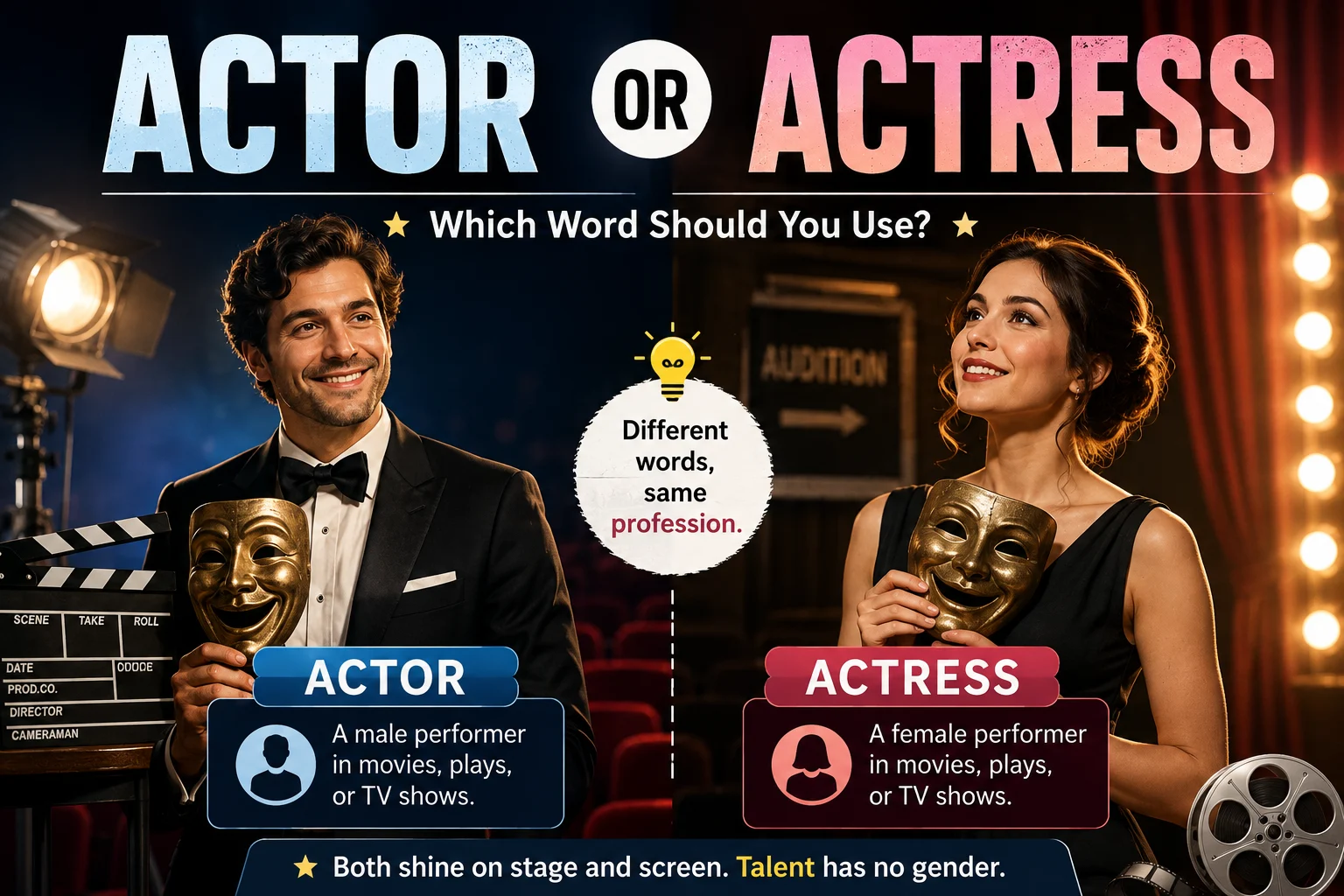
Actor or actress refers to a person who performs a character in a film, TV show, play, or other production. Actor is now widely used as a gender-neutral term, while actress specifically refers to a woman who acts.
Actor or Actress – Quick Answer
If you are unsure whether to write actor or actress, you are not alone. Both words are correct, but they are used in slightly different ways.
Actor can describe anyone who performs a role. It can be used for a man, woman, or person of any gender.
Actress traditionally means a female actor. It is still a correct word, but many people now prefer actor because it is gender-neutral.
For example:
- Tom Hanks is a famous actor.
- Emma Stone is a famous actor.
- Emma Stone is a famous actress.
The last two sentences can both be correct. The choice often depends on style, context, and personal preference.
If you are writing for a modern audience, actor is usually the safest general term.
The Origin / Background of Actor or Actress
The word actor has a long history. It comes from the Latin word actor, meaning a doer or performer. It later entered English through French and developed its modern meaning.
For centuries, English also used different forms of words for men and women.
Actor was commonly used for a male performer.
Actress developed as the feminine form. The ending -ess was often added to nouns to show that a person was female.
You can see the same pattern in older English words such as:
- waiter → waitress
- host → hostess
- prince → princess
- steward → stewardess
This explains why actor and actress exist as two forms.
Language, however, changes over time. Many modern English speakers prefer words that do not mark gender unless gender is relevant.
That is why actor has become very common as a general term.
Major film awards also show this change in language. The word actor is often used as a broad category, even when the people receiving the awards are women.
So, if you see a woman described as an actor, that does not mean the writer made a mistake.
Actor or Actress Explained — Key Differences and Variations
The main difference is simple:
- Actor = a person who acts or performs a role.
- Actress = traditionally, a woman who acts.
The word actor has a broader meaning.
When Should You Use “Actor”?
Use actor when you want a neutral term.
For example:
She is a talented actor who has appeared in several films.
Here, actor does not tell the reader the person’s gender. It simply tells us what the person does.
You can also use it when discussing a group:
The director praised all the actors after the performance.
The group could include men, women, or people of different genders.
When Should You Use “Actress”?
Use actress when the gender-specific term is wanted or when a person or publication prefers it.
For example:
She won an award for Best Actress.
Actress is especially common in phrases connected to awards, entertainment journalism, and traditional descriptions.
However, some women who work in acting prefer to be called actors rather than actresses.
That makes personal preference worth considering.
Comparison Table
| Term | Meaning | When to Use | Region/Context |
|---|---|---|---|
| Actor | A person who performs a role | General or gender-neutral use | Modern English worldwide |
| Actress | A female actor | When a female-specific term is preferred | Common in traditional and entertainment contexts |
| Performing artist | A person who performs | Broader professional context | Formal and creative contexts |
| Cast member | A person in a production | When discussing a film, play, or show | Film, TV, and theater |
| Lead actor | Main performer in a production | When discussing the main role | Film, TV, theater |
The key point is that actor is broader, while actress is gender-specific.
Which Version / Approach Should You Use?
Your best choice depends on your audience and the context.
For Beginners and Students
Use actor as the general word.
It is simple and widely understood.
For example:
My favorite actor is from Canada.
If you are talking about a specific woman and your teacher or textbook uses actress, that form is also correct.
For Professional or Academic Writing
Actor is usually the better neutral choice.
For example:
The actor gave a strong performance in the final scene.
It sounds natural and avoids making gender part of the description when gender is not important.
For Entertainment Writing
Both actor and actress can work.
If you are writing about an award called Best Actress, use the official award name.
For example:
She won the award for Best Actress.
Do not change the official name just to make it gender-neutral.
For Personal Preference
Follow the person’s preferred term when you know it.
Some women proudly use actress. Others prefer actor.
Neither choice automatically makes the other wrong.
For Global or Neutral Use
Choose actor.
It is clear, simple, and works for people of any gender.
Common Mistakes with Actor or Actress
Many mistakes happen because people think one word is always correct.
Here are the most common problems.
1. Thinking “Actor” Only Means a Man
Mistake:
She is an actor, so the sentence is wrong.
Correction:
She is an actor, so the sentence is correct.
Why?
Modern English commonly uses actor as a gender-neutral noun.
2. Thinking “Actress” Is Wrong
Mistake:
You should never use the word actress.
Correction:
Actress is still a correct English word.
Why?
The word is established English. Some people still use it regularly.
3. Using “Actress” for Every Female Performer
This is not always necessary.
Better approach:
The actor gave an excellent performance.
Use actress when a female-specific description fits the context or is preferred.
4. Changing an Official Award Name
Mistake:
She won Best Actor.
Correction:
She won Best Actress.
If the official award category is called Best Actress, keep the official title.
5. Assuming One Style Fits Every Person
English is not always about finding one “correct” word.
A person may prefer actor, while another may prefer actress.
When writing about a real person, respecting their preferred terminology is a good practice.
Actor or Actress in Real-World Examples
Seeing the words in context makes the difference easier to understand.
Professional Email
Subject: Casting Update
We have selected an actor for the main role. The casting team will contact the performer tomorrow.
Here, actor is neutral and professional.
News Headline
Actor Wins Major Film Award
This headline uses actor as a broad term.
A news story may also use actress if the publication follows that style.
Social Media Post
Just watched the new movie, and the lead actor was amazing!
This sounds natural in everyday online English.
Formal Report
The actor delivered a strong performance and helped create the emotional tone of the final scene.
Here, actor works well because the report focuses on the person’s professional role.
Talking About a Woman
She is a talented actor with years of experience.
This is correct.
You could also write:
She is a talented actress with years of experience.
Both can be grammatically correct. The difference is mainly in whether you want a gender-neutral or gender-specific term.
Actor or Actress — Data, Trends & Usage
The growing use of actor as a gender-neutral term reflects a wider change in English.
Modern English often favors professional titles that do not need to identify gender.
You can see this pattern in words such as:
- police officer instead of policeman
- firefighter instead of fireman
- chairperson or chair instead of chairman
- flight attendant instead of stewardess
The same trend applies to actor.
Searchers often type “actor or actress” because they want a quick answer to one of three questions:
- Is actor correct for a woman?
- Is actress still correct?
- Which word should I use in formal writing?
The answer to the first question is yes. A woman can correctly be called an actor.
The answer to the second is also yes. Actress remains a valid word.
For the third question, actor is usually the safest neutral choice.
This matters for students, bloggers, journalists, writers, and anyone learning English. Choosing the right word can make your writing sound more natural and current.
Actor or Actress: Side-by-Side Comparison
| Term/Variant | Meaning | Region/Context | Best Used When |
|---|---|---|---|
| Actor | Person who performs a role | Modern English | You want a neutral term |
| Actress | Female actor | Traditional and modern English | A female-specific term is preferred |
| Performing artist | Person who performs | Arts and professional writing | You need a broader term |
| Cast member | Person who belongs to a production’s cast | Film, TV, theater | Gender is not relevant |
| Lead actor | Main performer | Entertainment | Discussing the main role |
| Supporting actor | Performer in a supporting role | Film and TV | Discussing a secondary role |
There is no universal rule saying that actress must replace actor when the performer is a woman.
The context decides which word sounds best.
Actor or Actress in American and British English
Both actor and actress are used in American and British English.
There is no major spelling difference between the two varieties.
The bigger difference is style and preference.
In both forms of English, actor is widely understood as gender-neutral.
Actress is also understood as a female performer.
For example, these sentences work in both American and British English:
She is a talented actor.
She is a talented actress.
You may notice differences between publications, award organizations, and individual writers. That does not mean one version is grammatically wrong.
Why Do Some People Prefer “Actor”?
There are several reasons.
First, actor is short and simple.
Second, it can describe a person without adding gender information.
Third, many professional fields now prefer gender-neutral job titles.
For example, if a casting notice says:
Actors wanted for a new production.
The word actors can refer to everyone auditioning.
This makes communication easier and more inclusive.
Still, actress has not disappeared.
It remains familiar, widely understood, and accepted in standard English.
Why Do Some People Prefer “Actress”?
For some writers and performers, actress is a useful and natural word.
It clearly identifies a female performer.
It can also be part of an established title or category.
For example:
Best Actress
This is a familiar award category.
Some women also personally prefer actress because they see it as a distinct professional identity.
That choice should be respected.
The important lesson is simple: do not assume that one word is always preferred by everyone.
FAQ: Actor or Actress
Q: What does actor or actress mean?
A: Actor means a person who performs a role. Actress traditionally means a female actor. Today, actor is often used as a gender-neutral term.
Q: Can a woman be called an actor?
A: Yes. A woman can correctly be called an actor. The word is widely used as a gender-neutral term for someone who acts.
Q: Is actress still a correct word?
A: Yes. Actress is still a correct English word. It is used for a female actor, especially when a gender-specific term is wanted.
Q: Actor vs actress — what is the difference?
A: Actor is gender-neutral and can refer to anyone who acts. Actress specifically refers to a woman who acts.
Q: Which is better for formal writing, actor or actress?
A: Actor is usually the better neutral choice. However, use actress when it is part of an official title or when the person prefers that term.
Q: Where does the word actor come from?
A: Actor comes from Latin actor, meaning a doer or performer. The English word developed through French and later became associated with stage and screen performers.
Q: Can I say “female actor”?
A: Yes, but it is often unnecessary. If gender matters, female actor is clear. If it does not matter, simply use actor.
Final Thoughts on Actor or Actress
The choice between actor or actress is easier once you understand the main difference.
Actor is the broad, gender-neutral term. It can describe any person who performs a role.
Actress is the traditional female-specific term. It is still correct and remains common in entertainment writing and award titles.
For most modern writing, actor is the safest general choice. It is simple, clear, and works for everyone.
But context still matters. If an official award says Best Actress, keep that title. If a performer tells you they prefer actress, use it. Good writing is not only about grammar. It is also about accuracy and respect.
You do not need to overthink the choice. Ask one simple question: Do I need to identify the person’s gender here?
If the answer is no, actor is usually your best choice.
Now you know exactly how to use actor or actress. Bookmark this guide so you never have to second-guess the difference again.