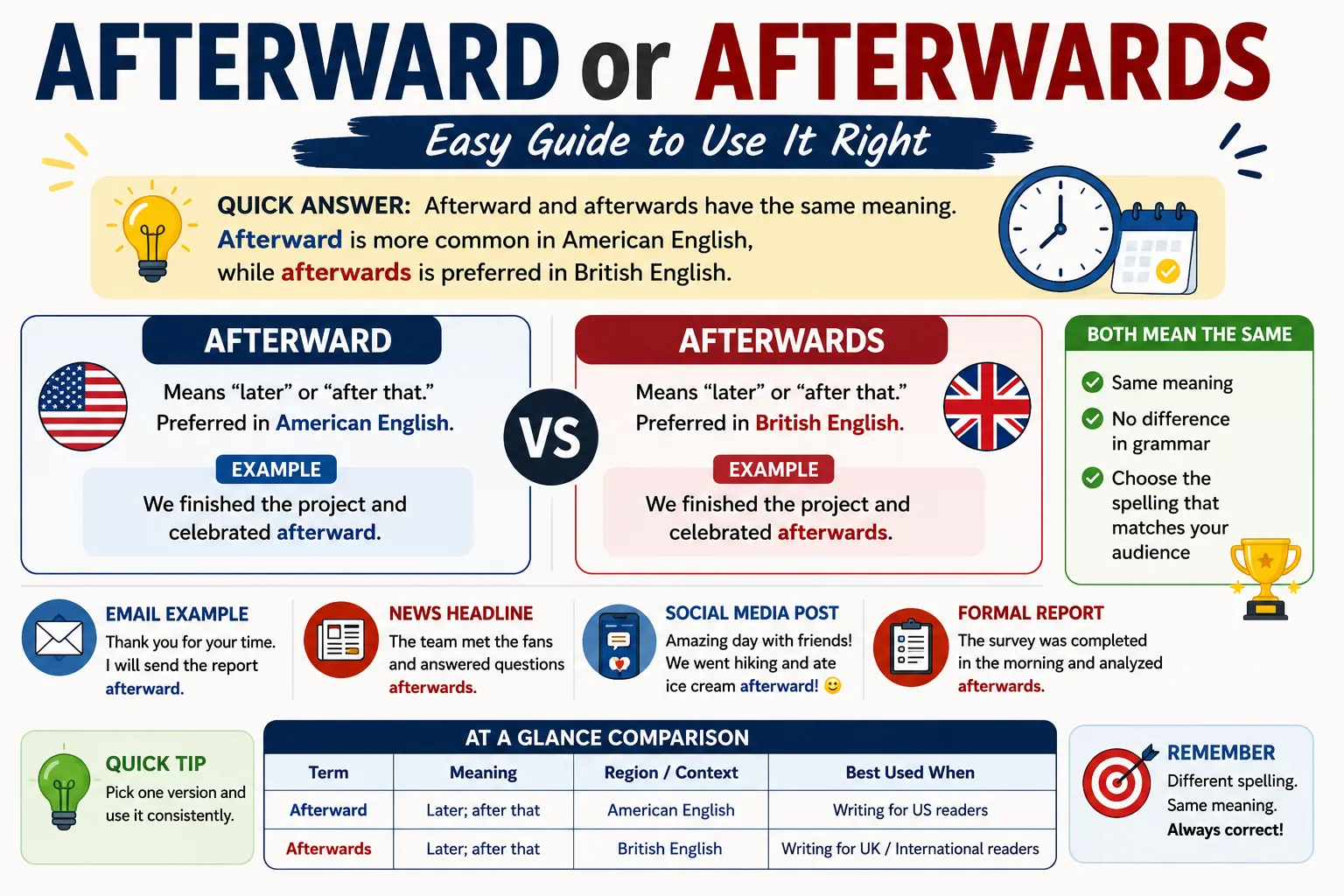
Afterward and afterwards have the same meaning. Afterward is more common in American English, while afterwards is preferred in British English.
Afterward or Afterwards: Which One Should You Use?
I still remember reading two travel articles on the same day. One said, “We visited the museum and went to dinner afterward.” The other read, “We visited the museum and went to dinner afterwards.” At first, I thought one writer had made a mistake. Later, I learned both were completely correct.
Many English learners worry about this tiny “s” at the end of the word. They wonder if one spelling is wrong or more formal. The good news is that there is no difference in meaning.
The only real difference is where people use each spelling. Once you know your audience, the choice becomes easy.
By the end of this guide, you will know when to use afterward or afterwards, avoid common mistakes, and write with confidence.
Afterward or Afterwards – Quick Answer
Both words mean “later” or “at a later time.” They describe something that happens after another event.
Examples
- We watched a movie and went for coffee afterward.
- We watched a movie and went for coffee afterwards.
Both sentences are correct. Only the regional spelling changes.
The Origin / Background of Afterward or Afterwards
The word comes from after and ward, which means “toward a direction.”
Hundreds of years ago, English speakers began adding -s to some adverbs. This created words like towards, backwards, and afterwards.
American English later dropped the final “s” from many of these words. British English kept it.
That is why both spellings exist today.
Afterward or Afterwards Explained — Key Differences
The meaning never changes.
Only the preferred spelling changes depending on where you are writing.
| Term | Meaning | When to Use | Region/Context |
|---|---|---|---|
| Afterward | Later or after that | American writing | United States |
| Afterwards | Later or after that | British writing | UK, Australia, Canada (often) |
Examples
- We had lunch. Afterward, we visited the park.
- We had lunch. Afterwards, we visited the park.
Both are grammatically correct.
Which Version Should You Use?
Choosing the right spelling is simple.
- For American readers → Use afterward.
- For British readers → Use afterwards.
- For Australian readers → Afterwards is more common.
- For international audiences → Either spelling works. Just stay consistent.
My advice is easy.
Pick one version and use it throughout your document.
Common Mistakes with Afterward or Afterwards
Here are mistakes people often make.
| Mistake | Correct Form |
|---|---|
| Mixing both spellings | Use one spelling consistently |
| Thinking the words have different meanings | They mean exactly the same thing |
| Using “after word” as two words | Write afterward or afterwards |
| Adding extra punctuation | Use the word naturally in the sentence |
Why These Mistakes Happen
- Writers see both spellings online.
- Different dictionaries follow different styles.
- Regional English creates confusion.
Afterward or Afterwards in Real-World Examples
Professional Email
“Thank you for attending today’s meeting. We will send the presentation afterward.”
News Headline
“The president met world leaders and spoke to reporters afterwards.”
Social Media Post
“Great workout this morning. I felt amazing afterward!”
Formal Report
“The data were collected during the experiment and analyzed afterwards.”
Afterward or Afterwards — Data, Trends & Usage
People search for this topic because they notice different spellings in books, websites, and news articles.
- Most searched in: United States, United Kingdom, Canada, Australia, and India.
- Search intent: Informational.
- Popular among: Students, writers, editors, bloggers, and English learners.
- Why it matters today: Many people write for international audiences where consistent spelling builds trust.
Standalone Comparison Table
| Term/Variant | Meaning | Region/Context | Best Used When |
|---|---|---|---|
| Afterward | Later | American English | Writing for US readers |
| Afterwards | Later | British English | Writing for UK or international readers |
Frequently Asked Questions
Q: What does afterward or afterwards mean?
A: Both words mean later or after that. They describe something happening after another event.
Q: How do you use afterward or afterwards correctly?
A: Use afterward in American English and afterwards in British English. The meaning stays the same.
Q: Is there any difference between afterward and afterwards?
A: No. The only difference is regional spelling. Both are grammatically correct.
Q: Is afterward acceptable in formal writing?
A: Yes. It is perfectly correct in formal American English.
Q: Which version is correct—afterward or afterwards?
A: Both are correct. Choose the spelling that matches your audience.
Q: Where do these words come from?
A: They developed from the word after. British English kept the ending -s, while American English usually dropped it.
Q: Can afterward or afterwards start a sentence?
A: Yes. Both words can begin a sentence. For example, “Afterward, we went home.”
Conclusion
The difference between afterward and afterwards is much smaller than many people think. Both words mean exactly the same thing. The only real difference is regional preference. Americans usually write afterward, while British writers often choose afterwards.
When writing, think about your audience first. Then stay consistent from beginning to end. That simple habit makes your writing look polished and professional.
Now you know exactly how to use afterward or afterwards. Bookmark this guide, use it in your next piece of writing, and share it with someone who has wondered.
Whom or Who