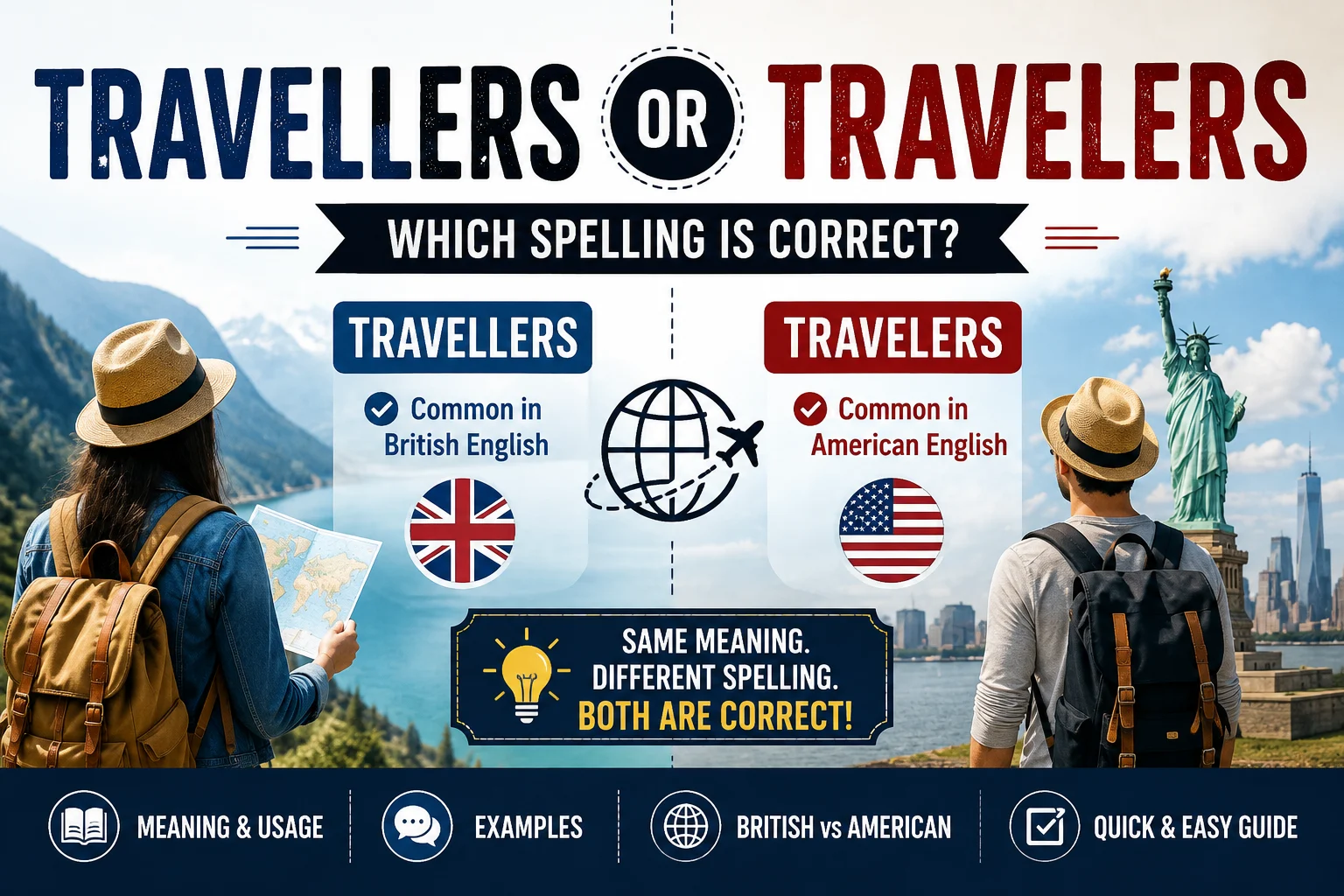
Travellers and travelers are both correct spellings. Travellers is standard in British English, while travelers is standard in American English
Have you ever typed travellers and wondered if you needed one “l” instead? Or perhaps you wrote travelers and were told that British English uses two “l”s?
This is a common spelling question because both travellers and travelers are correct. The difference comes from the English variety you use.
As an English teacher and language writer, I often see learners pause over words like this. The problem is not the meaning. Both forms mean people who travel. The real question is which spelling matches your audience.
The rule is simple. Travellers is the usual British English spelling. Travelers is the usual American English spelling. The same pattern appears in the singular forms: traveller and traveler.
This guide explains the difference, the reason for the extra “l,” common mistakes, and real examples. You will also learn which form to use in school, business, websites, and everyday writing.
Once you know the rule, choosing between travellers or travelers becomes easy.
Travellers or Travelers – Quick Answer
Travellers and travelers have the same meaning. Both refer to people who travel from one place to another.
The spelling depends mainly on the English variety:
- Travellers → British English
- Travelers → American English
Examples
British English:
Many travellers visit London each year.
American English:
Many travelers visit New York each year.
Neither spelling is wrong.
The important thing is to match your spelling style to your audience.
The Origin / Background of Travellers or Travelers
The word comes from the verb travel.
When you add -er, you create a noun for a person who performs an action:
- teach → teacher
- drive → driver
- work → worker
- travel → traveller/traveler
The spelling becomes interesting because English varieties developed different rules for words ending in a vowel plus l.
Why Does British English Use Two “l”s?
British English commonly doubles the final l when adding certain suffixes.
So:
travel + er → traveller
The same pattern appears in other words:
- travel → traveller
- cancel → cancelled
- model → modelling
- label → labelled
American English often keeps the single l in these cases:
- travel → traveler
- cancel → canceled
- model → modeling
- label → labeled
This is one of the most useful spelling patterns to learn if you write in both British and American English.
Why Did American English Develop a Different Style?
American English developed its own spelling conventions over time.
Some American spelling choices favored shorter forms. The differences became more established through dictionaries, schools, publishing, and everyday use.
As a result, both systems are now standard.
So traveller is not an old-fashioned version of traveler, and traveler is not a spelling mistake in American English.
They simply belong to different spelling traditions.
Travellers or Travelers Explained — Key Differences
The meaning stays the same.
The main difference is regional spelling.
Traveller
Traveller is the standard British English spelling.
Example:
The traveller arrived at the station early.
Its plural form is:
travellers
This spelling is common in the UK and in writing that follows British spelling conventions.
Traveler
Traveler is the standard American English spelling.
Example:
The traveler arrived at the airport early.
Its plural form is:
travelers
This form is common in the United States.
The Difference in One Look
| Term | Meaning | When to Use | Region/Context |
|---|---|---|---|
| traveller | A person who travels | British spelling | UK and British-style English |
| traveler | A person who travels | American spelling | US and American-style English |
| travellers | More than one person who travels | British spelling | UK and British-style English |
| travelers | More than one person who travels | American spelling | US and American-style English |
Singular vs. Plural
The spelling rule applies to both forms.
British English:
traveller → travellers
American English:
traveler → travelers
The meaning does not change when the spelling changes.
Which Version Should You Use?
Your audience should guide your choice.
For British English → Use “Travellers”
If your readers are mainly in the United Kingdom, use:
traveller
travellers
Example:
International travellers should check their passports before departure.
This matches British spelling.
For American English → Use “Travelers”
If your audience is mainly in the United States, use:
traveler
travelers
Example:
International travelers should check their passports before departure.
This matches American spelling.
For Students → Follow Your School’s English Style
Students should check which spelling system their school or teacher expects.
If your assignment follows British English, write travellers.
If it follows American English, write travelers.
Do not mix spelling systems without a reason.
For Professional Writing → Be Consistent
Business writers should choose one English variety and stick to it.
For example, a British travel company might write:
We help travellers find affordable holiday packages.
An American company might write:
We help travelers find affordable vacation packages.
Both are correct.
For Global Websites → Know Your Target Audience
If your website serves readers around the world, either spelling can work.
You can even use both forms when the topic calls for it.
For example:
Whether you call them travellers or travelers, the advice is the same.
But within one variety of English, consistency matters.
Common Mistakes with Travellers or Travelers
1. Calling “Travelers” Incorrect
Mistake:
“Travelers is spelled incorrectly.”
Correction:
Travelers is the standard American English spelling.
Travellers is the standard British English spelling.
2. Calling “Travellers” Incorrect
Mistake:
“Travellers has an unnecessary l.”
Correction:
The double l is normal in British English.
For example:
British travellers often use this spelling.
3. Mixing the Two Forms
Mistake:
Our website helps travelers plan holidays in Britain.
If the rest of the website uses British spelling, travellers would be more consistent.
Better:
Our website helps travellers plan holidays in Britain.
4. Using One Rule for Every Word
Some learners think every word ending in l must follow the same rule.
English spelling is not that simple.
For example, British English uses:
- travelled
- travelling
- traveller
American English uses:
- traveled
- traveling
- traveler
Learning the pattern helps, but you should still check individual words when needed.
5. Changing the Meaning by Changing the Spelling
There is no meaning change between travellers and travelers.
The extra l does not create a different type of traveler.
It only reflects the spelling convention.
Travellers or Travelers in Real-World Examples
1. Professional Email
British English:
Dear Customer,
We are pleased to inform travellers that the new timetable is now available.
American English:
Dear Customer,
We are pleased to inform travelers that the new schedule is now available.
Notice that the spelling follows the wider English style.
2. News Headline
British style:
Travellers Face Delays After Severe Weather
American style:
Travelers Face Delays After Severe Weather
Both headlines are grammatically correct.
3. Social Media Post
British English:
“Calling all travellers! What is your favorite place to visit?”
American English:
“Calling all travelers! What is your favorite place to visit?”
The message stays the same.
4. Formal Document
British:
“All travellers must present a valid passport.”
American:
“All travelers must present a valid passport.”
Both are suitable for formal writing when the spelling matches the chosen English variety.
5. Travel Blog
British:
“These tips will help travellers save money on their next trip.”
American:
“These tips will help travelers save money on their next trip.”
The difference is only spelling.
Travellers or Travelers — Data, Trends & Usage
The search intent behind travellers or travelers is mainly informational and spelling-related.
People who search this phrase often want a fast answer to questions such as:
- Is travellers correct?
- Is travelers correct?
- Which spelling is British?
- Which spelling is American?
- Why does traveller have two “l”s?
- Should I write traveler or traveller?
- Which spelling should I use in an essay?
Where Is “Travellers” Used?
Travellers is common in British English.
You may see it in:
- UK newspapers
- British travel websites
- UK school materials
- British books
- Government writing using British spelling
- Travel content aimed at British readers
Where Is “Travelers” Used?
Travelers is common in American English.
You may see it in:
- US newspapers
- American websites
- US school materials
- American books
- Travel companies targeting US customers
- American business writing
Why Is This Useful for Writers?
Regional spelling can affect how natural your writing feels.
A British reader expects travellers.
An American reader expects travelers.
Neither group needs to see the other spelling as an error. It is simply a difference between English varieties.
For SEO writers, this can also matter because people may search using the spelling they see most often in their region.
Singular and Related Forms You Should Know
The spelling difference does not stop at travellers or travelers.
Here are the most useful forms:
| British English | American English |
|---|---|
| traveller | traveler |
| travellers | travelers |
| travelled | traveled |
| travelling | traveling |
| traveller’s | traveler’s |
| travellers’ | travelers’ |
Example
British:
The traveller had travelled for three days and was travelling home.
American:
The traveler had traveled for three days and was traveling home.
This is a helpful pattern to remember.
Standalone Comparison: Travellers vs. Travelers
| Term/Variant | Meaning | Region/Context | Best Used When |
|---|---|---|---|
| traveller | One person who travels | British English | Writing for UK readers |
| traveller | One person who travels | British-style international English | Following British spelling |
| traveler | One person who travels | American English | Writing for US readers |
| travellers | Two or more people who travel | British English | Writing for UK readers |
| travelers | Two or more people who travel | American English | Writing for US readers |
| travelling | The act of going from place to place | British English | British spelling |
| traveling | The act of going from place to place | American English | American spelling |
Frequently Asked Questions About Travellers or Travelers
Q: What does “travellers” mean?
A: Travellers means people who travel from one place to another. It is the standard British English spelling of the plural form.
Q: How do you use “travellers” correctly?
A: Use travellers when writing in British English. For example: “The airport was crowded with travellers.”
Q: Travellers vs. travelers — what’s the difference?
A: There is no difference in meaning. Travellers is the British spelling, while travelers is the American spelling.
Q: Is “travellers” acceptable in formal writing?
A: Yes. Travellers is completely acceptable in formal British English. The American equivalent is travelers.
Q: Which version is correct — travellers or travelers?
A: Both are correct. Choose travellers for British English and travelers for American English.
Q: Why does “travellers” have two l’s?
A: British English commonly doubles the final l when adding certain endings to words such as travel. This produces traveller and travellers.
Q: Can “travelers” be used in British English?
A: It can be understood, but travellers is the usual British spelling. If you are writing in British English, use travellers for consistency.
Q: Is “traveler” American or British?
A: Traveler is the standard American English spelling. British English normally uses traveller.
Q: What is the singular of travellers?
A: The singular British form is traveller. In American English, the singular is traveler.
Conclusion
The choice between travellers or travelers is simple once you know the English variety you are using.
Travellers is the standard British English spelling. Travelers is the standard American English spelling. Both forms mean people who travel, so the difference is spelling rather than meaning.
If you are writing for readers in the UK, use travellers. If your audience is mainly in the United States, use travelers.
The same pattern appears in related words. British English uses traveller, travelled, and travelling, while American English uses traveler, traveled, and traveling.
The most useful rule is to choose one spelling system and stay consistent. Do not change between British and American forms without a reason.
So, if you are unsure, ask yourself one question: Who will read my writing? That answer usually tells you which form to choose.
Now you know exactly when to use travellers or travelers. Bookmark this guide so you never second-guess this spelling difference again.