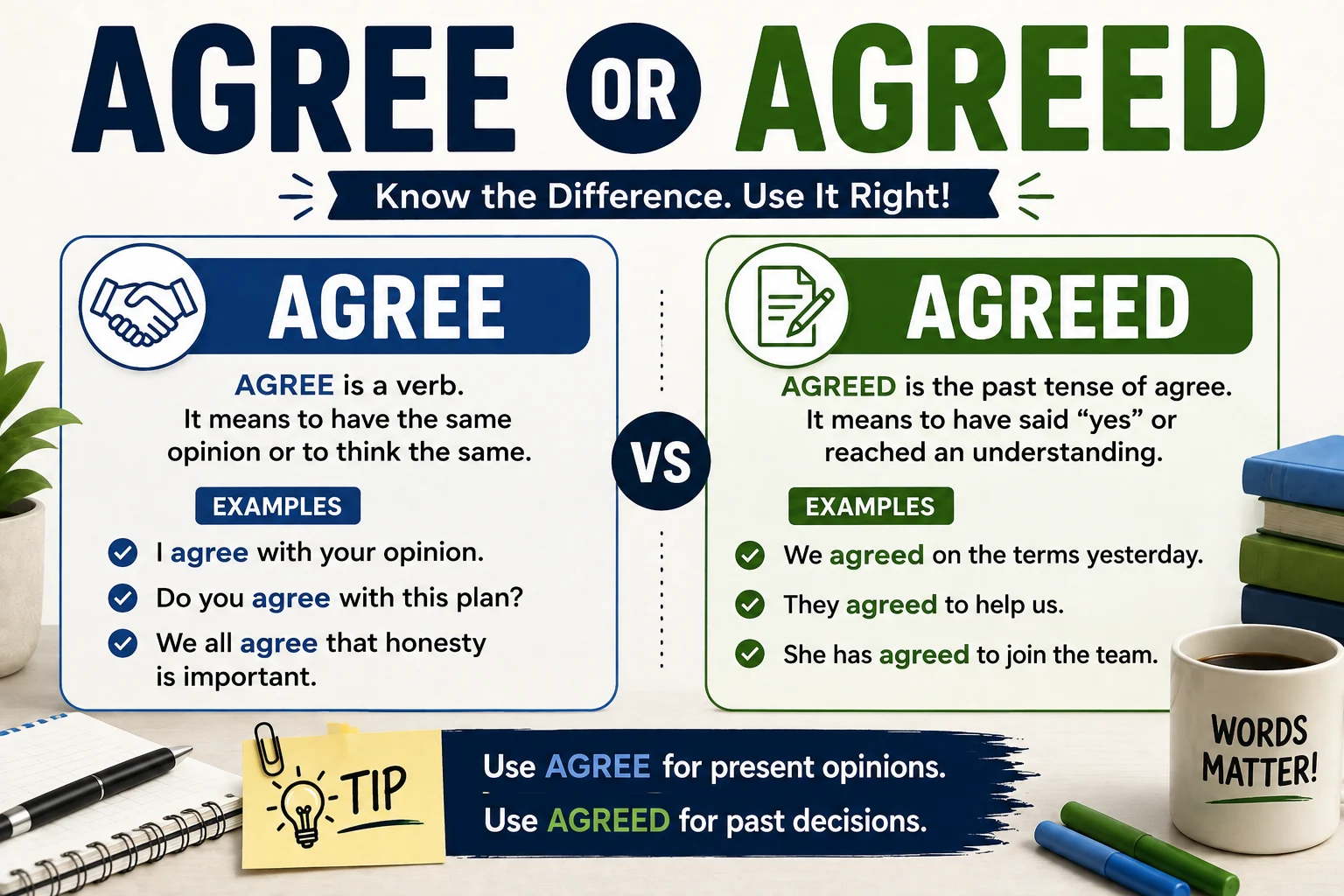
Agree is the present-tense verb, while agreed is its past tense and past participle. Use agree for what you think or accept now, and agreed for something accepted in the past.
Have you ever written a message like “I agreed with you” when you meant “I agree with you”? This is a small mistake, but it can change the time of your sentence.
I have seen this confusion often when helping English learners improve their everyday writing. The two words look almost the same, so it is easy to choose the wrong one. The key is simple: agree usually talks about the present, while agreed usually talks about the past.
You may see both words in emails, school work, meetings, conversations, and social media posts. Knowing when to use each form helps your English sound clear and natural.
This guide explains agree or agreed, their meanings, grammar, common mistakes, and real-world examples. By the end, you will know exactly which word to choose.
agree or agreed – Quick Answer
Agree is the base and present form of the verb.
I agree with your idea.
This means I share your opinion now.
Agreed is the past tense and past participle of agree.
I agreed with your idea yesterday.
This means I shared your opinion in the past.
Quick rule
- agree = present
- agreed = past
- agreeing = present participle
- agrees = third-person singular present
Simple examples
Present:
I agree with you.
Past:
I agreed with you during the meeting.
The choice depends mainly on when the agreement happens.
The Origin and Background of agree or agreed
The verb agree has a long history in English. It comes from the Old French agreer, which means “to please” or “to be agreeable.” It is related to the idea of being pleasing or acceptable.
The word later entered English through Anglo-French and Middle English.
Over time, agree developed its modern meanings. Today, it can mean to have the same opinion, accept a proposal, or be in harmony with someone or something.
The word agreed is simply the regular past form of agree.
English often forms the past tense of regular verbs by adding -ed. For example:
- agree → agreed
- walk → walked
- accept → accepted
- decide → decided
So there is no spelling choice between agree and agreed. They are different grammatical forms of the same verb.
agree or agreed Explained — Key Differences
The main difference is time and grammar.
| Term | Meaning | When to Use | Region/Context |
|---|---|---|---|
| agree | Have the same opinion or accept something | Present | All major varieties of English |
| agrees | Agrees in the present | He, she, it | All major varieties of English |
| agreed | Had the same opinion or accepted something | Past | All major varieties of English |
| agreeing | Being in agreement | Continuous forms | All major varieties of English |
1. Agree
Use agree when the agreement is happening now or is generally true.
I agree with your opinion.
We agree that the plan is useful.
2. Agrees
Use agrees with he, she, it, or another singular subject in the present tense.
She agrees with me.
The manager agrees with the proposal.
3. Agreed
Use agreed when the agreement happened in the past.
We agreed on the price yesterday.
They agreed to meet at noon.
4. Agreeing
Use agreeing in continuous structures.
I am agreeing with you on this point.
However, I agree with you is much more natural in most everyday situations.
Which Version Should You Use?
Choosing between agree and agreed is easy when you look at the time of the action.
For present opinions → use agree
Use agree when you still share an opinion.
I agree with your point.
This means you share the opinion now.
For past agreement → use agreed
Use agreed when the agreement happened before now.
We agreed on the plan last week.
The agreement happened in the past.
For he, she, or it → use agrees
He agrees with the teacher.
Do not write:
He agree with the teacher. ❌
For formal writing
Both forms are correct.
Choose the form based on the time and sentence structure, not on whether the writing is formal or informal.
Common Mistakes with agree or agreed
These mistakes are common among English learners.
| Mistake | Correction | Why? |
|---|---|---|
| I agreed with you now. | I agree with you now. | “Now” calls for the present form. |
| I agree with him yesterday. | I agreed with him yesterday. | “Yesterday” shows past time. |
| She agree with me. | She agrees with me. | Singular third-person subjects need -s. |
| We agrees with the decision. | We agree with the decision. | “We” takes the base form. |
| They agreed to the plan now. | They agree to the plan now. | The sentence describes a present action. |
Mistake 1: Using “agreed” for a present opinion
I agreed with you.
This can sound like you agreed in the past.
If you still have the same opinion, write:
I agree with you.
Mistake 2: Using “agree” with a past time
We agree yesterday. ❌
Use:
We agreed yesterday. ✅
The word yesterday clearly places the action in the past.
Mistake 3: Forgetting the “s”
She agree with the idea. ❌
Correct:
She agrees with the idea. ✅
agree or agreed in Real-World Examples
Seeing the words in normal situations can make the difference much easier to remember.
Professional email
Present:
I agree with your suggestion and believe it will help the team.
Past:
We agreed during yesterday’s meeting to review the proposal again.
The first sentence describes your current opinion. The second describes a past decision.
News headline or article
Officials agree on new safety measures.
This means the agreement is current or newly reached.
For a past event:
Officials agreed on new safety measures last week.
The past form works because the agreement happened earlier.
Social media post
I agree with this completely!
Here, the person is expressing a current opinion.
Another example:
We agreed to try the new restaurant, and it was great!
The decision happened before the person posted.
Formal document
The parties agree to the terms stated below.
This is common in contracts and formal agreements.
You may also see:
The parties agreed to the terms during the meeting.
Here, the sentence refers to a past event.
How “Agree” Is Used in English
The verb agree can appear in several useful patterns.
Agree with someone
Use agree with when you share someone’s opinion.
I agree with Sarah.
Do you agree with me?
Agree with an opinion or idea
I agree with your argument.
She agrees with the proposal.
Agree to something
Use agree to when you accept a plan, offer, request, or condition.
They agreed to the new rules.
He agreed to help us.
Agree on something
Use agree on when people reach the same decision about something.
We agreed on a price.
They agreed on the final date.
Agree that…
Use agree that before a statement or idea.
I agree that this is the best option.
We agreed that the project needed more time.
These patterns are worth learning because they make your English sound more natural.
agree or agreed — Data, Trends & Usage
The search intent behind “agree or agreed” is mainly informational. People usually search the phrase when they are unsure about verb tense or correct sentence structure.
The confusion is easy to understand. Agree and agreed have the same basic meaning, but they show different times.
English learners often meet this issue when writing:
- Emails
- Essays
- Messages
- Reports
- School assignments
- Workplace communication
- Comments and social media posts
The topic also matters because choosing the wrong tense can make the timing of an action unclear.
A useful habit is to look for time words before choosing the verb.
Words such as now, today, every day, yesterday, last week, earlier, and before can give you a strong clue.
agree vs. agreed: Comparison Table
| Term/Variant | Meaning | Region/Context | Best Used When |
|---|---|---|---|
| agree | Share an opinion now | Global English | Present situations |
| agrees | Shares an opinion now | Global English | He, she, or it |
| agreed | Shared an opinion before | Global English | Past situations |
| agreeing | Being in agreement | Global English | Continuous grammar |
| agreement | A shared decision or understanding | Formal and informal | As a noun |
The easiest memory trick
Think of a simple timeline:
NOW → agree
BEFORE → agreed
For example:
Today, I agree with you.
Yesterday, I agreed with you.
That one idea solves most agree or agreed questions.
Frequently Asked Questions About agree or agreed
Q: What does “agree” mean?
A: Agree means to have the same opinion as someone or to accept an idea, plan, or proposal. It is the present form of the verb.
Q: When should I use “agree”?
A: Use agree for a present opinion or a general agreement. For example, “I agree with your idea.”
Q: When should I use “agreed”?
A: Use agreed when the agreement happened in the past. For example, “We agreed on the price yesterday.”
Q: What is the difference between agree and agreed?
A: Agree is normally the present form, while agreed is the past form. The main difference is the time of the action.
Q: Is “agree” correct in formal writing?
A: Yes. Agree is completely correct in formal writing. It is common in reports, emails, contracts, essays, and professional communication.
Q: Is “agreed” grammatically correct?
A: Yes. Agreed is the correct past tense and past participle of agree. For example, “The two companies agreed on the terms.”
Q: Should I say “I agree” or “I agreed”?
A: Say I agree when you share the person’s opinion now. Say I agreed when you are talking about an agreement that happened in the past.
Q: Is “I agreed with you” wrong?
A: No. I agreed with you is grammatically correct. It simply tells the reader that you agreed at an earlier time.
Q: Which is correct: “I agree with you” or “I agree to you”?
A: I agree with you is correct when you share someone’s opinion. Use agree to for accepting something, such as “I agree to the terms.”
Q: Can “agreed” be used as an adjective?
A: Yes. In phrases such as “the agreed price”, agreed describes something that people have already accepted. For example, “We paid the agreed amount.”
Conclusion
The choice between agree or agreed becomes simple once you focus on time. Use agree when you share an opinion now. Use agreed when the agreement happened in the past. For he, she, or it, use agrees in the present tense.
Remember these three examples:
- I agree with you. → present
- I agreed with you yesterday. → past
- She agrees with you. → present with a singular subject
Also remember that agree with, agree to, and agree on have different uses. Learning these patterns will make your writing clearer and more natural.
Do not worry if you have mixed up these forms before. Even small grammar choices become easy with practice. Bookmark this guide so you never second-guess “agree or agreed” again.