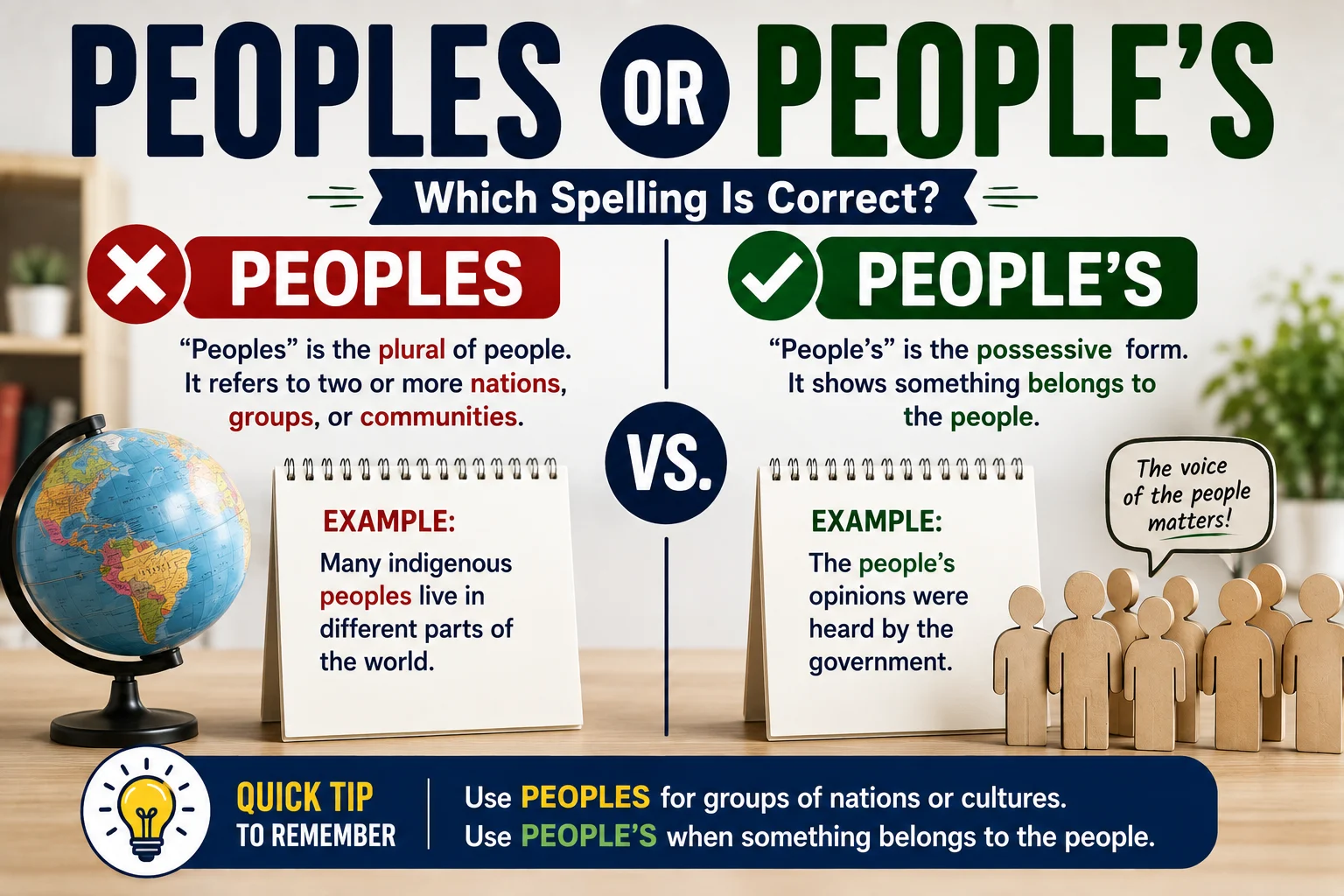
peoples is the plural of people in a special context, while people’s is the possessive form of people. In most everyday writing, people’s shows that something belongs to or relates to people.
Have you ever stopped while writing a sentence and wondered, “Should I write peoples or people’s?” This small apostrophe can change the meaning of a sentence.
For example, people’s opinions means the opinions of people. But peoples of the world means different groups or nations of people.
This is a common problem for students, English learners, writers, and even careful editors. The two forms look almost the same, but they have different jobs. One is mainly a plural noun, while the other is a possessive form.
Understanding this difference can make your writing much clearer. It also helps you avoid one of the most common apostrophe mistakes in English.
This guide explains peoples or people’s in simple English. You will learn their meanings, origins, correct uses, common mistakes, real-world examples, and the differences between them. By the end, choosing the right form should feel easy.
peoples or people’s – Quick Answer
The words peoples and people’s are both correct, but they do not mean the same thing.
People’s
People’s is usually the possessive form of people. It means belonging to people or connected with people.
Examples:
- People’s opinions can change over time.
- We should respect people’s rights.
- The law protects people’s privacy.
Here, the apostrophe shows possession or connection.
Peoples
Peoples is the plural form of people when referring to different ethnic, cultural, national, or social groups.
Examples:
- The museum celebrates the peoples of Africa.
- Many Indigenous peoples have unique traditions.
- The history of different peoples is worth studying.
So, the quick rule is:
people’s = belonging to or relating to people
peoples = different groups of people
The Origin / Background of peoples or people’s
The difference comes from the history and grammar of the word people.
The word people came into English through Old French pople or peuple, which came from Latin populus, meaning “people” or “population.”
Over time, people became the normal English word for human beings considered as a group.
The plural form is unusual because people itself is already a plural noun in its most common meaning.
For example:
- One person
- Two people
- Many people
We normally do not say peoples when simply talking about several human beings.
However, English uses peoples when the focus is on separate groups.
For example:
The peoples of the region have different languages.
The apostrophe in people’s has a different purpose. It marks possession or association.
Compare:
- People need clean water.
- People’s need for clean water is serious.
- Different peoples have different traditions.
The apostrophe is therefore not a spelling variation. It changes the grammatical function of the word.
peoples or people’s Explained — Key Differences
The easiest way to understand these forms is to look at what you are trying to say.
| Term | Meaning | When to Use | Region/Context |
|---|---|---|---|
| people | More than one person | General plural | Standard English |
| people’s | Belonging to or relating to people | Possession or association | All major varieties of English |
| peoples | Different groups of people | Ethnic, cultural, national, or social groups | Formal, academic, historical contexts |
| person’s | Belonging to one person | Singular possession | Standard English |
| persons | More than one individual person | Formal or legal contexts | Legal and official English |
When to use people’s
Use people’s when you can replace it with a phrase such as “of the people.”
For example:
People’s rights must be protected.
This means:
The rights of the people must be protected.
Another example:
People’s choices affect society.
This means:
The choices of people affect society.
When to use peoples
Use peoples when you mean separate populations or communities.
For example:
The traditions of the world’s peoples are diverse.
This refers to different groups, not simply a large number of individuals.
The word is common in discussions about:
- Indigenous communities
- ethnic groups
- nations
- cultures
- historical populations
- language groups
A useful test
Ask yourself:
Am I talking about possession or connection?
If yes, use people’s.
Am I talking about separate groups?
If yes, use peoples.
Which Version / Approach Should You Use?
Your choice depends on the meaning of your sentence.
For beginners and students
Use people’s when you want to show that something belongs to or concerns people.
Examples:
- people’s lives
- people’s homes
- people’s opinions
- people’s needs
- people’s rights
Use peoples only when you clearly mean different groups.
For academic writers
Both forms can be correct.
Academic writing often uses peoples when discussing cultures, ethnic groups, Indigenous communities, or historical populations.
For example:
The study examines the traditions of several Indigenous peoples.
But when discussing ownership or general human concerns, use people’s:
The research focuses on people’s attitudes toward education.
For global and general writing
People’s is much more common in everyday English.
If you mean “belonging to people,” choose people’s.
If you mean “different groups of people,” choose peoples.
Do not add the apostrophe just because the word ends in an “s” sound. The apostrophe has a grammatical purpose.
Common Mistakes with peoples or people’s
Mistake 1: Using peoples for ordinary plural people
❌ Many peoples attended the event.
✅ Many people attended the event.
If you simply mean several human beings, use people.
Mistake 2: Removing the apostrophe from people’s
❌ Peoples rights should be protected.
✅ People’s rights should be protected.
Here, the meaning is “the rights of people,” so the apostrophe is needed.
Mistake 3: Using people’s for different groups
❌ The traditions of many people’s are different.
✅ The traditions of many peoples are different.
The sentence refers to different cultural or ethnic groups. Therefore, peoples is the better choice.
Mistake 4: Confusing people’s with persons
❌ Several people’s were interviewed.
✅ Several people were interviewed.
People’s is possessive. It cannot normally replace the plural noun people.
Mistake 5: Using peoples’ incorrectly
The form peoples’ can also be correct. It is the plural possessive form of peoples.
For example:
The peoples’ traditions were carefully recorded.
This means the traditions belonging to several distinct peoples.
So there are three useful forms:
- people’s = belonging to people
- peoples = different groups of people
- peoples’ = belonging to different groups of people
peoples or people’s in Real-World Examples
Seeing these forms in context makes the difference easier to remember.
Professional email
We value our customers’ feedback and respect people’s privacy.
Here, people’s means the privacy belonging to people.
News headline or article
New Research Explores the Traditions of Indigenous Peoples
Here, peoples refers to distinct Indigenous groups.
Social media post
We should listen to people’s concerns before making major changes.
The word describes concerns held or expressed by people.
Formal report
The project aims to protect the rights of Indigenous peoples.
The writer is referring to distinct communities or groups.
Another everyday example
People’s lives can change quickly after a natural disaster.
Here, the sentence refers to the lives of people.
Compare it with:
The histories of different peoples can teach us a great deal.
This sentence refers to separate cultural or social groups.
peoples or people’s — Data, Trends & Usage
Searches for peoples or people’s are mainly informational. People often search this phrase when checking an apostrophe, plural form, or grammar rule.
The confusion is especially common among English learners because people already has an unusual plural form. Learners may naturally assume that peoples is simply another way to say “many people.”
In everyday English, people’s is much more likely to appear when the word shows possession or connection.
For example:
- people’s homes
- people’s opinions
- people’s lives
- people’s choices
- people’s rights
The word peoples has a narrower use. It appears more often in academic, historical, cultural, political, and legal discussions.
You may see it in phrases such as:
- Indigenous peoples
- peoples of the world
- ancient peoples
- different peoples
- native peoples
This matters for SEO and professional writing because using the wrong form can change the meaning of your content. A search engine may understand the words, but your readers still need the sentence to be grammatically clear.
The best strategy is simple: choose the form based on meaning, not appearance.
Standalone Comparison Table
| Term/Variant | Meaning | Region/Context | Best Used When |
|---|---|---|---|
| people | More than one person | Everyday English | Talking about several people |
| people’s | Belonging to people | All English varieties | Showing possession or connection |
| peoples | Separate groups of people | Academic, cultural, historical | Discussing distinct groups |
| peoples’ | Belonging to separate groups | Formal or academic | Showing possession by several peoples |
| person | One human being | All English varieties | Talking about one individual |
| person’s | Belonging to one person | All English varieties | Showing singular possession |
| persons | Individual people | Legal and formal contexts | Formal or legal writing |
Frequently Asked Questions
Q: What does people’s mean?
A: People’s is the possessive form of people. It usually means something belongs to, concerns, or is connected with people. For example, people’s rights means “the rights of people.”
Q: What does peoples mean?
A: Peoples means different groups of people. It is often used for distinct ethnic, cultural, national, or Indigenous groups.
Q: Which is correct, peoples or people’s?
A: Both are correct, but they have different meanings. Use people’s for possession or connection, and peoples for separate groups of people.
Q: Is people’s acceptable in formal writing?
A: Yes. People’s is fully correct in formal writing when you need a possessive form. For example, people’s rights is standard English.
Q: Is peoples the plural of people?
A: Not in normal everyday use. People is already the usual plural of person. Peoples is used when referring to several distinct groups of people.
Q: What is the difference between people’s and peoples’?
A: People’s usually refers to possession by people in general. Peoples’ is the possessive form of peoples, so it refers to something belonging to several distinct groups.
For example:
People’s rights matter.
But:
The peoples’ traditions were recorded.
Q: Can I use peoples in everyday conversation?
A: You can, but it is less common than people. Use peoples when you mean distinct groups, such as different cultural or ethnic communities.
Conclusion
The difference between peoples or people’s becomes simple once you focus on meaning.
Use people’s when you mean belonging to people or connected with people. Examples include people’s rights, people’s opinions, and people’s lives.
Use peoples when you mean different groups of people. This form is common in cultural, historical, academic, and Indigenous contexts.
Remember one more form: peoples’. It shows possession by several distinct peoples.
The most common mistake is treating peoples as the normal plural of people. In ordinary English, simply use people for more than one person.
A quick memory trick can help:
people’s = possession
peoples = groups
Once you learn this small difference, your writing will become clearer and more accurate. When you are unsure, ask what you mean first. If you mean ownership or connection, choose people’s. If you mean separate groups, choose peoples.
Bookmark this guide so you never second-guess peoples or people’s again.