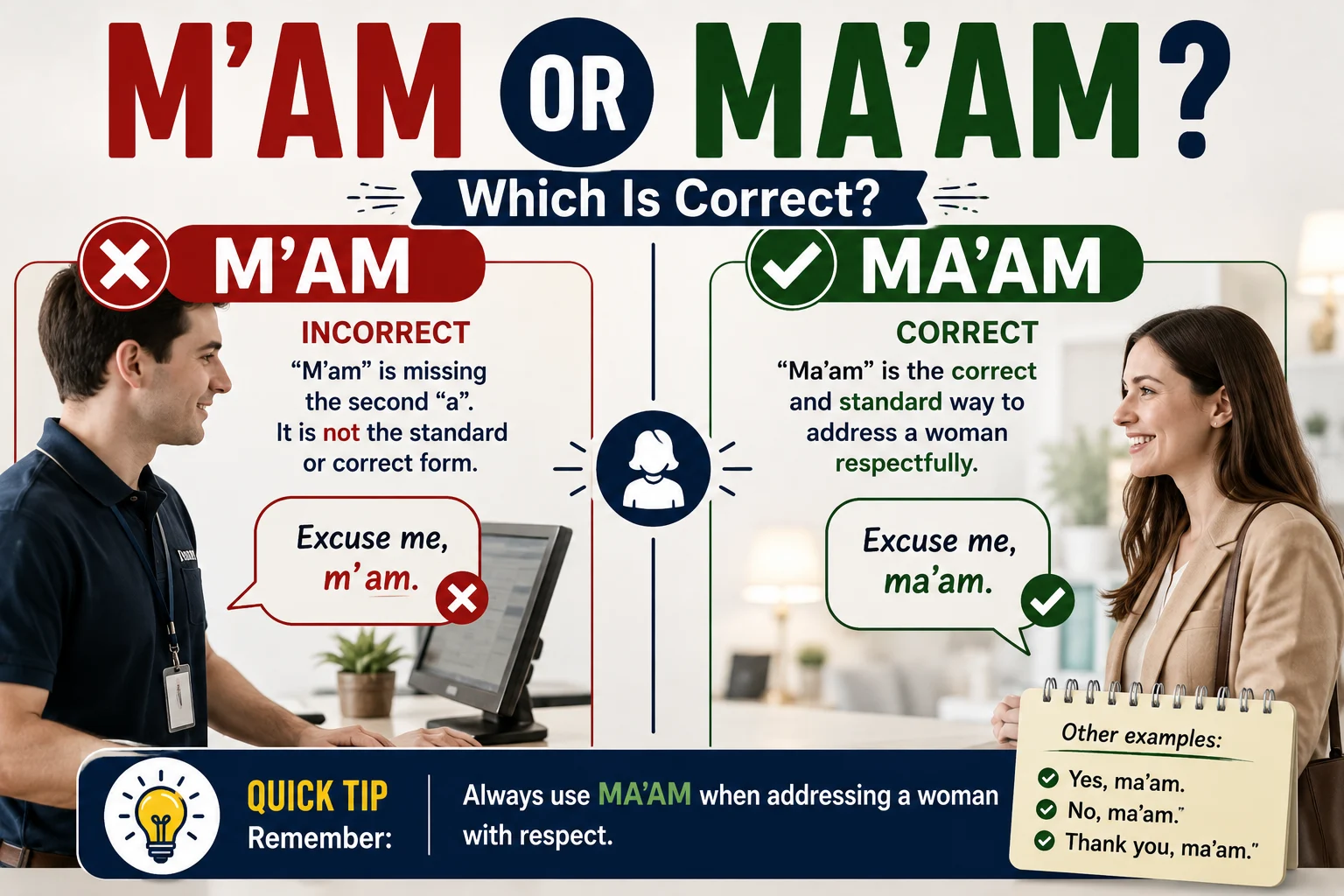
Ma’am is the standard spelling of the polite form of madam. M’am is an uncommon variant and is generally not the best choice in modern English.
Have you ever typed m’am or ma’am and stopped to check which one looks right? You are not alone. This is a small spelling question, but the apostrophe can make a big difference.
I have seen this confusion often in formal writing, school work, emails, and dialogue. A writer may know that ma’am is a short form of madam, yet the spelling can still feel unusual. Why does the word have an apostrophe? Why is there no second d? And is m’am also correct?
The answer is simple once you understand where the word comes from. Ma’am is the standard modern form. It is used as a polite way to address a woman, especially in formal, respectful, or service situations.
This guide explains m’am or ma’am in clear English. You will learn the correct spelling, history, pronunciation, common mistakes, real-world examples, and when to use the word. By the end, you will know which form to choose with confidence.
m’am or ma’am – Quick Answer
The correct and standard modern spelling is ma’am.
It is a shortened form of madam, a polite form of address for a woman.
Correct
Ma’am, your table is ready.
Excuse me, ma’am, you dropped your phone.
Less common variant
M’am
You may find m’am in older texts or in some historical or informal uses. However, it is not the normal spelling used in modern standard English.
The simple rule
Use “ma’am” in modern English.
The apostrophe shows that letters have been left out when madam is shortened.
madam → ma’am
This is why the apostrophe matters.
The Origin / Background of m’am or ma’am
The word ma’am comes from madam.
Madam entered English through French madame, which means roughly “my lady.” It was formed from French ma (“my”) and dame (“lady” or “woman”).
English later developed the shortened form ma’am.
When a word is shortened by leaving out letters, English often uses an apostrophe to show the missing letters.
For example:
- do not → don’t
- I am → I’m
- madam → ma’am
The spelling ma’am therefore makes sense when you see its history.
The word madam contains the letters madam. The shorter form removes part of the word and uses an apostrophe to mark the change.
Why does it sound different from madam?
In normal speech, ma’am is usually pronounced as one short syllable. In many varieties of English, it sounds approximately like “mam” or “mahm.”
The pronunciation can vary by accent.
The important point is that ma’am is a shortened form of madam, not a completely unrelated word.
What about m’am?
M’am can be found in some older writing and in attempts to represent speech. However, it is much less common than ma’am in modern standard English.
For everyday writing, school assignments, professional communication, and most published content, ma’am is the safer and more widely accepted choice.
m’am or ma’am Explained — Key Differences
The two forms are closely related, but they do not have equal status in modern usage.
| Term | Meaning | When to Use | Region/Context |
|---|---|---|---|
| ma’am | Short form of madam | Polite address to a woman | Modern standard English |
| m’am | Variant of ma’am | Mainly older, historical, or stylized writing | Uncommon modern usage |
| madam | Formal form of address | Formal speech or writing | Standard English |
| Miss | Title for a girl or unmarried woman | Before a name or in direct address | Modern English |
| Mrs. | Title traditionally used for a married woman | Before a surname | Modern English |
| Ms. | Neutral adult female title | Before a surname | Modern professional English |
Ma’am
Ma’am is the normal modern spelling.
You may hear it when:
- speaking politely to a woman
- addressing a customer
- speaking to a teacher
- addressing an officer
- speaking respectfully to an older woman
- using formal dialogue
Examples:
Yes, ma’am.
Ma’am, may I ask you a question?
Thank you, ma’am.
M’am
M’am is not normally the preferred spelling today.
It may appear in older books, historical dialogue, or texts that try to reproduce a particular style of speech.
For modern writing, changing m’am to ma’am will usually make your writing look more standard.
Madam
Madam is the full form.
It can sound more formal than ma’am.
For example:
Dear Madam,
This is possible in formal correspondence, although modern business letters often use a person’s name when it is known.
Compare:
Ma’am, may I help you?
with:
Dear Madam,
The first is direct speech. The second is a formal written address.
Which Version / Approach Should You Use?
For students
Use ma’am.
If you are writing a school assignment, dialogue, story, or email, ma’am is the standard choice.
Example:
“Yes, ma’am,” the student replied.
Avoid using m’am unless your teacher or source specifically requires an older style.
For professional writing
Use ma’am when you need a polite form of direct address.
For example:
Thank you for your time, ma’am.
However, think about your audience. In some workplaces, using a person’s name or professional title may sound more natural.
For example:
Thank you, Dr. Ahmed.
can be more specific than:
Thank you, ma’am.
For American English
Ma’am is especially common in American English.
It is widely heard in polite speech, customer service, schools, the military, and other formal settings.
Example:
Ma’am, please wait here.
For British English
Ma’am is also understood and used in British English, but its frequency and social use can differ by setting.
In some situations, madam, a person’s name, or a professional title may be preferred.
For global English
If you need one spelling that is clear and widely recognized, choose:
ma’am
It is the best general-purpose option.
Common Mistakes with m’am or ma’am
Mistake 1: Writing m’am in normal modern text
❌ Thank you, m’am.
✅ Thank you, ma’am.
Why? Ma’am is the standard modern spelling.
Mistake 2: Writing maam without the apostrophe
❌ Thank you, maam.
✅ Thank you, ma’am.
The apostrophe helps show that the word is a shortened form of madam.
Mistake 3: Writing mam when you mean madam
❌ Excuse me, mam, can you help me?
✅ Excuse me, ma’am, can you help me?
Mam can be a separate word in some varieties of English. It is not the standard spelling of the shortened form of madam.
Mistake 4: Using madam and ma’am in the same way
Both can be polite, but they are not always interchangeable.
Ma’am, your order is ready.
This sounds natural in direct speech.
Dear Madam,
This can appear in formal correspondence.
Mistake 5: Adding an unnecessary apostrophe
❌ Ma’ams were waiting outside.
If you mean more than one woman addressed as ma’am, the plural can be ma’ams in contexts where that plural is needed.
However, it is often better to rewrite the sentence for clarity.
m’am or ma’am in Real-World Examples
Context makes the correct spelling easier to remember.
Professional email
Dear Ms. Khan,
Thank you for contacting us. We are happy to assist you.
In professional email, using the person’s name is often better than ma’am.
But in a direct reply:
Yes, ma’am. We can arrange that for you.
Here, ma’am works as a polite form of address.
News article
“Yes, ma’am,” the witness told the court.
News writing may use ma’am when quoting someone’s exact words.
Social media post
A simple “thank you, ma’am” can show respect.
The word works naturally when discussing polite speech.
Formal document
A formal document may use madam rather than ma’am, especially in a traditional form of address.
For example:
Madam Chair, the meeting can now begin.
In modern professional settings, titles such as Chair, Professor, or Dr. may be more suitable when known.
Everyday conversation
“Can I help you, ma’am?”
“Yes, ma’am.”
“Excuse me, ma’am. Is this seat free?”
These examples show the most common use: polite direct address.
m’am or ma’am — Data, Trends & Usage
Searches for m’am or ma’am are mainly informational. People usually search the phrase because they want to confirm the correct spelling.
The question is especially common among students, English learners, writers, and people who hear the word more often than they see it written.
The spelling ma’am is far more useful for modern standard writing. It appears in dialogue, customer service language, formal speech, fiction, and many forms of American English.
The variant m’am has a much smaller role. Readers may encounter it in older literature or stylized writing, but it is not the form you should normally choose for modern English.
This distinction matters because spelling tools and search engines may recognize both forms, but readers often expect ma’am.
If your goal is clear, modern, professional English, the choice is easy:
Choose ma’am.
Why is the topic still searched?
The spelling looks unusual because the apostrophe does not appear where many learners expect it. Some people also hear the word as “mam” and wonder whether the written form should match the sound.
That makes ma’am a common spelling question even though the word itself is familiar.
Standalone Comparison Table
| Term/Variant | Meaning | Region/Context | Best Used When |
|---|---|---|---|
| ma’am | Short form of madam | Modern English | Polite direct address |
| m’am | Older or uncommon variant | Historical or stylized text | Reproducing an older style |
| madam | Full form | Formal English | Formal address |
| Miss | Female title | Modern English | Before a name or in suitable direct address |
| Ms. | Adult female title | Professional English | Before a surname |
| Mrs. | Traditional married-woman title | Modern English | Before a surname when appropriate |
Frequently Asked Questions
Q: What does ma’am mean?
A: Ma’am is a shortened form of madam. It is used as a polite or respectful way to address a woman.
Q: Is ma’am or m’am correct?
A: Ma’am is the standard modern spelling. M’am exists as an uncommon or older variant, but it is not the preferred form for most modern writing.
Q: How do you use ma’am correctly?
A: Use ma’am when speaking directly to a woman in a polite or respectful way. For example: “Excuse me, ma’am.”
Q: Is ma’am acceptable in formal writing?
A: Yes. Ma’am is grammatically correct. However, in formal business writing, a person’s name or professional title may sound more natural.
Q: Where does ma’am come from?
A: Ma’am comes from madam, which entered English through French madame. The shortened form developed as a polite form of direct address.
Q: Why does ma’am have an apostrophe?
A: The apostrophe shows that letters have been removed from madam. It is similar to don’t from do not.
Q: Can I use m’am in modern writing?
A: You can encounter m’am in older or stylized writing, but it is not the usual modern spelling. For school, business, and general writing, use ma’am.
Conclusion
The choice between m’am or ma’am is easier than it first appears. For modern English, ma’am is the clear winner.
Ma’am is the shortened form of madam. It is used as a polite way to address a woman, especially in direct speech. The apostrophe shows that part of the original word has been removed.
M’am is a much less common variant. You may see it in older writing or in text that tries to copy a particular historical style. It is not the form most writers should choose today.
Remember three simple points:
- ma’am = standard modern spelling
- m’am = uncommon or older variant
- madam = full form
If you are writing an email, school assignment, article, story, or professional text, ma’am is usually the safest choice.
Now you know exactly how to use m’am or ma’am. Bookmark this guide so you never have to second-guess the spelling again.