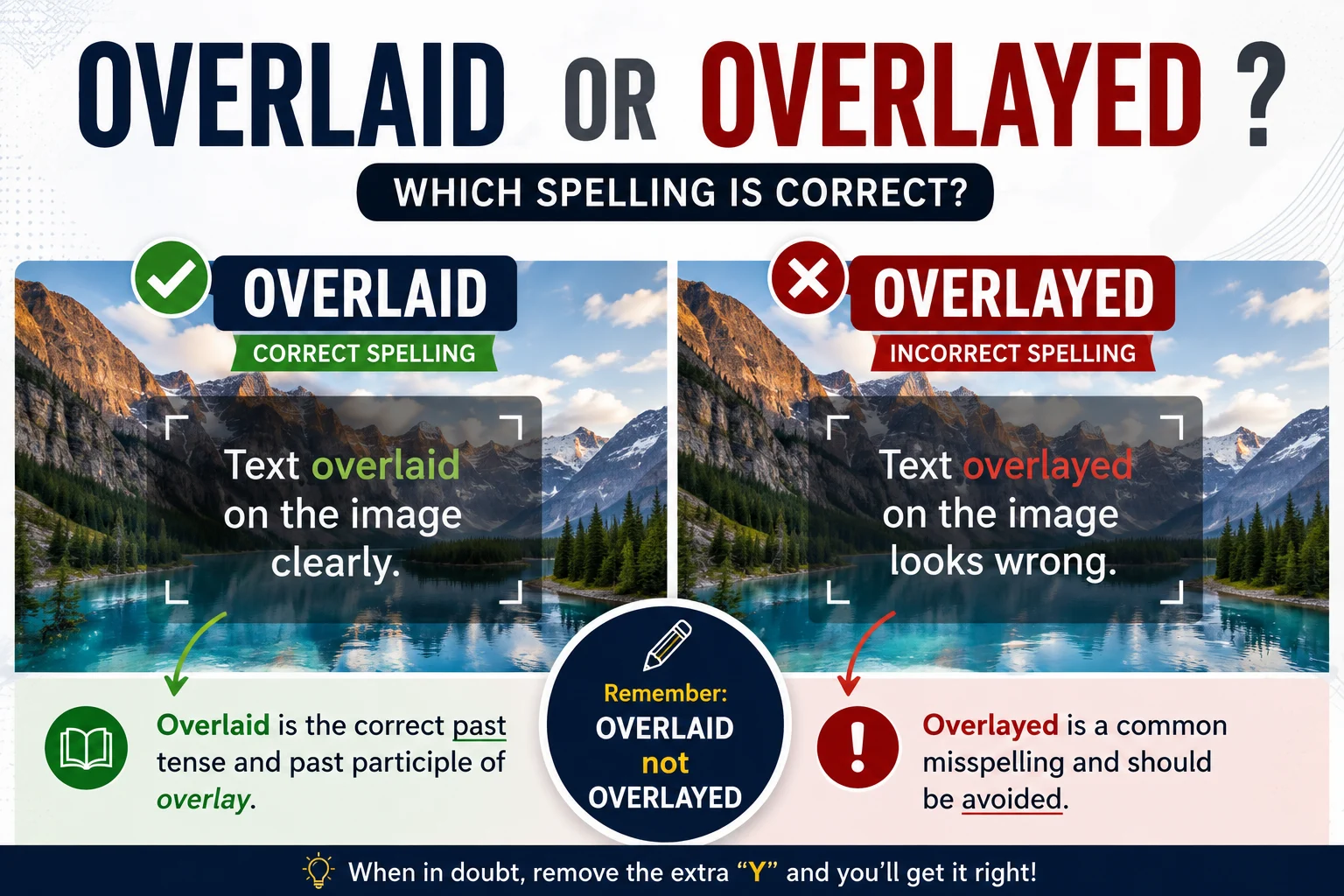
“Overlaid” is the standard past tense and past participle of “overlay,” while “overlayed” is generally considered incorrect.
Have you ever wondered whether overlaid or overlayed is the correct spelling? Both forms may appear online, especially in writing about images, text, technology, design, or information placed on top of something else. This can make the choice confusing.
The short answer is that overlaid is the standard and traditional past tense and past participle of overlay. Overlayed is also used, especially in modern technical and digital writing, but it is less common in general English.
For example, you can say, “The designer overlaid text on the image.” You may also see “The text was overlayed on the video,” particularly in software or web-related contexts.
The word overlay means to put one thing over another. Its past form can follow the older irregular pattern overlay → overlaid. However, English also often creates past forms by adding -ed, which helps explain the growing use of overlayed.
This guide explains overlaid or overlayed, including their meanings, origins, British and American usage, common mistakes, everyday examples, and the best choice for clear writing.
Overlaid or Overlayed – Quick Answer
Overlaid is the standard traditional past tense and past participle of overlay.
Overlayed is also used, especially in technical, digital, and informal contexts.
Example 1
The designer overlaid the logo on the photograph.
Example 2
The map was overlaid with additional information.
Example 3
Text was overlayed on the video.
For general, formal, and polished writing, overlaid is usually the safer choice.
Easy rule
Remember:
overlay → overlaid
If you are writing a formal article, academic paper, business document, or general English text, overlaid is usually preferred.
The Origin of Overlaid or Overlayed
The word overlay is made from over + lay. It means to place or spread one thing over another.
The verb lay has an old and irregular set of forms:
- lay
- laid
- laid
The related verb overlay traditionally follows this pattern:
- overlay
- overlaid
- overlaid
This is why overlaid has been the established form for a long time.
However, English speakers often create past-tense forms by adding -ed. Because overlay ends in a way that looks like a regular verb, overlayed developed as an alternative.
Modern technology has also helped increase the use of overlayed. People often talk about text, graphics, captions, images, filters, and other elements being placed over videos or digital content.
As a result, both forms can be found, but overlaid remains the traditional standard form.
British English vs American English Spelling
There is no major British-versus-American spelling difference between overlaid and overlayed.
Both British and American English use overlaid as the traditional form. Overlayed can also appear, especially in technical or digital contexts.
| Version | Spelling | Region | Example Sentence |
|---|---|---|---|
| Traditional English | overlaid | UK, US, Commonwealth | The image was overlaid with text. |
| Alternative form | overlayed | UK, US, especially technical contexts | The text was overlayed on the image. |
| Present tense | overlay | UK, US, Commonwealth | We overlay the image with text. |
| Past participle | overlaid | UK, US, Commonwealth | The map was overlaid with data. |
The key point is that overlaid is not a British spelling while overlayed is an American spelling. The difference is mainly about verb formation, usage, and style.
Which Spelling Should You Use?
Your choice depends on the type of writing and your audience.
US audience
For American readers, overlaid is the safest choice in general and formal writing.
The graphic was overlaid on the photograph.
Overlayed may appear in software, design, and technology writing, but it is not required simply because the audience is American.
UK/Commonwealth audience
Use overlaid for standard, formal English.
The image was overlaid with a transparent pattern.
The same form works well in British English and other varieties that follow British-style usage.
Global/SEO audience
For global content, overlaid is usually the best primary choice because it is widely recognized and follows the traditional verb pattern.
If your article is about software, video editing, graphic design, or web development, you may encounter overlayed in industry-specific writing. If you use it, make sure it matches the terminology and style of your source or publication.
Common Mistakes with Overlaid or Overlayed
Mistake 1: Assuming overlayed is always wrong
Overlayed is used in modern English, especially in technical contexts.
Better understanding:
Overlaid is the traditional standard form.
Overlayed is an accepted alternative in some modern usage.
Mistake 2: Using “overlayed” in formal writing without checking style
For formal writing, overlaid is usually the safer option.
Preferred:
The image was overlaid with a transparent layer.
Mistake 3: Treating overlay like a regular verb
Because many verbs simply add -ed, writers may assume:
overlay + ed = overlayed
But the traditional form follows lay → laid, giving:
overlay → overlaid
Mistake 4: Confusing “overlay” with “overlap”
Overlay means one thing is placed over another.
Overlap means two things partly cover the same area.
For example:
The designer overlaid text on the image.
The two shapes overlap.
Mistake 5: Mixing forms in one document
Try not to switch randomly between overlaid and overlayed.
If your style guide prefers overlaid, use it consistently.
Overlaid or Overlayed in Everyday Examples
Emails
The revised image has been overlaid with the new company logo.
We overlaid the customer data on the map.
News headlines
New Data Overlaid on Satellite Images
Graphics Overlaid During Live Broadcast
News writing often uses overlaid because it is concise and widely understood.
Social media
Text overlaid on the photo makes the message easier to read.
I overlaid a quote on the image before posting it.
In casual digital writing, you may also see overlayed.
Formal writing
The researchers overlaid the survey results onto a geographic map.
A second layer of information was overlaid onto the original image.
For academic and professional writing, overlaid is generally the better choice.
Overlaid or Overlayed – Google Trends & Usage
Overlaid is the more established form and appears across many types of English writing. It is common in formal, academic, literary, scientific, and general writing.
Overlayed is often seen in digital and technical contexts. It may appear in discussions about video editing, graphic design, websites, images, user interfaces, and software.
Searchers may type overlaid or overlayed when they notice both forms online and want to know which one is correct. The confusion is understandable because overlayed follows the common English pattern of adding -ed to verbs.
Usage does not show a simple British-versus-American split. Both forms can be found in both varieties of English.
For SEO and general writing, overlaid is usually the strongest choice. If your content is specifically about digital technology, you can explain that overlayed is also used in modern technical writing.
Overlaid vs Overlayed: Quick Comparison
| Word | Status | Common Context | Example |
|---|---|---|---|
| overlaid | Standard traditional form | General and formal English | The image was overlaid with text. |
| overlayed | Alternative modern form | Technical and digital contexts | Text was overlayed on the video. |
| overlay | Base verb | Present tense | We overlay the image with data. |
| overlays | Present tense, third person | General use | The software overlays text on images. |
Separate Comparison Table
| Variation | Correct? | Main Usage | Example |
|---|---|---|---|
| overlaid | Yes | Traditional standard form | The map was overlaid with data. |
| overlayed | Yes, in some usage | Modern technical/digital writing | The text was overlayed on the image. |
| overlay | Yes | Base form | They overlay the design with text. |
| overlays | Yes | Present tense | The program overlays the image. |
| overlaying | Yes | -ing form | She is overlaying text on the photo. |
FAQs About Overlaid or Overlayed
1. Is overlaid or overlayed correct?
Overlaid is the traditional and generally preferred form. Overlayed is also used, especially in modern technical and digital contexts.
2. Is overlaid the past tense of overlay?
Yes. Overlaid is the traditional past tense and past participle of overlay.
3. Is overlayed a real word?
Yes. Overlayed is used in modern English, particularly in technical and digital writing, although overlaid is more established.
4. Should I use overlaid in formal writing?
Yes. Overlaid is usually the safest and most polished choice for formal, academic, and general writing.
5. Is overlaid British or American English?
It is used in both British and American English. There is no strict regional spelling difference.
6. Is overlayed more common in technology?
It can be. Digital writing often uses overlayed when describing text, graphics, filters, or other elements placed over images or videos.
7. Which is better for SEO, overlaid or overlayed?
For general SEO content, overlaid is usually the safer primary form. Use overlayed naturally when discussing alternative technical usage.
Conclusion
The choice between overlaid or overlayed can be confusing because both forms appear in modern English. However, overlaid is the traditional and generally preferred past tense and past participle of overlay.
The verb overlay comes from over + lay and follows the traditional pattern of lay → laid. This gives us overlay → overlaid. The form overlayed developed because English speakers often form past tense verbs by adding -ed, and it is now found in some modern usage.
There is no simple British-versus-American rule here. Both overlaid and overlayed can appear in different types of English. Still, overlaid is the safer choice for formal, academic, professional, and general writing.
If you are writing about images, maps, videos, graphics, or data, overlaid is usually a clear and polished choice. In technical or digital contexts, you may encounter overlayed, but check the style of your publication or organization.
The easiest rule to remember is:
General/formal English → overlaid
Some modern technical usage → overlayed
When in doubt, choose overlaid.