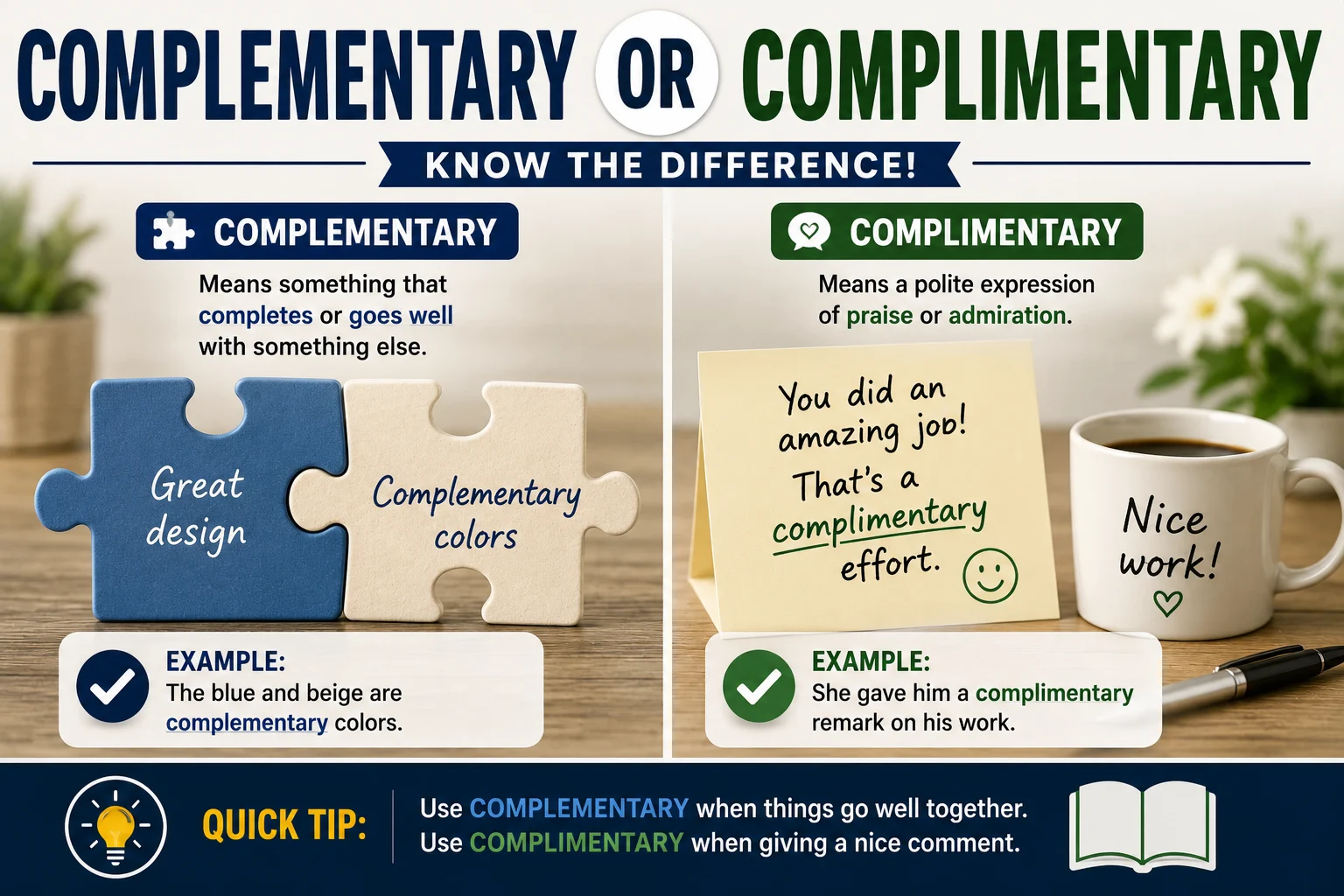
Complementary means something that completes or works well with another thing, while complimentary means free of charge or expressing praise.
One small letter can change the meaning of an English word. This is especially true with complementary or complimentary. These two words look almost the same and sound very similar, so it is easy to mix them up.
Both complementary and complimentary are correct English words, but they have different meanings. Complementary describes things that work well together, complete each other, or improve each other. Complimentary usually means something is given free of charge or expresses praise.
For example, two colors that look good together are complementary. A hotel may offer complimentary breakfast, meaning the breakfast is free. Someone can also give you a complimentary comment, meaning they praise you.
Knowing the difference is important in emails, business writing, marketing, travel, and everyday communication. Using the wrong word can change the meaning of your sentence.
This guide explains complementary or complimentary in simple English. You will learn their meanings, origins, spelling differences, common mistakes, everyday examples, and easy ways to remember which word to use.
Complementary or Complimentary – Quick Answer
Both complementary and complimentary are correct, but they have different meanings.
- Complementary = completing, matching, or working well together.
- Complimentary = free of charge or expressing praise.
Examples
- The two colors are complementary.
- The hotel offers complimentary breakfast.
- She gave me a complimentary comment about my work.
Easy Tip:
Complementary = completes or matches
Complimentary = free or praise
The Origin of Complementary or Complimentary
The two words come from the related word complement and the verb compliment, which developed different meanings over time.
Complementary comes from complement, which means something that completes or improves another thing. The word ultimately comes from Latin complēre, meaning “to fill up” or “complete.”
Complimentary is related to compliment, meaning an expression of praise. It also developed a second meaning: something provided free of charge.
The spelling difference is small but meaningful. Complementary contains e after the l, while complimentary contains i.
A simple way to remember the difference is to connect complement with complete. If something completes or matches something else, choose complementary.
British English vs American English Spelling
There is no major British-American spelling difference for these words. Both varieties use complementary and complimentary with the same meanings.
| Version | Spelling | Region | Example Sentence |
|---|---|---|---|
| Completing or matching | Complementary | US & UK | The colors are complementary. |
| Free of charge | Complimentary | US & UK | Guests receive complimentary drinks. |
| Expressing praise | Complimentary | US & UK | She was complimentary about the service. |
Which Spelling Should You Use?
US Audience
Use complementary when something completes, matches, or works well with something else.
Use complimentary when something is free or expresses praise.
UK/Commonwealth Audience
The same rule applies. British English uses both spellings in the same way.
Global/SEO Audience
Focus on the meaning rather than the region:
- Complementary → completes, matches, or supports.
- Complimentary → free or praising.
For SEO, using both words naturally can help readers who are searching for this common spelling and meaning confusion.
Common Mistakes with Complementary or Complimentary
Here are some common mistakes.
❌ The hotel provides complementary breakfast.
✅ The hotel provides complimentary breakfast.
❌ The two colors are complimentary.
✅ The two colors are complementary.
❌ She was very complementary about my work.
✅ She was very complimentary about my work.
❌ These two services are complimentary to each other.
✅ These two services are complementary to each other.
Remember
If you mean complete or match, use complementary.
If you mean free or praise, use complimentary.
Complementary or Complimentary in Everyday Examples
Emails
- The two services offer complementary benefits.
- Thank you for your complimentary feedback.
- We are pleased to offer you a complimentary consultation.
News Headlines
- New Study Finds Complementary Treatments Work Together.
- Hotel Offers Complimentary Breakfast to Guests.
Social Media
- These colors are perfectly complementary!
- Enjoy your complimentary coffee!
Formal Writing
- The two policies provide complementary support for small businesses.
- The manager was complimentary about the employee’s performance.
- Guests will receive complimentary refreshments during the event.
Complementary or Complimentary – Google Trends & Usage
Both words appear often in online searches because their spelling and pronunciation are very similar.
Complimentary is common in travel, hotels, restaurants, customer service, marketing, and reviews because businesses often provide complimentary services or products. It is also common when people describe praise or positive comments.
Complementary is common in education, science, technology, design, business, mathematics, and everyday descriptions of things that work well together.
Searchers may type complementary or complimentary when they are unsure which spelling fits their sentence. The best solution is to focus on the meaning rather than pronunciation.
For SEO, use both terms naturally. Explain the difference clearly instead of repeating the keyword many times.
Comparison Table
| Feature | Complementary | Complimentary |
|---|---|---|
| Correct English word | ✅ Yes | ✅ Yes |
| Means completing | ✅ Yes | ❌ No |
| Means matching | ✅ Yes | ❌ No |
| Means free | ❌ No | ✅ Yes |
| Means praise | ❌ No | ✅ Yes |
| Common in business | ✅ Yes | ✅ Yes |
| Common in hotels | Sometimes | ✅ Very common |
| British English | ✅ Yes | ✅ Yes |
| American English | ✅ Yes | ✅ Yes |
| Memory clue | Complete | Compliment |
FAQs
Is it complementary or complimentary?
Both are correct. Complementary means completing or matching, while complimentary means free or expressing praise.
What does complementary mean?
Complementary describes things that complete, support, or work well with each other.
What does complimentary mean?
Complimentary can mean free of charge or showing praise.
Is complimentary breakfast free?
Yes. In phrases such as complimentary breakfast, complimentary means the breakfast is provided free of charge.
How do I remember complementary vs complimentary?
Think complementary = complete. Think complimentary = compliment or free.
Is there a British and American spelling difference?
No. Both British and American English use complementary and complimentary with the same meanings.
Which word should I use for praise?
Use complimentary. For example: “The manager was complimentary about her work.”
Conclusion
The difference between complementary or complimentary becomes easy when you focus on meaning. Both spellings are correct, but they are used in different situations.
Use complementary when two things complete, match, or support each other. For example, two colors can be complementary, or two services can provide complementary benefits.
Use complimentary when something is given free of charge or when someone expresses praise. A hotel may offer complimentary breakfast, and a manager may be complimentary about an employee’s work.
There is no important difference between British and American English in this case. Both varieties use the same spellings.
The best memory trick is simple: complementary is connected to complete, while complimentary is connected to compliment. If something completes or matches something else, choose complementary. If it is free or expresses praise, choose complimentary.
Once you learn this simple difference, you can confidently use the right word in emails, business writing, social media, schoolwork, and formal documents.