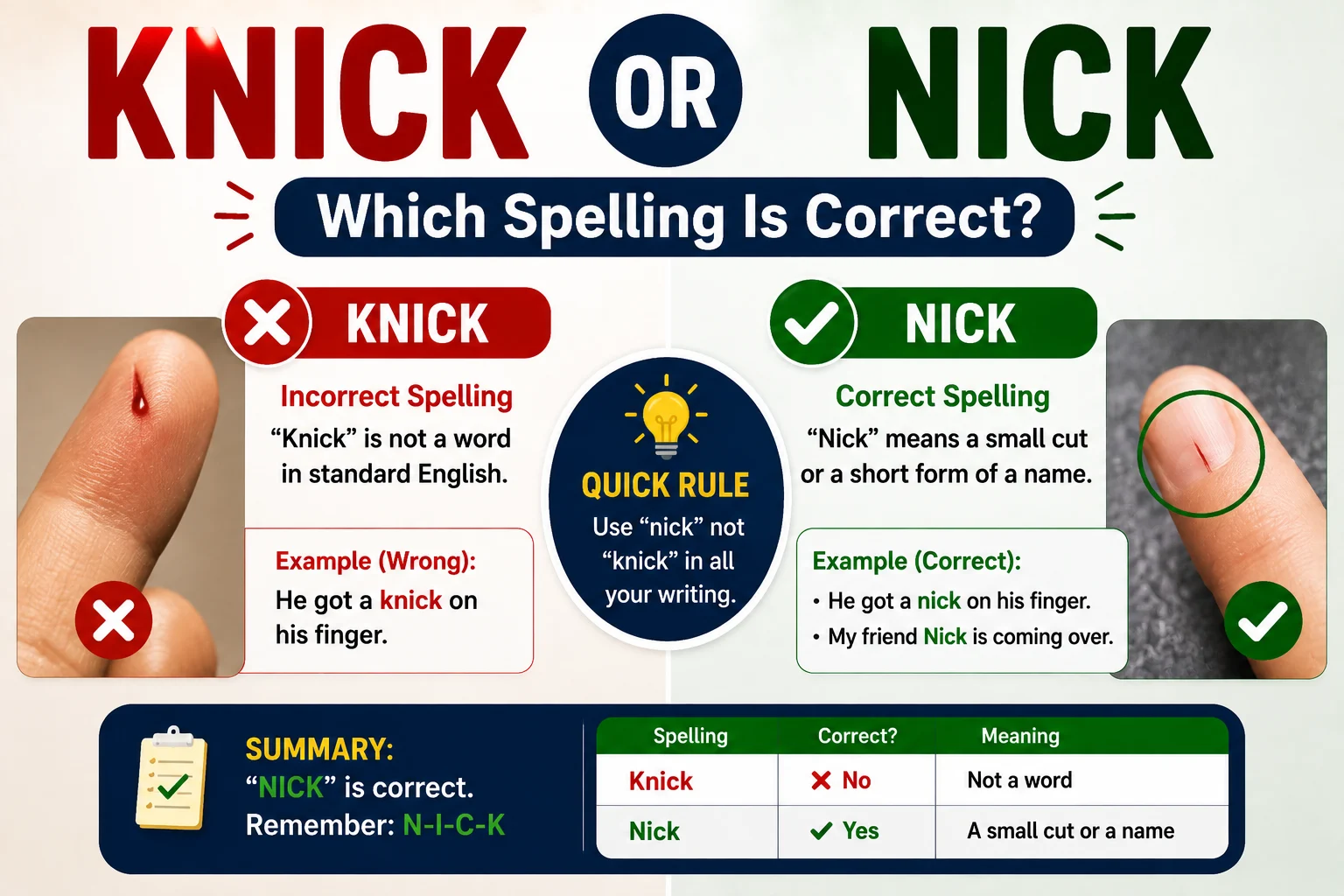
Nick is the standard spelling for a small cut, notch, or a shortened name, while knick is mainly used in the phrase knick-knack and is rarely used on its own.
Have you ever wondered whether you should write knick or nick? Many English learners and even native speakers search for this because the two words sound exactly the same. At first glance, they may seem interchangeable, but they have different meanings and are used in different situations.
Understanding the difference between knick or nick can help you avoid mistakes in writing, school assignments, emails, and everyday conversations. While one spelling is much more common today, the other still appears in certain phrases and older expressions.
This guide explains both words in simple English. You will learn what each word means, where it came from, how British and American English use it, and which spelling you should choose. By the end of this article, you will know exactly when to use knick and when to use nick with confidence.
Knick or Nick – Quick Answer
Nick is the common and correct spelling in most situations.
It usually means:
- A small cut or notch.
- To make a tiny cut.
- A slang word for stealing something.
- A nickname in some contexts.
Knick is much less common. It mainly appears in the phrase knick-knack, which means a small decorative object or ornament.
Examples
- I got a small nick while shaving.
- Be careful not to nick the table with the knife.
- She bought colorful knick-knacks for her living room.
The Origin of Knick or Nick
The word nick has been part of English for hundreds of years. It comes from older Germanic languages and originally referred to a small cut, notch, or mark. Over time, it gained several meanings, including making a small cut, stealing, or finding the perfect moment.
The spelling knick is much rarer. It became well known because of the word knick-knack, which likely developed from older words describing small, decorative objects. Outside this expression, knick is rarely used in modern English.
Because both words are pronounced the same way, many people confuse them when writing.
British English vs American English Spelling
There is no major spelling difference between British and American English for these words.
| Version | Spelling | Region | Example Sentence |
|---|---|---|---|
| Standard English | Nick | US | I put a small nick in the paint. |
| Standard English | Nick | UK | The key left a nick on the door. |
| Fixed Expression | Knick-knack | US & UK | She collects antique knick-knacks. |
Both countries use nick for cuts and other common meanings. Both also use knick-knack for decorative objects.
Which Spelling Should You Use?
US Audience
Use nick unless you are writing the phrase knick-knack.
UK/Commonwealth Audience
The same rule applies. Nick is the standard spelling in everyday English.
Global/SEO Audience
Use nick for most content because it matches common searches and everyday usage. Only use knick when referring to knick-knacks.
Common Mistakes with Knick or Nick
Here are some mistakes people often make.
❌ I got a small knick on my finger.
✅ I got a small nick on my finger.
❌ Don’t knick the wall with the chair.
✅ Don’t nick the wall with the chair.
❌ She bought pretty nick-nacks.
✅ She bought pretty knick-knacks.
❌ He knicked his finger while cooking.
✅ He nicked his finger while cooking.
Knick or Nick in Everyday Examples
Emails
- I accidentally nicked the package while opening it.
- The desk has a small nick, but it still looks good.
News Headlines
- Worker suffers minor nick during repair work.
- Museum displays rare antique knick-knacks.
Social Media
- I got a tiny nick while shaving today.
- My grandmother loves collecting vintage knick-knacks.
Formal Writing
- Inspect the surface for scratches or small nicks before use.
- The exhibit includes handmade knick-knacks from the nineteenth century.
Knick or Nick – Google Trends & Usage
In general, nick is searched and used far more often than knick.
People usually search for nick when talking about:
- Small cuts
- Damage
- Slang meanings
- Nicknames
The word knick is mostly searched by people looking for the phrase knick-knack or checking whether knick is a correct spelling.
English-speaking countries such as the United States, the United Kingdom, Canada, and Australia generally follow the same usage patterns.
Comparison Table
| Feature | Nick | Knick |
|---|---|---|
| Common today | Yes | Rare |
| Means small cut | Yes | No |
| Means make a small cut | Yes | No |
| Used in knick-knack | No | Yes |
| Found in everyday writing | Very common | Rare |
| Best choice in most situations | ✅ Yes | ❌ No |
FAQs
Is it knick or nick for a small cut?
The correct word is nick.
Why do people confuse knick and nick?
They sound the same but have different meanings.
Is knick a real word?
Yes. It mainly appears in the word knick-knack.
Can I use knick instead of nick?
No. Use nick unless you mean knick-knack.
Is nick correct in British English?
Yes. British and American English both use nick.
What does knick-knack mean?
It means a small decorative object, ornament, or souvenir.
Conclusion
The difference between knick or nick is simple once you know their meanings. Nick is the standard spelling and is used for small cuts, tiny marks, making a slight cut, and several other common meanings. It appears in everyday conversations, books, newspapers, emails, and professional writing.
Knick, on the other hand, is rarely used by itself. Most people only see it in the word knick-knack, which refers to small decorative objects or keepsakes. Because the two words sound the same, it is easy to choose the wrong spelling, especially when writing quickly.
If you are talking about a scratch, cut, notch, or minor damage, always choose nick. If you are referring to decorative ornaments or collectibles, use knick-knack. Following this simple rule will make your writing clearer, more accurate, and easier for readers to understand. Remember this difference, and you’ll be able to use both words with confidence.