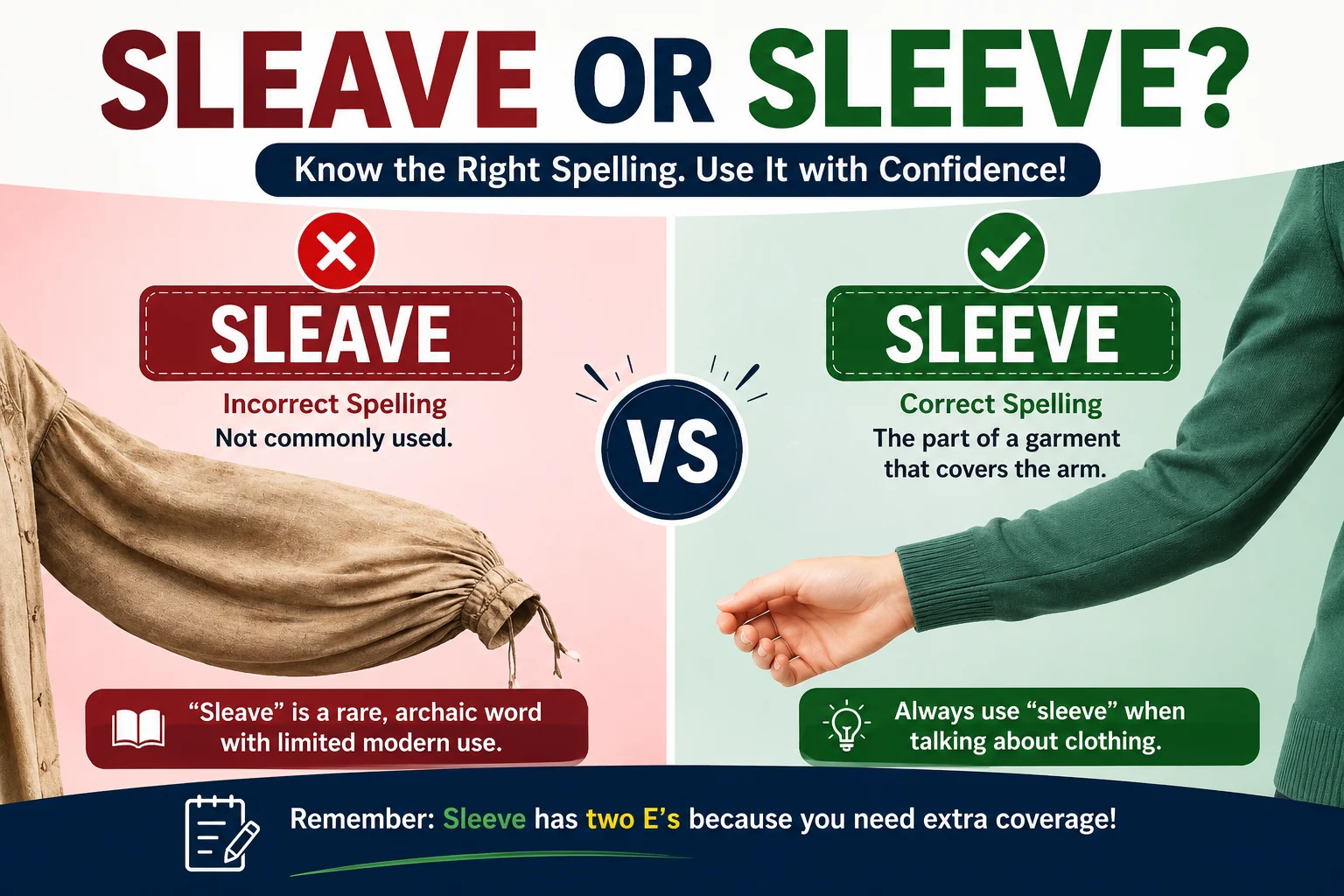
Sleeve is the correct spelling for the part of a garment that covers the arm, while sleave is a rare, archaic word with limited modern use.
Have you ever searched for sleave or sleeve because you weren’t sure which spelling was correct? You’re not alone. These two words look very similar, but they have very different meanings and levels of use. Most people are looking for the clothing word sleeve, while sleave is an extremely rare word that many English speakers never encounter.
The correct choice depends on what you want to say. Sleeve is the standard English word for the part of a shirt, jacket, dress, or coat that covers the arm. It also has several figurative meanings, such as “having something up your sleeve.” Sleave, on the other hand, is an old and uncommon English word meaning untwisted silk or thread. Today, it is mainly seen in historical texts or famous literary works.
In this guide, you’ll learn the difference between sleave or sleeve, their origins, correct usage, common mistakes, and practical examples. By the end, you’ll know exactly which spelling to use in everyday English.
## Sleave or Sleeve – Quick Answer
Sleeve is the correct spelling for modern everyday English.
It means:
- The part of a piece of clothing that covers the arm.
- A protective covering for an object.
- Part of several common English expressions.
Sleave is a rare and old English word. It usually refers to untwisted silk or thread and is almost never used in modern writing.
Examples
- She rolled up her sleeves before washing the dishes.
- My shirt has a torn sleeve.
- He had a clever idea up his sleeve.
## The Origin of Sleave or Sleeve
The word sleeve comes from Old English slēfe, meaning the arm covering of a garment. It has been part of the English language for hundreds of years and remains the standard spelling today.
The word sleave has a different history. It comes from older forms of English and Scots and originally referred to fine, untwisted silk or thread. The word is now considered archaic and is rarely used outside historical writing or literature.
One famous example appears in William Shakespeare’s Macbeth, where sleave refers to tangled threads in the phrase “the sleave of care.”
Because sleave is so uncommon, many people mistakenly think it is simply a misspelling of sleeve.
## British English vs American English Spelling
There is no spelling difference between British and American English.
Both varieties use sleeve.
| Version | Spelling | Region | Example Sentence |
|---|---|---|---|
| Standard English | Sleeve | United States | The jacket has long sleeves. |
| Standard English | Sleeve | United Kingdom | She repaired the torn sleeve. |
| Archaic Word | Sleave | Historical English | The old poem mentioned sleave. |
The spelling sleeve is standard in both regions.
## Which Spelling Should You Use?
US Audience
Use sleeve for clothing, protective covers, and everyday expressions.
UK/Commonwealth Audience
Choose sleeve. It is the accepted spelling throughout the English-speaking world.
Global/SEO Audience
Use sleeve unless you are discussing historical language, Shakespeare, or textile history. It is the spelling readers expect and search for.
## Common Mistakes with Sleave or Sleeve
Many writers accidentally replace sleeve with sleave because the words look similar.
Incorrect vs Correct
❌ My shirt has a torn sleave.
✅ My shirt has a torn sleeve.
❌ Roll up your sleave.
✅ Roll up your sleeve.
❌ He had a trick up his sleave.
✅ He had a trick up his sleeve.
❌ Sleave is the standard spelling for clothing.
✅ Sleeve is the correct spelling for clothing.
## Sleave or Sleeve in Everyday Examples
Emails
“Please make sure the sleeve length matches the measurements.”
News Headlines
“Designer Introduces Jackets with Adjustable Sleeves“
Social Media
“I spilled coffee on my sleeve this morning!”
Formal Writing
“The protective sleeve prevents damage during shipping.”
## Sleave or Sleeve – Google Trends & Usage
Across English-speaking countries, sleeve is overwhelmingly more popular than sleave.
People search for sleeve when looking for clothing, fashion, sewing, sports equipment, document sleeves, or common English expressions.
Searches for sleave are much less common and usually relate to:
- Shakespeare
- Historical literature
- Textile history
- Rare English vocabulary
For everyday communication, sleeve is the correct and expected spelling.
## Comparison Table
| Feature | Sleeve | Sleave |
|---|---|---|
| Dictionary Word | Yes | Yes (Archaic) |
| Standard Modern English | Yes | No |
| Clothing Term | Yes | No |
| Common in Daily Writing | Yes | Rare |
| Used in Literature | Sometimes | Mainly Historical |
| Best for SEO | Yes | Only for historical topics |
## FAQs
Is it sleave or sleeve?
Sleeve is the correct spelling for modern English. Sleave is an old and uncommon word.
Is sleave a real word?
Yes. Sleave is a real but archaic English word that originally referred to untwisted silk or thread.
Why do people confuse sleave and sleeve?
They look very similar, and many people have never seen the rare word sleave before.
Is sleeve correct in British English?
Yes. Both British and American English use sleeve.
What does sleeve mean?
A sleeve is the part of a garment that covers the arm. It can also mean a protective cover or appear in idioms.
When should I use sleave?
Only use sleave when discussing historical texts, Shakespeare, or the original textile meaning.
## Conclusion
Understanding the difference between sleave or sleeve is simple once you know their meanings. Sleeve is the correct and standard English word used for the arm covering of a shirt, jacket, dress, or coat. It also appears in many everyday expressions, such as “up your sleeve,” and is commonly used in fashion, sewing, business, and daily conversations.
Sleave, however, is an archaic English word that refers to untwisted silk or thread. Today, it is rarely used outside historical writing, literature, or discussions about Shakespeare. Although it is a real word, most English learners and native speakers will never need it in everyday communication.
If you are writing emails, articles, school assignments, website content, or social media posts, always choose sleeve unless you are specifically referring to the historical meaning of sleave. Remember this simple rule: use sleeve for modern English and sleave only for historical or literary contexts. This will help keep your writing clear, accurate, and easy to understand.