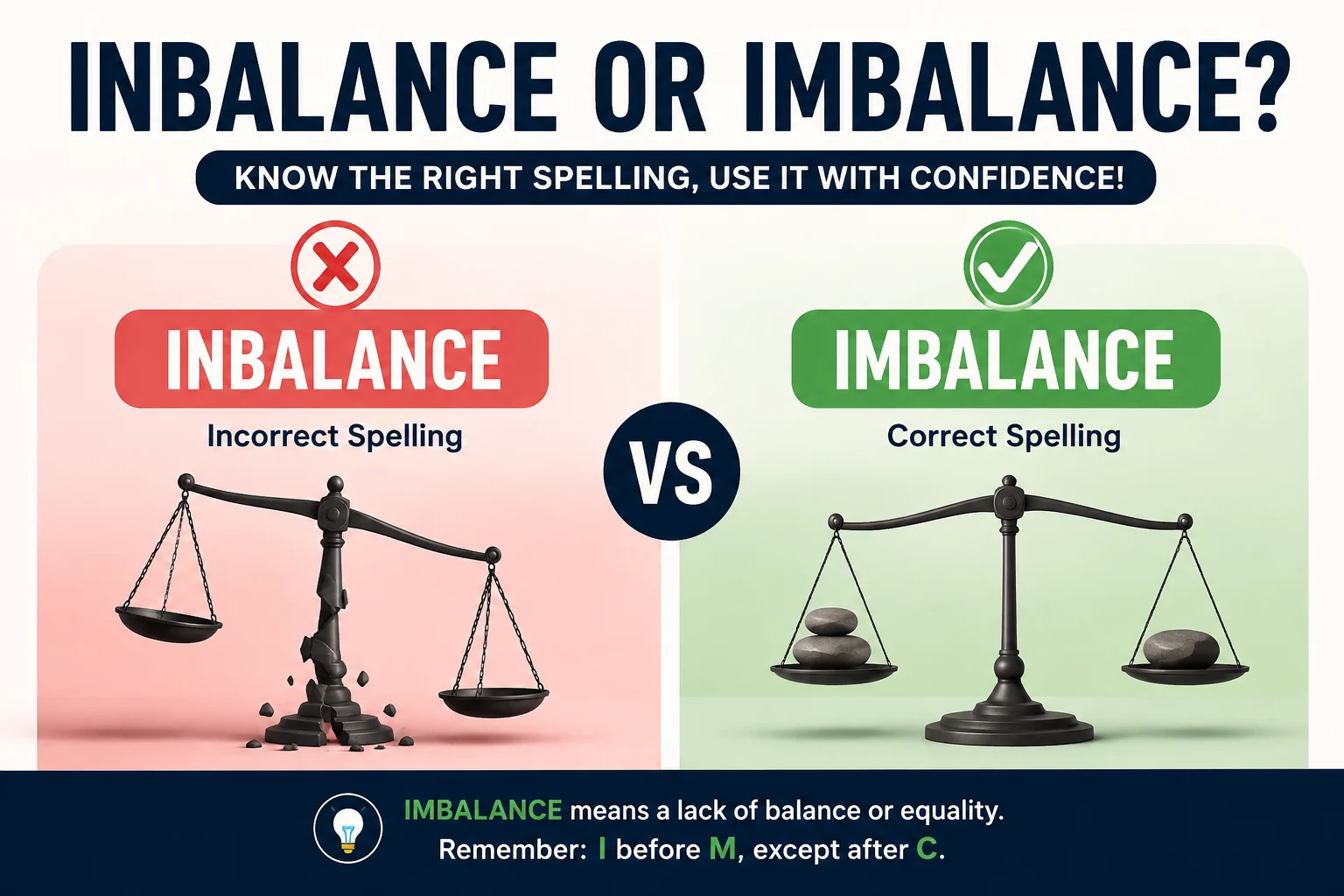
Imbalance is the correct spelling for a lack of balance or equality, while inbalance is a misspelling.
Have you ever wondered whether inbalance or imbalance is the correct spelling? You’re not alone. Many English learners and even native speakers confuse these two words because both seem like they could be correct. Since the prefix in- often means “not,” it’s easy to assume that inbalance is the right form.
However, the correct spelling in standard English is imbalance. This word describes a lack of balance, equality, or stability. It is commonly used when talking about health, finances, sports, business, emotions, and many other topics. Inbalance is not a standard English word and is generally considered a spelling mistake.
In this guide, you’ll learn the difference between inbalance or imbalance, where the word comes from, how it is used in British and American English, common mistakes to avoid, and practical examples from everyday life. By the end, you’ll know exactly which spelling to use in emails, school assignments, business writing, and online content.
## Inbalance or Imbalance – Quick Answer
Imbalance is the correct spelling.
It means a lack of balance, fairness, or equality between two or more things.
Inbalance is not a standard English word and should generally be avoided.
Examples
- The doctor found a hormone imbalance.
- There is an imbalance between supply and demand.
- Poor budgeting can create a financial imbalance.
## The Origin of Inbalance or Imbalance
The word imbalance is formed by adding the prefix im- to the word balance.
The prefix im- is a variation of in-, meaning “not” or “without.” In English, the prefix changes from in- to im- before words that begin with the letters b, m, or p. This makes the word easier to pronounce.
For example:
- possible → impossible
- mature → immature
- balance → imbalance
This spelling rule explains why imbalance is correct and inbalance is not.
## British English vs American English Spelling
There is no spelling difference between British and American English.
Both varieties use imbalance.
| Version | Spelling | Region | Example Sentence |
|---|---|---|---|
| Standard English | Imbalance | United States | The report shows a budget imbalance. |
| Standard English | Imbalance | United Kingdom | The patient has a chemical imbalance. |
| Incorrect Spelling | Inbalance | Not standard | The company faces an inbalance. ✗ |
Both countries follow the same spelling rule.
## Which Spelling Should You Use?
US Audience
Always use imbalance. It is the accepted American English spelling.
UK/Commonwealth Audience
Use imbalance. British and Commonwealth English follow the same spelling.
Global/SEO Audience
Choose imbalance for websites, blogs, academic writing, and professional content. It is the standard dictionary spelling recognized worldwide.
## Common Mistakes with Inbalance or Imbalance
Many people mistakenly write inbalance because they assume the prefix should always be in-.
Incorrect vs Correct
❌ The market has an inbalance.
✅ The market has an imbalance.
❌ She suffers from a hormone inbalance.
✅ She suffers from a hormone imbalance.
❌ There is an inbalance in the team’s performance.
✅ There is an imbalance in the team’s performance.
❌ Inbalance is the correct spelling.
✅ Imbalance is the correct spelling.
## Inbalance or Imbalance in Everyday Examples
Emails
“We need to address the imbalance in the project budget before next week.”
News Headlines
“Experts Warn of Growing Trade Imbalance“
Social Media
“Too much work and not enough rest creates an imbalance in life.”
Formal Writing
“The study identified a significant imbalance between available resources and public demand.”
## Inbalance or Imbalance – Google Trends & Usage
Across English-speaking countries, imbalance is the standard spelling used in books, newspapers, healthcare, education, business, and scientific writing.
People usually search for inbalance because they are unsure of the correct spelling or are learning English spelling rules.
Topics where imbalance commonly appears include:
- Health and medicine
- Economics and finance
- Sports
- Nutrition
- Mental health
- Business management
For everyday and professional writing, imbalance is always the recommended choice.
## Comparison Table
| Feature | Imbalance | Inbalance |
|---|---|---|
| Dictionary Word | Yes | No |
| Standard English | Yes | No |
| Used in Formal Writing | Yes | No |
| Used in Medicine | Yes | No |
| Common Spelling Error | No | Yes |
| Best for SEO | Yes | No |
## FAQs
Is it inbalance or imbalance?
Imbalance is the correct spelling. Inbalance is a common spelling mistake.
Why is it imbalance instead of inbalance?
The prefix in- changes to im- before words beginning with b, m, or p to make pronunciation easier.
Is inbalance a real English word?
No. Standard English dictionaries recognize imbalance, not inbalance.
Is imbalance correct in British English?
Yes. Both British and American English use imbalance.
What does imbalance mean?
Imbalance means a lack of balance, equality, stability, or proportion between things.
How can I remember the correct spelling?
Remember this simple rule: before b, use im-. That’s why balance becomes imbalance.
## Conclusion
Understanding the difference between inbalance or imbalance is straightforward once you know the spelling rule. Imbalance is the correct and accepted English word in both British and American English. It describes a situation where things are unequal, unstable, or not properly balanced. You will often see it in discussions about health, finance, business, education, science, and everyday life.
Inbalance, on the other hand, is not a standard English word. It usually appears because writers mistakenly use the prefix in- instead of im-. The correct form follows a common English spelling rule where in- changes to im- before words beginning with b, m, or p.
If you’re writing an email, article, report, school assignment, or website content, always choose imbalance. Remember the simple tip: before the letter “b,” use “im-“. Following this rule will help you avoid a common spelling mistake and make your writing clearer, more accurate, and more professional.