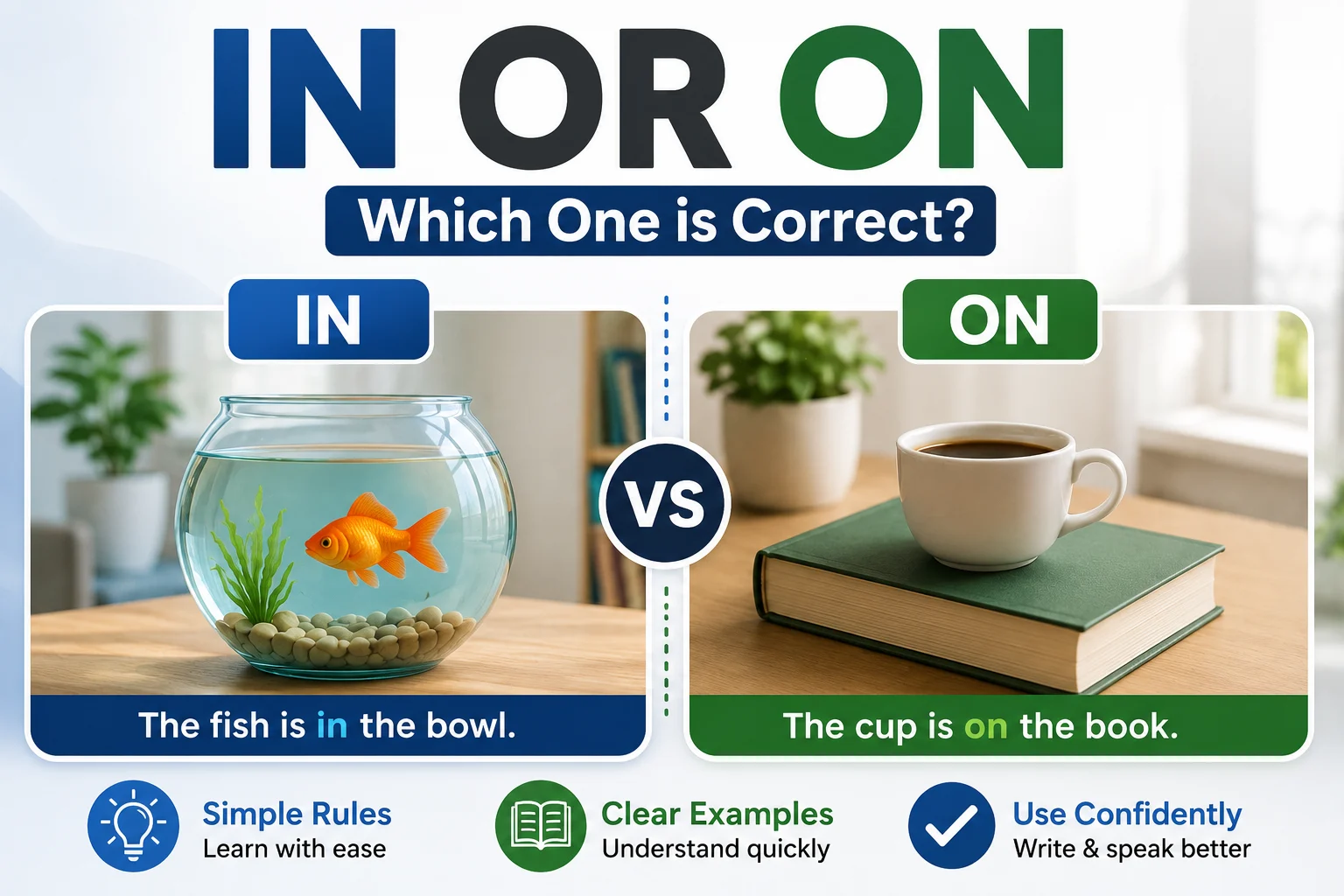
In is used for something inside an enclosed space, while on is used for something resting on a surface or referring to specific days and dates.
Have you ever paused while writing because you were unsure whether to use in or on? You are not alone. These are two of the most common English prepositions, yet they often confuse students, English learners, and even experienced writers. Since both words describe location, time, and position, it is easy to choose the wrong one.
Understanding the difference between in or on will help you write and speak more naturally. In many cases, changing just one of these words can change the meaning of a sentence. For example, saying someone is in a car usually means they are inside it, while saying someone is on a bus means they are riding it. Small differences like these matter in everyday communication.
The good news is that both in and on are correct. The important part is knowing when each one should be used. This guide explains their meanings, origins, common mistakes, and practical examples in simple English so you can choose the right preposition with confidence.
In or On – Quick Answer
Both in and on are correct English prepositions, but they are used in different situations.
- In usually means inside something or within a period, place, or area.
- On usually means touching a surface or referring to specific days, dates, or supported positions.
Real-life examples
- The keys are in my bag.
- The book is on the table.
- We will meet on Monday.
The Origin of In or On
The words in and on are among the oldest words in the English language.
In comes from Old English and has always referred to being inside, within, or enclosed by something.
On also comes from Old English and originally meant being above or in contact with a surface. Over time, both words developed additional meanings related to time, movement, transportation, and communication.
Because these prepositions have many uses, learners often confuse them even though each follows clear grammar rules.
British English vs American English Spelling
There is no spelling difference between British English and American English.
Both varieties use in and on with the same spellings. However, there are a few usage differences in certain expressions.
| Version | Spelling | Region | Example Sentence |
|---|---|---|---|
| Standard English | In | UK & US | She is in the office. |
| Standard English | On | UK & US | The picture is on the wall. |
Some expressions may differ slightly, such as at the weekend in British English and on the weekend in American English, but the spellings remain the same.
Which Spelling Should You Use?
US audience
Use in and on according to their meanings. American English commonly says on the weekend.
UK/Commonwealth audience
Follow the same grammar rules for in and on. British English often prefers at the weekend, but in and on keep the same meanings.
Global/SEO audience
If your content answers the common search query “in or on,” mention both words near the beginning. Then use each preposition correctly throughout the rest of your writing.
Common Mistakes with In or On
Because these prepositions have many meanings, they are often mixed up.
| Incorrect | Correct |
|---|---|
| The keys are on my bag. | The keys are in my bag. |
| The book is in the table. | The book is on the table. |
| We will meet in Monday. | We will meet on Monday. |
| She is on the room. | She is in the room. |
| The photo is in the wall. | The photo is on the wall. |
Quick tip
Think of this simple rule:
- In = Inside
- On = On the surface
This memory trick helps you choose the correct preposition in many everyday situations.
In or On in Everyday Examples
Seeing these prepositions in real-life situations makes them much easier to understand.
Emails
- The report is in the shared folder.
- The meeting is on Tuesday at 10 a.m.
News Headlines
- New Museum Opens In the City Center
- Concert Scheduled On Saturday Evening
Social Media
- I’m in London for the weekend!
- My favorite photo is on my profile now.
Formal Writing
- The results are presented in the final report.
- Details are listed on the first page of the document.
In or On – Google Trends & Usage
Many people search for in or on because these prepositions appear in almost every English sentence. They are among the first grammar topics taught to English learners, yet they remain one of the most common sources of confusion.
Searches often increase when students are writing essays, professionals are preparing emails, or learners are studying for English exams. People usually want a quick explanation with simple examples that show which preposition fits a particular sentence.
The confusion exists because in and on have several meanings depending on the context. They can describe location, time, transportation, and even digital spaces. Learning the basic rule first and then practicing with real examples makes choosing the correct preposition much easier.
Comparison Table
| Feature | In | On |
|---|---|---|
| Main Meaning | Inside something | On a surface |
| Time | Months, years, seasons, parts of the day | Days and specific dates |
| Place | Rooms, buildings, cities, countries | Tables, walls, floors, screens |
| Transportation | In a car or taxi | On a bus, train, plane, or bike |
| Formal Writing | Yes | Yes |
| Correct English | Yes | Yes |
Frequently Asked Questions
1. Is in or on correct?
Both are correct. The right choice depends on whether you are talking about being inside something, on a surface, or referring to time.
2. When should I use in instead of on?
Use in for enclosed spaces, larger places, months, years, seasons, and when something is inside another thing.
3. When should I use on instead of in?
Use on for surfaces, specific days, dates, and most forms of public transportation such as buses, trains, and planes.
4. Is there a British or American English difference?
The spellings are the same. A few expressions differ, such as at the weekend in British English and on the weekend in American English.
5. Why are in and on confusing?
These prepositions have many meanings depending on the context. Practice with real examples helps you understand the difference more easily.
6. How can I remember the difference between in and on?
Think of in as inside and on as on the surface. This simple rule works in many everyday situations.
Conclusion
Understanding the difference between in and on is an important step toward writing and speaking natural English. Although these prepositions are short, they carry different meanings depending on location, time, and context. In usually refers to being inside an area or within a period, while on commonly describes something touching a surface or happening on a specific day.
The best way to master these prepositions is through regular practice. Reading books, writing short sentences, and paying attention to how native speakers use them will help you remember the correct choice over time.
Whenever you are unsure, ask yourself a simple question: Is it inside something, or is it on a surface or specific day? This quick check will help you choose confidently and avoid one of the most common English grammar mistakes.