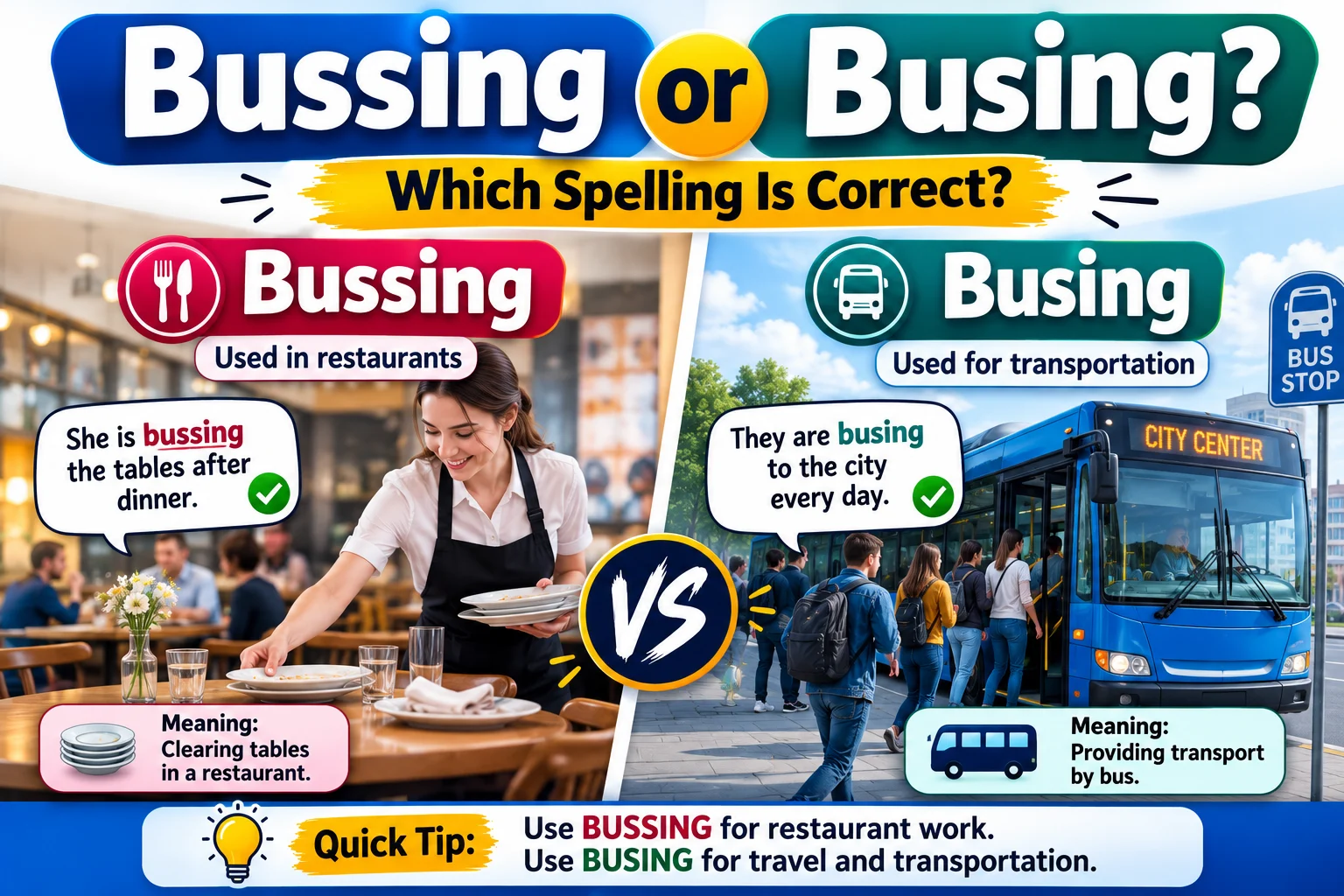
“Busing” is the standard spelling for transporting people by bus, while “bussing” usually refers to clearing tables in restaurants or is a less common spelling variant.
Have you ever wondered whether to write bussing or busing? You’re not alone. These two spellings often confuse students, writers, and English learners because both appear in dictionaries and online articles. The confusion becomes even greater because the word bus can refer to public transportation or the action of clearing tables in a restaurant.
The good news is that both bussing and busing are correct, but they are often used in different contexts or according to different style guides. Busing is the more common spelling for transporting people by bus, especially in American English. Bussing is frequently used when talking about clearing tables in restaurants, although some dictionaries also accept it for transportation.
In this guide, you’ll learn the difference between bussing or busing, where each spelling comes from, how British and American English treat them, common mistakes to avoid, and practical examples. By the end, you’ll know which spelling best fits your audience and your writing.
Bussing or Busing – Quick Answer
Quick Answer:
- ✅ Busing is the preferred spelling for transporting people by bus.
- ✅ Bussing is commonly used for clearing tables in restaurants.
- Both spellings are accepted, but the meaning often depends on the context.
Examples
- The city is busing students to the new school.
- She is bussing tables during the dinner shift.
- The company is busing employees to the event.
The Origin of Bussing or Busing
The noun bus comes from the Latin word omnibus, meaning “for everyone.” Over time, English speakers shortened it to bus.
When the verb to bus developed, two spellings became common:
- Busing for transporting people by bus.
- Bussing for clearing tables in restaurants.
Many dictionaries now recognize both spellings, although usage varies depending on the meaning and editorial style.
British English vs American English Spelling
There is no strict British versus American spelling rule, but usage preferences exist.
| Version | Spelling | Region | Example Sentence |
|---|---|---|---|
| Transport by bus | Busing | More common in American English | The district is busing students across town. |
| Clear restaurant tables | Bussing | Common worldwide | She spent the evening bussing tables. |
| Transport by bus | Bussing | Accepted by some style guides | The city began bussing passengers during repairs. |
Most style guides recommend busing for transportation because it clearly distinguishes the word from bussing tables.
Which Spelling Should You Use?
US Audience
Use busing when referring to transportation by bus. Use bussing when describing restaurant work, such as clearing tables.
UK/Commonwealth Audience
Both spellings are understood, but many publishers also prefer busing for transportation and bussing for restaurant service.
Global/SEO Audience
For online articles and blogs, using busing for transportation and bussing for restaurant work helps readers immediately understand your meaning.
Common Mistakes with Bussing or Busing
Many writers use the wrong spelling because they don’t consider the context.
| Incorrect | Correct |
|---|---|
| She is busing tables. | She is bussing tables. |
| The school is bussing students. (less common for transportation) | The school is busing students. |
| Bussing and busing always mean the same thing. | Their preferred spelling often depends on the context. |
Easy Tip:
- Busing = Transportation by bus
- Bussing = Clearing restaurant tables
Bussing or Busing in Everyday Examples
Emails
“The company is busing employees to the conference.”
News Headlines
“School District Expands Busing Program.”
Social Media
“My summer job is bussing tables at a local café.”
Formal Writing
“The city approved additional busing services to reduce traffic congestion.”
Bussing or Busing – Google Trends & Usage
Searches for bussing or busing are common because both spellings appear in dictionaries and published writing. People often want to know whether one spelling is incorrect or whether the choice depends on meaning.
In transportation-related articles, busing is generally more common because it avoids confusion. In restaurant-related content, bussing is widely used to describe clearing tables.
Using the spelling that matches the context makes your writing clearer and more professional.
Comparison Table
| Feature | Bussing | Busing |
|---|---|---|
| Correct Spelling | Yes | Yes |
| Main Meaning | Clearing restaurant tables | Transporting people by bus |
| Transportation Usage | Less common | More common |
| Restaurant Usage | Preferred | Less common |
| Dictionary Recognition | Yes | Yes |
| Best for Clarity | Restaurant context | Transportation context |
FAQs
Is it bussing or busing?
Both are correct. Busing usually refers to transportation, while bussing commonly refers to clearing restaurant tables.
Is bussing a real word?
Yes. Bussing is a recognized English spelling, especially in the restaurant industry.
Is busing correct?
Yes. Busing is the preferred spelling for transporting people by bus.
Do bussing and busing have different meanings?
Often, yes. Their preferred spelling usually depends on whether you’re talking about transportation or restaurant work.
Is there a British or American spelling difference?
Not officially. The distinction is based more on usage and editorial style than on regional English.
Which spelling should I use in professional writing?
Choose busing for transportation and bussing for restaurant service. This is the clearest approach for most readers.
Conclusion
The answer to bussing or busing depends on the meaning you want to express. Both spellings are correct, but they are commonly used in different situations. Busing is the preferred spelling when talking about transporting people by bus, especially in schools, public transportation, and official documents. Bussing is widely used in the restaurant industry to describe clearing tables after customers finish eating.
There is no major British or American spelling difference, although many editors and style guides recommend following this distinction for clarity. Choosing the right spelling helps readers understand your message immediately and makes your writing look more polished.
A simple way to remember the rule is: Busing moves people. Bussing clears tables. Keeping this tip in mind will help you choose the correct spelling confidently in emails, articles, reports, and everyday communication.