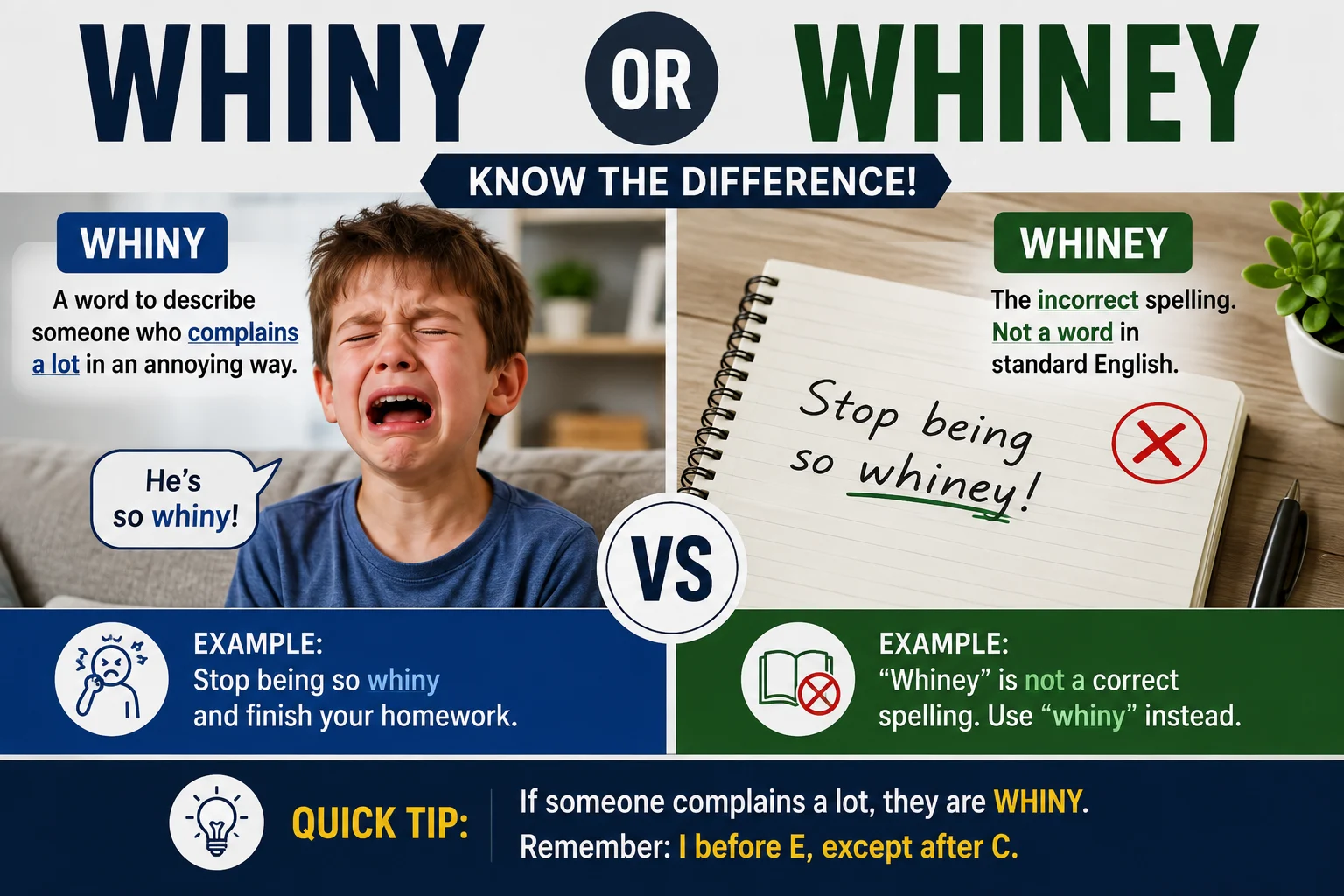
Whiny is the correct and preferred spelling for someone who complains a lot, while whiney is a less common variant.
Have you ever wondered whether you should write whiny or whiney? You’re not alone. These two spellings look very similar, and both appear online from time to time. This often leaves English learners and even native speakers wondering which one is correct.
The confusion happens because both words come from the verb whine, which means to complain in an annoying or high-pitched voice. However, only one spelling is considered the standard in modern English. Choosing the correct form will help your writing look more professional and easier to understand.
In this guide, you’ll learn the difference between whiny or whiney, where the word comes from, how British and American English use it, common mistakes to avoid, and which spelling you should choose. By the end of this article, you’ll know exactly when to use whiny and why whiney is usually considered a nonstandard variant.
Whiny or Whiney – Quick Answer
Whiny is the standard and correct spelling in modern English.
It describes someone who complains too much or speaks in an annoying, complaining voice.
Whiney is an alternative spelling that occasionally appears, but it is much less common and is generally considered nonstandard.
Examples
- The child sounded whiny after missing his nap.
- Stop being so whiny and enjoy the trip.
- Most dictionaries recommend whiny, not whiney.
The Origin of Whiny or Whiney
The adjective whiny comes from the verb whine, which has been used in English for centuries to describe making a long, complaining, or high-pitched sound.
When the adjective developed, whiny became the accepted spelling in dictionaries and style guides.
The spelling whiney likely appeared because some writers naturally kept the full word whine before adding -y. Although this spelling is sometimes seen online, it has never become the preferred standard.
Today, whiny is the spelling recommended in most dictionaries and professional writing.
British English vs American English Spelling
There is no major spelling difference between British and American English.
| Version | Spelling | Region | Example Sentence |
|---|---|---|---|
| Standard English | Whiny | US | His whiny voice annoyed everyone. |
| Standard English | Whiny | UK | The review described the character as whiny. |
| Alternative Variant | Whiney | Occasionally seen | Some informal writing uses whiney. |
Both British and American English prefer whiny.
Which Spelling Should You Use?
US Audience
Use whiny. It is the standard spelling used in American English.
UK/Commonwealth Audience
Use whiny. It is also the preferred spelling in British English and other Commonwealth countries.
Global/SEO Audience
Choose whiny because it is recognized worldwide and appears more often in dictionaries, books, and online searches.
Common Mistakes with Whiny or Whiney
Here are common mistakes people make.
❌ He has a whiney attitude.
✅ He has a whiny attitude.
❌ Whiney is the preferred dictionary spelling.
✅ Whiny is the preferred dictionary spelling.
❌ British English prefers whiney.
✅ Both British and American English generally use whiny.
❌ Whiny and whiney have different meanings.
✅ They have the same intended meaning, but whiny is the standard spelling.
Whiny or Whiney in Everyday Examples
Emails
- Please avoid using a whiny tone in customer emails.
- The feedback sounded a little whiny.
News Headlines
- Critics call the speech whiny.
- Reviewers describe the movie character as whiny.
Social Media
- Stop posting whiny comments all day!
- That sounded a bit whiny, but I understand your point.
Formal Writing
- The author avoided a whiny tone throughout the article.
- Professional communication should not appear whiny.
Whiny or Whiney – Google Trends & Usage
Searches for whiny are much more common than searches for whiney.
Most dictionaries, grammar guides, publishers, and style manuals recommend whiny, making it the spelling readers expect to see.
People usually search whiny or whiney because they are unsure whether the extra e should remain after the word whine. Since many English words follow different spelling patterns, this confusion is understandable.
Across English-speaking countries, whiny is the accepted standard for both everyday and professional writing.
Comparison Table
| Feature | Whiny | Whiney |
|---|---|---|
| Correct spelling | ✅ Yes | Less Common |
| Dictionary preference | ✅ Yes | Rarely Preferred |
| American English | ✅ Standard | Uncommon |
| British English | ✅ Standard | Uncommon |
| Same meaning | ✅ Yes | ✅ Yes |
| Best for professional writing | ✅ Yes | ❌ No |
| Best for SEO | ✅ Yes | ❌ No |
FAQs
Is it whiny or whiney?
Whiny is the standard spelling recommended by most dictionaries.
Is whiney a real word?
Whiney appears occasionally, but it is generally considered a nonstandard variant of whiny.
Which spelling is used in American English?
American English uses whiny.
Does British English use whiney?
No. British English also generally prefers whiny.
Why do people spell it whiney?
Many writers keep the e from whine, but standard English drops it when forming whiny.
Which spelling is better for SEO?
Whiny is better because it is more commonly searched and widely accepted.
Conclusion
Understanding the difference between whiny or whiney is simple once you know the standard spelling. Whiny is the correct and widely accepted form used in dictionaries, books, newspapers, websites, and professional writing. It describes someone who complains too much or speaks in an irritating, complaining way.
Although whiney sometimes appears in informal writing and online conversations, it is not the preferred spelling. Most editors, teachers, and style guides recommend using whiny instead. There is also no regional difference between British and American English, as both varieties generally favor the same spelling.
If you want your writing to look polished and professional, always choose whiny. Using the standard form helps readers understand your message clearly and avoids unnecessary spelling mistakes. Remember this simple rule, and you’ll use the correct spelling with confidence every time.