Totaling or totalling: Learn which spelling is correct, why both are accepted, and when to use each in American and British English.
Have you ever paused while writing and wondered whether to use totaling or totalling? You’re not the only one. This spelling question often confuses students, writers, accountants, business professionals, and English learners because both versions appear in books, websites, and official documents.
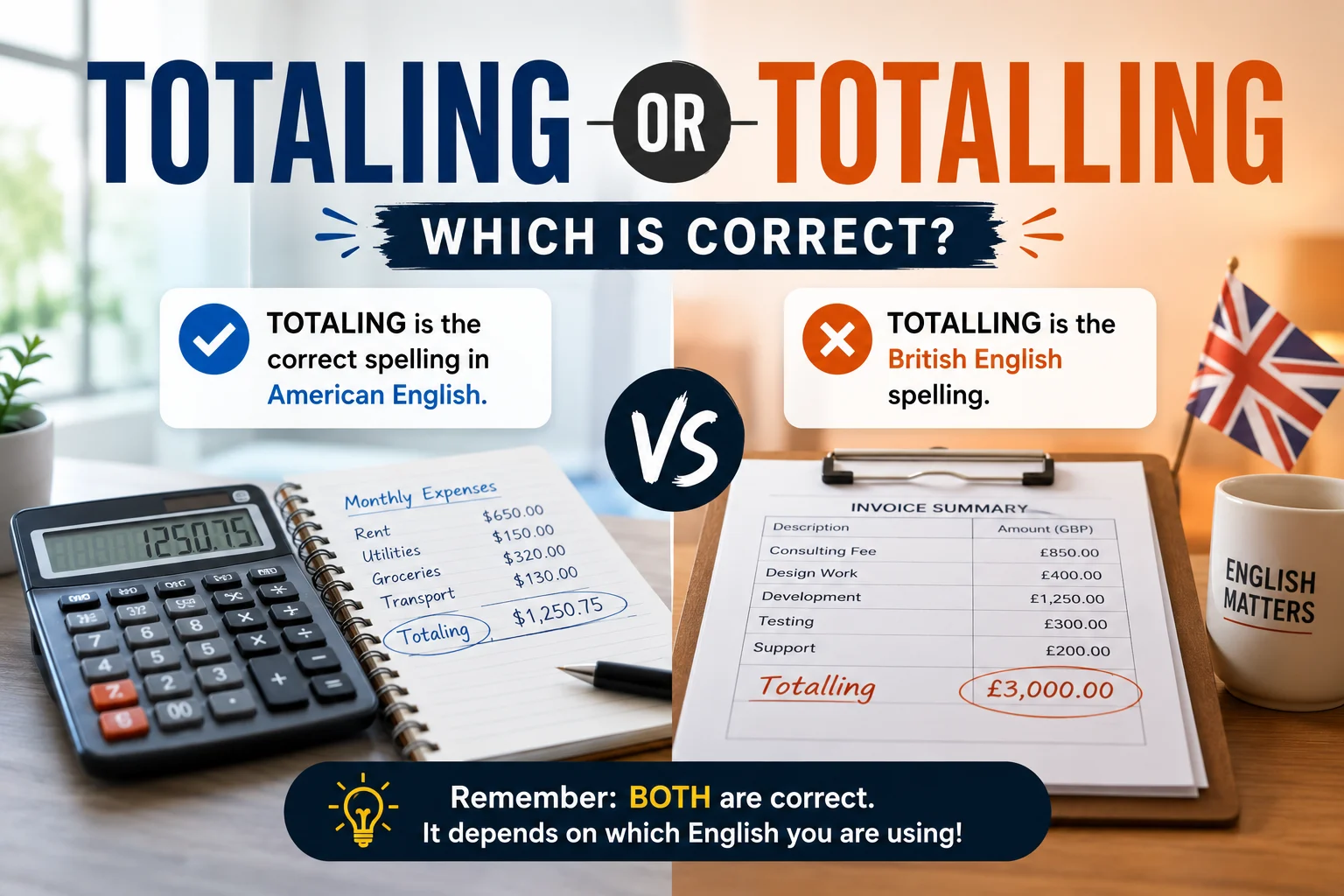
The good news is that totaling and totalling are both correct. They have the same meaning and are used in the same way. The only difference is the type of English you are writing. Totaling with one l is the preferred spelling in American English, while totalling with two l’s is preferred in British English and many Commonwealth countries.
Whether you’re preparing a financial report, writing an email, creating a business proposal, or posting online, choosing the right spelling helps your writing match your audience. In this guide, you’ll learn the meaning, history, spelling differences, common mistakes, everyday examples, and simple tips to help you choose the correct spelling with confidence.
Totaling or Totalling – Quick Answer
Both totaling and totalling are correct spellings.
They are the present participle (or gerund) of the verb total, which means to add numbers together or reach a final amount.
The difference is regional:
- Totaling is preferred in American English.
- Totalling is preferred in British English.
Simple Examples
- The bill is totaling PKR 8,500. (US)
- The bill is totalling PKR 8,500. (UK)
- We are totaling/totalling this month’s expenses.
All these sentences have the same meaning.
The Origin of Totaling or Totalling
The word total comes from the Latin word totalis, meaning whole or entire. It entered English through French and became widely used in mathematics, business, and everyday language.
When adding -ing to the verb total, different spelling rules developed.
American English usually keeps a single l, producing totaling.
British English often doubles the final l before adding -ing, resulting in totalling.
Both spellings are accepted by modern dictionaries and style guides.
British English vs American English Spelling
This spelling difference follows the same pattern as words like traveling/travelling, modeling/modelling, and canceling/cancelling.
| Version | Spelling | Region | Example Sentence |
|---|---|---|---|
| American English | Totaling | United States | The expenses are totaling PKR 25,000. |
| British English | Totalling | United Kingdom | The expenses are totalling PKR 25,000. |
| Canadian English | Both | Canada | Both spellings are accepted depending on the style guide. |
| Australian English | Totalling | Australia | The invoices are totalling more than expected. |
Easy Rule
- US English → Totaling
- UK English → Totalling
Which Spelling Should You Use?
The best spelling depends on your readers.
For a US Audience
Use totaling.
It follows American dictionaries, newspapers, and business writing conventions.
For a UK/Commonwealth Audience
Use totalling.
Readers in the UK, Australia, New Zealand, and many Commonwealth countries are more familiar with the double l.
For Global/SEO Audience
Either spelling is correct.
If your content targets readers worldwide:
- Choose one spelling.
- Use it consistently throughout your article.
- Avoid mixing both versions unless you are comparing them.
Consistency improves readability and professionalism.
Common Mistakes with Totaling or Totalling
Here are some common mistakes writers make.
| Incorrect | Correct |
|---|---|
| Mixing both spellings in one article | Choose one spelling style and stay consistent. |
| Thinking one spelling is wrong | Both spellings are correct. |
| Using totalling in an American style guide | Use totaling. |
| Using totaling in a British publication | Use totalling. |
| Believing they have different meanings | They have exactly the same meaning. |
Totaling or Totalling in Everyday Examples
Emails
“The final invoice is totaling PKR 45,000.”
“Our monthly expenses are totalling more than expected.”
News Headlines
“Flood Damage Totaling Millions Reported”
“Government Spending Totalling New Record Announced”
Social Media
“Just finished totaling all my travel costs!”
“Our donations are totalling more every day. Thank you!”
Formal Writing
“The project costs are totaling PKR 2 million.”
“The audited accounts show expenses totalling PKR 10 million.”
Totaling or Totalling – Google Trends & Usage
People frequently search for totaling or totalling because they notice both spellings in business reports, accounting documents, newspapers, and online articles.
American websites and financial publications usually prefer totaling, while British publishers, educational institutions, and government organizations often use totalling.
The topic is especially popular among students, accountants, business professionals, editors, and English learners who want to follow the correct regional writing style.
Neither spelling is replacing the other. Both remain standard English and continue to be widely used around the world.
Comparison Table
| Feature | Totaling | Totalling |
|---|---|---|
| Meaning | Adding up to a total | Adding up to a total |
| Correct Spelling | Yes | Yes |
| American English | Preferred | Less common |
| British English | Less common | Preferred |
| Canadian English | Both | Both |
| Australian English | Rare | Preferred |
| Formal Writing | Yes | Yes |
| SEO Friendly | Yes | Yes |
Frequently Asked Questions
Is totaling or totalling correct?
Yes. Both are correct spellings of the verb total in its -ing form.
Which spelling is used in the United States?
American English generally prefers totaling.
Which spelling is used in Britain?
British English usually prefers totalling.
Do totaling and totalling have different meanings?
No. They mean exactly the same thing.
Which spelling should I use for SEO?
Use the spelling that matches your target audience and keep it consistent throughout your content.
Can I use both spellings in one article?
Only if you’re comparing them. Otherwise, choose one spelling style and use it consistently.
Why does British English use two “l’s”?
British English often doubles the final l before adding -ing, following traditional spelling conventions.
Conclusion
Choosing between totaling or totalling is easy once you know your audience. Both spellings are correct, accepted by major dictionaries, and mean adding numbers together or reaching a final amount. The only difference is regional spelling. American English prefers totaling, while British English and many Commonwealth countries use totalling.
If you’re writing for readers in the United States, totaling is the better choice. If your audience is in the United Kingdom, Australia, or other Commonwealth countries, totalling is the preferred spelling. For international websites, either version works well as long as you use it consistently from beginning to end.
By matching your spelling to your audience and avoiding unnecessary changes within the same document, you’ll produce writing that is clear, professional, and easy to read. Now you can confidently choose the correct spelling for every report, email, article, or business document.