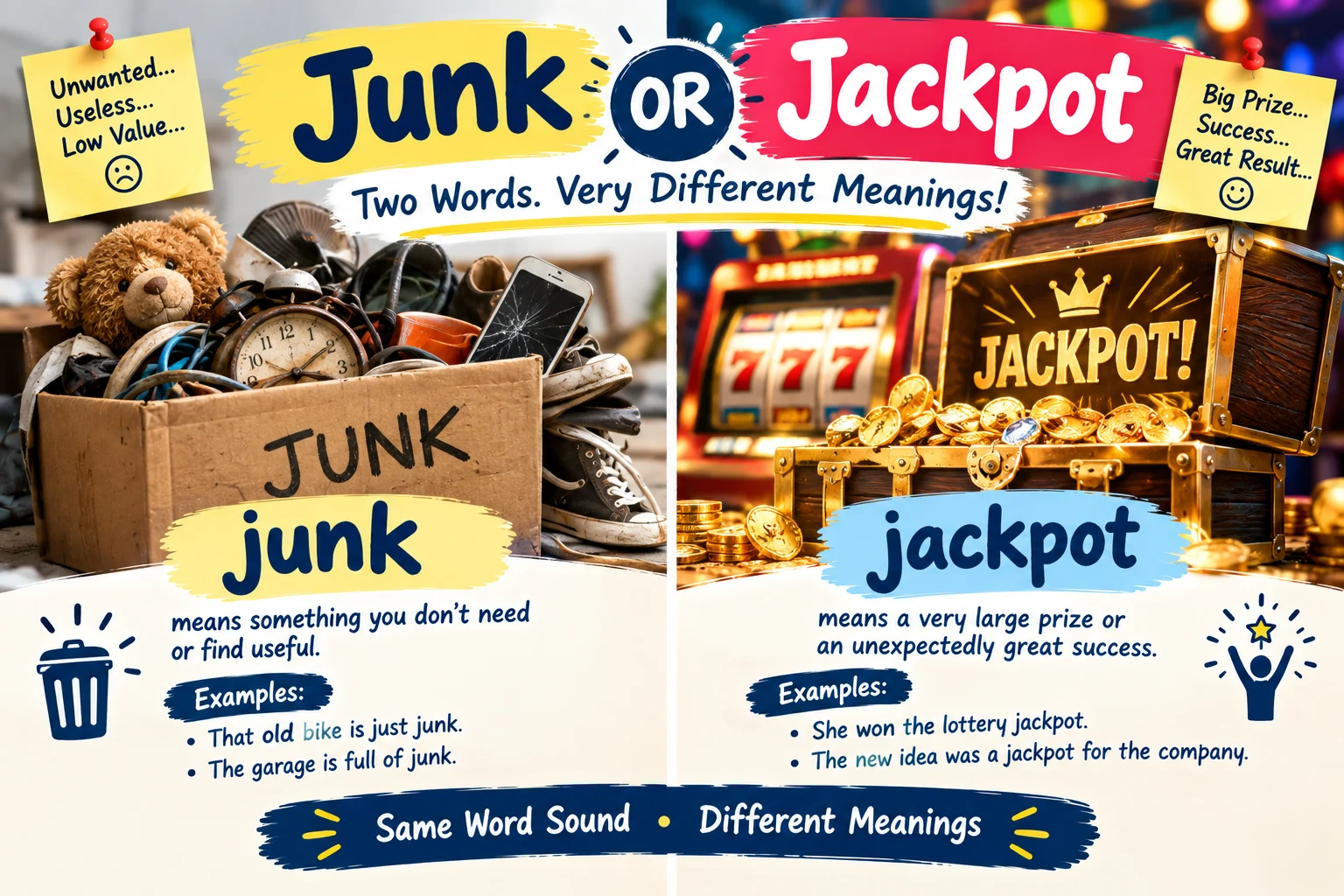
Junk means something useless, unwanted, or low in value, while jackpot means a very large prize or an unexpectedly great success. They describe very different outcomes.
Have you ever found something old and wondered, “Is this just junk, or could it be worth something?”
I have seen this happen often when people sort through old boxes, books, coins, clothes, or forgotten items. One person may see a pile of useless things. Another may see something valuable.
That simple contrast helps explain junk or jackpot.
These two words are not spelling variations. They are different words with very different meanings. Junk usually describes something with little use or value. Jackpot describes a large prize or a very successful result. Cambridge Dictionary defines junk as things seen as useless, worthless, or low quality. It defines jackpot as the largest prize in a competition or game and also gives a broader meaning of a big unexpected success.
English learners may search for junk or jackpot because the words often appear together when people compare poor results with great ones.
In this guide, you will learn the meaning, history, differences, common mistakes, examples, and natural ways to use both words.
Junk or Jackpot – Quick Answer
Junk and jackpot describe opposite ideas.
- Junk = something unwanted, useless, or of low value.
- Jackpot = a very large prize or a highly successful result.
Example with junk
The garage was full of junk.
This means the garage contained many old or unwanted things.
Example with jackpot
Finding that rare book was a jackpot.
Here, jackpot means a very lucky or valuable discovery.
So, when you ask “junk or jackpot?”, you are often asking whether something is worthless or surprisingly valuable.
The Origin and Background of Junk and Jackpot
The two words have very different histories.
Where does “junk” come from?
The history of junk is surprisingly old.
Etymonline traces one meaning of junk to Middle English jonke or junk, referring to old rope or cable used on ships. Over time, the word developed broader meanings connected with old, discarded, or unwanted things. By the late 19th century, junk could refer to old or discarded articles more generally.
Today, junk is used in many common expressions:
- junk food
- junk mail
- junk drawer
- junk shop
- junk materials
The word can also work as a verb.
We should junk this broken machine.
As a verb, junk means to throw something away or get rid of it because it is no longer useful.
Where does “jackpot” come from?
Jackpot has a more colorful history.
Etymonline records an earlier poker-related use from the 1880s and a later use connected with prize-winning machines. The modern sense of a big prize developed from these earlier uses.
Today, jackpot has also moved beyond games.
You can use it to describe a big unexpected success.
For example:
The small company found a jackpot when its new idea became popular.
This does not have to mean a literal prize. It can mean a result that brings great success or value. Cambridge gives this broader business meaning as a big unexpected success or profit.
Junk or Jackpot Explained — Key Differences
The biggest difference is value.
Junk suggests little or no useful value.
Jackpot suggests an unusually large amount of value, success, or reward.
| Term | Meaning | When to Use | Region/Context |
|---|---|---|---|
| junk | Useless, unwanted, or low-value things | When something has little practical value | Common in everyday English |
| jackpot | A very large prize or great success | When a result is unusually valuable or successful | Common in everyday, business, and media English |
| junk as a verb | To throw away or discard | When getting rid of something | Informal English |
| hit the jackpot | To achieve a very successful result | When something works extremely well or brings a major benefit | Idiomatic English |
Junk in everyday English
You might say:
My desk drawer is full of junk.
Or:
We found some old junk in the attic.
In both cases, the word suggests that the things are not very useful or valuable.
Jackpot in everyday English
You might say:
We found a jackpot of useful information in the old records.
Here, jackpot is being used figuratively. It means a very valuable discovery.
Another example:
The new design was a jackpot for the company.
The meaning is that the design brought an unusually good result.
Which Word Should You Use?
There is no single “correct” choice between junk and jackpot. The right word depends on what you mean.
For beginners
Use junk when something is unwanted or not useful.
These old papers are junk.
Use jackpot when something brings a very large reward or success.
Finding the missing document was a jackpot.
For students
Ask yourself one simple question:
Is the thing useless, or is it highly valuable?
If it is useless or unwanted, choose junk.
If it represents an unusually good result, choose jackpot.
For professional writing
Junk can be used in professional writing, but it may sound informal. More formal alternatives can include:
- waste
- unwanted material
- discarded items
- low-value material
Jackpot is also somewhat conversational. In a formal report, you may prefer:
- major success
- significant gain
- valuable discovery
- substantial benefit
For example:
Casual:
The research team hit the jackpot.
More formal:
The research team made a valuable discovery.
For global or neutral English
Use the simplest word that matches your meaning.
If you mean unwanted things, junk is clear.
If you mean a surprisingly valuable result, jackpot is clear in everyday English.
Common Mistakes with Junk or Jackpot
Because the words have very different meanings, most mistakes come from using the wrong word in a sentence.
1. Using “jackpot” for ordinary rubbish
❌ The broken boxes are a jackpot.
✅ The broken boxes are junk.
Why?
Broken and unwanted objects are normally described as junk.
2. Using “junk” for a great success
❌ The new product was a junk for the company.
✅ The new product was a jackpot for the company.
Why?
The sentence describes a very successful result, so jackpot fits the meaning.
3. Treating the words as synonyms
❌ Junk and jackpot have the same meaning.
✅ Junk and jackpot have contrasting meanings in many contexts.
Why?
One suggests low value or usefulness. The other suggests a very valuable prize or successful result.
4. Using “junk” as a countable noun
A common learner error is:
❌ I found three junks in the garage.
For the meaning “unwanted things,” junk is usually an uncountable noun.
Better:
✅ I found some junk in the garage.
Or:
✅ I found three pieces of junk in the garage.
Cambridge marks the main “useless things” sense of junk as uncountable.
5. Using “jackpot” when you only mean “good”
A normal good result is not always a jackpot.
For example:
I got a good grade.
That does not automatically mean:
I hit the jackpot.
Jackpot suggests something especially successful, valuable, or unexpected.
Junk or Jackpot in Real-World Examples
1. Professional email
We reviewed the old files and found mostly junk, but we also discovered several useful documents.
Here, junk means material that was not useful.
2. News headline
Small Local Museum Finds Historical Jackpot
Here, jackpot creates interest. It suggests that the museum made a valuable or exciting discovery.
3. Social media post
I cleaned my desk today. So much junk!
This is a natural informal use.
4. Formal report
The team initially considered the old records low-value material, but further research revealed a valuable discovery.
In a formal report, valuable discovery may be clearer than the informal phrase jackpot.
5. Everyday conversation
I thought the old box was full of junk, but it turned out to contain some valuable items.
This sentence shows the contrast very clearly.
At first, the items looked like junk.
Later, they appeared to be something valuable.
Junk or Jackpot — Data, Trends & Usage
The search intent behind “junk or jackpot” is mainly informational. A reader may want to understand the meanings of the two words, compare them, or learn how to use them in a sentence.
There is no reliable public source in the material reviewed here that establishes an exact worldwide search-volume figure for the phrase “junk or jackpot.” It would therefore be misleading to claim a specific monthly search number.
What the dictionary evidence does show is that both words have several established uses.
Junk is common in everyday English. It can describe unwanted objects and can also work as a verb meaning to discard something. It also appears in compounds such as junk food and junk mail.
Jackpot is used for a major prize and has a wider figurative use for a big unexpected success.
This matters for writers because context changes the best word.
A sentence about an old cupboard may need junk.
A sentence about a surprisingly valuable discovery may need jackpot.
The words are short, memorable, and useful because they create a strong contrast between low value and high value.
Junk or Jackpot: Standalone Comparison Table
| Term/Variant | Meaning | Region/Context | Best Used When |
|---|---|---|---|
| junk | Unwanted or useless things | Everyday English | Talking about things with little value |
| junk (verb) | To throw away or discard | Informal English | Talking about getting rid of something |
| jackpot | A very large prize | Games, competitions, |
Junk or Jackpot: How to Remember the Difference
Use this simple mental picture:
Junk = “Throw it away.”
Think about an old broken chair, empty boxes, or things you no longer need.
This is junk.
Jackpot = “What a great find!”
Think about discovering something unexpectedly valuable or achieving a very large success.
This is a jackpot.
A quick memory line can help:
Junk has little value. Jackpot has great value.
This is not a strict definition for every possible use, but it is an easy way for English learners to remember the main contrast.
FAQ: Junk or Jackpot
Q: What does junk mean?
A: Junk means things that are unwanted, useless, or of low value. It can also be used as a verb meaning to throw something away.
Q: What does jackpot mean?
A: Jackpot means a very large prize or an unusually successful result. It can also describe a major unexpected success in everyday or business English.
Q: Are junk and jackpot opposites?
A: They are not strict dictionary opposites, but they can express a strong contrast. Junk suggests low value or usefulness, while jackpot can suggest very high value or success.
Q: Which is correct: junk or jackpot?
A: Both words are correct, but they are used in different situations. Choose junk for unwanted or low-value things and jackpot for a major prize or unusually successful result.
Q: Is junk acceptable in formal writing?
A: Yes, but it can sound informal when used to mean unwanted things. In a formal report, phrases such as discarded material, waste, or unwanted items may be more precise.
Q: Is jackpot acceptable in formal writing?
A: Jackpot is a standard English word, but it has a conversational feel in some contexts. In formal writing, major success, valuable discovery, or significant gain may be clearer.
Q: Where does the word junk come from?
A: One meaning of junk comes from Middle English and was linked to old rope or cable used on ships. Its meaning later expanded to include old or discarded objects.
Q: Where does the word jackpot come from?
A: Jackpot developed from an older card-game term and later became associated with large prizes. Etymonline records the prize sense from the early 20th century.
Q: Can jackpot mean something other than money?
A: Yes. Jackpot can describe a valuable discovery, successful idea, or unexpectedly good result. Cambridge includes a broader sense of a big unexpected success or profit.
Conclusion
Junk or jackpot is a useful contrast to remember.
Junk describes things that are unwanted, useless, or low in value. It can also be a verb meaning to throw something away. Jackpot usually describes a very large prize, but it can also mean a major or unexpected success.
The two words are not interchangeable. Your choice depends on the result you want to describe.
If something has little use or value, call it junk. If something turns out to be a major success or valuable discovery, jackpot may fit better.
For formal writing, think about your audience. Junk and jackpot are natural in everyday English, but more precise phrases may work better in reports and academic writing.
The easiest memory trick is simple:
Junk = low value. Jackpot = big value or success.
Now you know exactly how these two words differ. Bookmark this guide so you never second-guess “junk or jackpot” again.