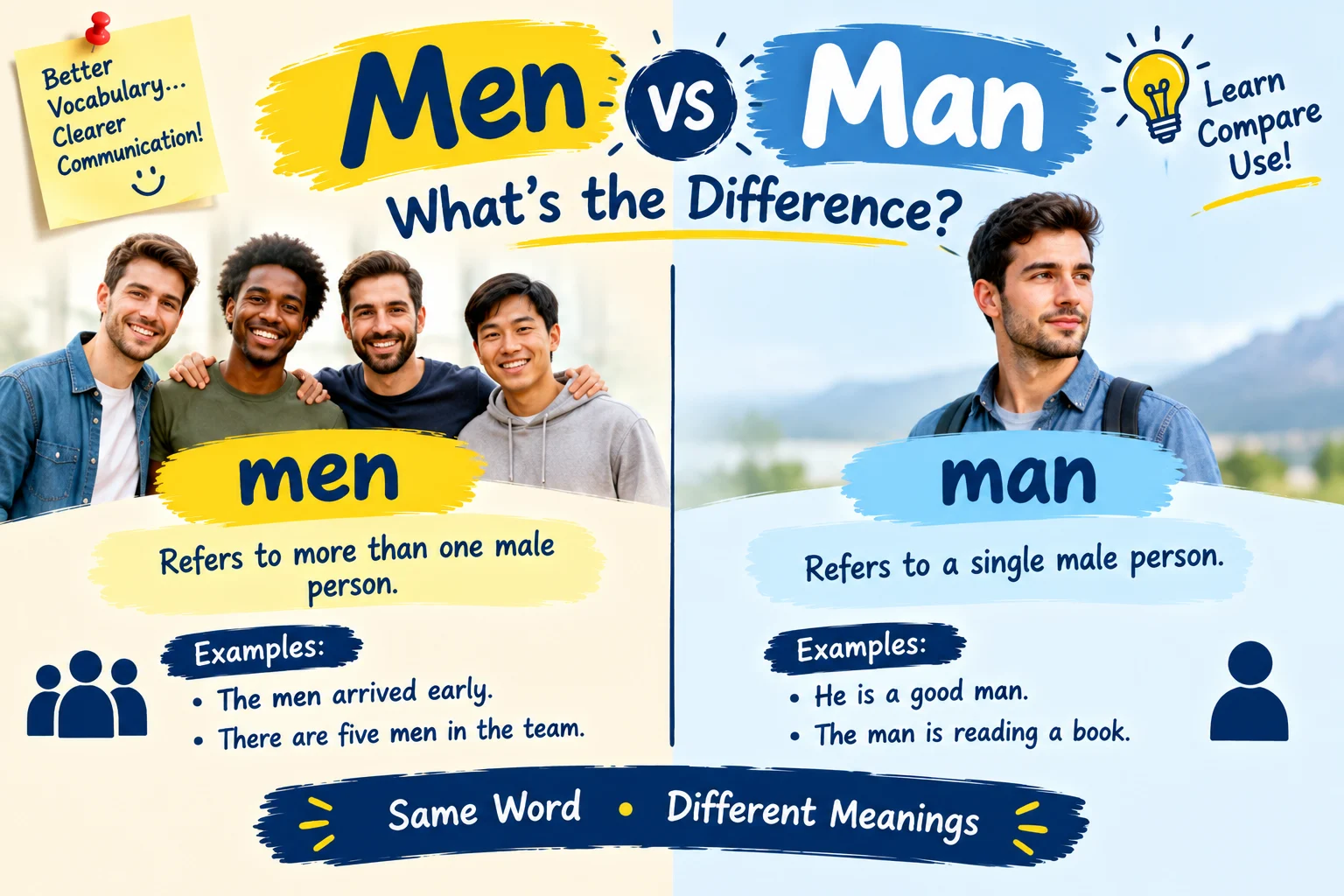
Man is the singular form for one adult male, while men is the plural form for two or more adult males. The key difference is simple: one man, two men.
Have you ever written a sentence like “Three man are waiting” and then stopped to wonder if it should be men?
This is a small English mistake, but it is very common. The reason is simple. Most English nouns form plurals by adding -s or -es. For example, book becomes books, and class becomes classes. But man does not follow that pattern.
Its plural form is men.
You will see these words everywhere. They appear in school work, emails, news stories, reports, books, and everyday conversations. Knowing the difference helps you write clear and natural English.
The good news is that you do not need a difficult grammar rule. You only need to remember one basic pair: man = one and men = more than one.
Let’s look at the difference, history, examples, common mistakes, and useful grammar rules.
Men or Man – Quick Answer
The difference between man and men is number.
- Man = one adult male.
- Men = two or more adult males.
Cambridge Dictionary lists man as a singular noun and gives men as its plural form.
Examples with man
- The man is waiting outside.
- I saw a man at the station.
- That man is my teacher.
Each sentence refers to one male person.
Examples with men
- The men are waiting outside.
- I saw three men at the station.
- The men are working together.
Here, the word refers to more than one male person.
The easiest rule
Think of this pattern:
One man → two men
Do not write two mans when you mean the plural of man. The correct plural is men.
The Origin and Background of Men and Man
The difference between man and men comes from the long history of the English language.
The word man goes back to Old English man or mann. At that time, the word could have broader meanings connected with a human being or person. Over time, its use developed, including the specific meaning of an adult male.
The plural men is also very old. It developed from the earlier form of man through a historical vowel change. This is why modern English has man → men instead of the more regular man → mans.
This type of plural is called an irregular plural.
An irregular plural does not follow the usual rule of simply adding -s.
For example:
- man → men
- woman → women
- child → children
- tooth → teeth
- foot → feet
So, if man and men seem unusual, you are not imagining it. They are part of an older pattern in English.
Men or Man Explained — Key Differences
The easiest way to understand the two words is to compare their grammatical number.
| Term | Meaning | When to Use | Region/Context |
|---|---|---|---|
| man | One adult male | When referring to one male person | Standard English |
| men | More than one adult male | When referring to two or more male people | Standard English |
| man’s | Something belonging to one man | Singular possessive | Standard English |
| men’s | Something belonging to or connected with several men | Plural possessive | Standard English |
Man = singular
Use man when you are talking about one person.
Example:
The man is reading a newspaper.
There is one person in the sentence.
Another example:
A man called the office this morning.
The article a also gives you a useful clue. We use a man, not a men.
Men = plural
Use men when you are talking about more than one person.
Example:
The men are talking outside.
Another example:
Five men joined the team.
Notice that five tells us that the noun must be plural.
Man’s and men’s
There is another useful difference.
Man’s is usually the possessive form of singular man.
The man’s car is new.
This means the car belongs to one man.
Men’s is the possessive form of plural men.
The men’s room is upstairs.
This refers to a room connected with or intended for men.
So remember:
one man → man’s
several men → men’s
Which Version Should You Use?
You do not need to choose between man and men based on style or region. The choice depends on how many people you mean.
For beginners
Use man for one and men for more than one.
- One man
- Two men
- Ten men
- Many men
This simple number test will solve most problems.
For students
Look at the noun’s number before choosing the word.
If the sentence says:
One ___ is standing there.
Use man.
If it says:
Three ___ are standing there.
Use men.
For formal writing
Both forms are completely standard.
The important thing is to use the correct form for the meaning.
The man was interviewed.
One person.
The men were interviewed.
More than one person.
For inclusive writing
The word man has also been used historically in English to mean humanity in general. However, modern readers may find this use unclear or dated. Cambridge recommends alternatives such as human beings, people, or humankind when referring to everyone.
For example:
Human beings need clean water.
This is often clearer than using man to mean all people.
Common Mistakes with Men or Man
These mistakes often happen because men looks like a normal plural but does not follow the usual -s rule.
1. Mistake: Using “mans” as the plural
❌ Three mans are waiting.
✅ Three men are waiting.
Why?
The plural of man is the irregular form men.
2. Mistake: Using “men” for one person
❌ One men is waiting.
✅ One man is waiting.
Why?
Men is plural. One person needs the singular form man.
3. Mistake: Using “man” after a plural number
❌ Five man joined the group.
✅ Five men joined the group.
Why?
A number such as five shows that you need a plural noun.
4. Mistake: Confusing man and men’s
❌ The men room is closed.
✅ The men’s room is closed.
Why?
Here, men’s is a plural possessive form.
5. Mistake: Writing “mans” when you need “men’s”
❌ The mans clothes are outside.
✅ The man’s clothes are outside.
This sentence means the clothes belong to one man.
For several men:
✅ The men’s clothes are outside.
Men or Man in Real-World Examples
Understanding grammar is easier when you see the words in normal situations.
1. Professional email
The men from the maintenance team will visit the office tomorrow.
The writer means more than one male worker.
If only one person is coming:
The man from the maintenance team will visit the office tomorrow.
2. News article
Police spoke to several men after the incident.
The word men is correct because the sentence refers to several people.
For one person:
Police spoke to a man after the incident.
3. Social media post
These men worked hard to complete the project.
The plural form is used because the post talks about a group.
For one person:
That man did an excellent job.
4. Formal report
The report examined how men and women participated in the survey.
Here, men refers to a group.
A sentence about one person would use man:
One man participated in the interview.
Men or Man — Data, Trends & Usage
The search intent behind “men or man” is mainly informational. People usually search the phrase because they want to check the correct plural form, understand the grammar, or avoid a spelling mistake.
The topic is especially useful for:
- English learners
- School students
- ESL learners
- Teachers
- Content writers
- People checking formal writing
- Anyone learning irregular plurals
There is an important limitation with search data: public search results do not provide a reliable, universal number for exactly how many people search “men or man” in every country. Search volume can also change by location, language, season, and search platform.
So it is better not to invent a specific search-volume figure.
What we can say with confidence is that man and men are common English words. Cambridge’s learner and advanced dictionaries list both forms, with men identified as the plural of man.
This matters for SEO writers because a short grammar question can represent a very clear search intent. A reader searching “men or man” usually wants a fast answer, examples, and a rule they can remember.
The best answer is therefore simple:
Man = one. Men = more than one.
Men or Man: Standalone Comparison
| Term/Variant | Meaning | Region/Context | Best Used When |
|---|---|---|---|
| man | One adult male | Standard English | Referring to one person |
| men | Two or more adult males | Standard English | Referring to a group |
| man’s | Belonging to one man | Standard English | Showing singular possession |
| men’s | Belonging to or connected with men | Standard English | Showing plural possession |
| human beings | People in general | Formal and neutral | Referring to all people |
| people | Persons in general or a group | Everyday and formal English | Referring to people without specifying sex |
Pronunciation: Man vs Men
The two words also have different vowel sounds.
Man is pronounced /mæn/.
Men is pronounced /men/.
The spelling changes from a to e, and the vowel sound changes too. This is useful to remember when speaking as well as writing. Cambridge lists the pronunciation of man as /mæn/ and men as /men/.
Try saying them slowly:
man → men
The ending stays similar, but the vowel changes.
A Simple Memory Trick
Here is an easy trick for students:
Think of numbers.
1 → man
2+ → men
For example:
- 1 man
- 2 men
- 3 men
- 20 men
- many men
You can also remember the pair like this:
Man has A. Men has E.
Then connect each word with its number:
Man = one
Men = many
This quick rule works in most everyday sentences.
FAQ: Men or Man
Q: What does man mean?
A: Man is a singular noun that usually refers to one adult male human being. Cambridge lists men as its plural form.
Q: What does men mean?
A: Men is the plural of man. Use it when talking about two or more adult males.
Q: Is “mans” the plural of man?
A: No. The standard plural is men, not mans. For example, write three men, not three mans.
Q: Which is correct: one man or one men?
A: One man is correct. The word one refers to a single person, so the singular noun man is needed.
Q: Which is correct: two man or two men?
A: Two men is correct. Because two refers to more than one person, use the plural form men.
Q: What is the difference between man and men’s?
A: Man is a singular noun. Men’s is a plural possessive form. For example, the man’s coat belongs to one man, while the men’s coats refers to coats connected with several men.
Q: Is “man” acceptable in formal writing?
A: Yes, when you mean one adult male. However, when man is used to mean all human beings, modern formal writing often uses clearer terms such as human beings, people, or humankind.
Q: Where do man and men come from?
A: Both words have very old Germanic roots. Man comes from Old English man or mann, while men developed as its historical plural through an old vowel-change pattern.
Q: Can I use man when talking about a group?
A: Not when you mean several adult males in ordinary modern English. Use men for the plural: The men are outside. If man is being used in an older general sense meaning humanity, the context is different, and people or human beings may be clearer.
Conclusion
The difference between men or man is much easier once you focus on number.
Use man when you mean one adult male. Use men when you mean two or more adult males. These are standard English forms, but they are irregular because the plural does not end in -s.
Remember the simplest rule:
One man. Two men.
You should also watch the possessive forms. Man’s means something belongs to one man, while men’s refers to something connected with or belonging to several men.
One more point is useful for modern writing. When man is used in an older general sense for all people, terms such as people, human beings, and humankind are often clearer.
Now you know the rule, the spelling, the pronunciation, and the common mistakes. Bookmark this guide so you never second-guess “man” and “men” again.