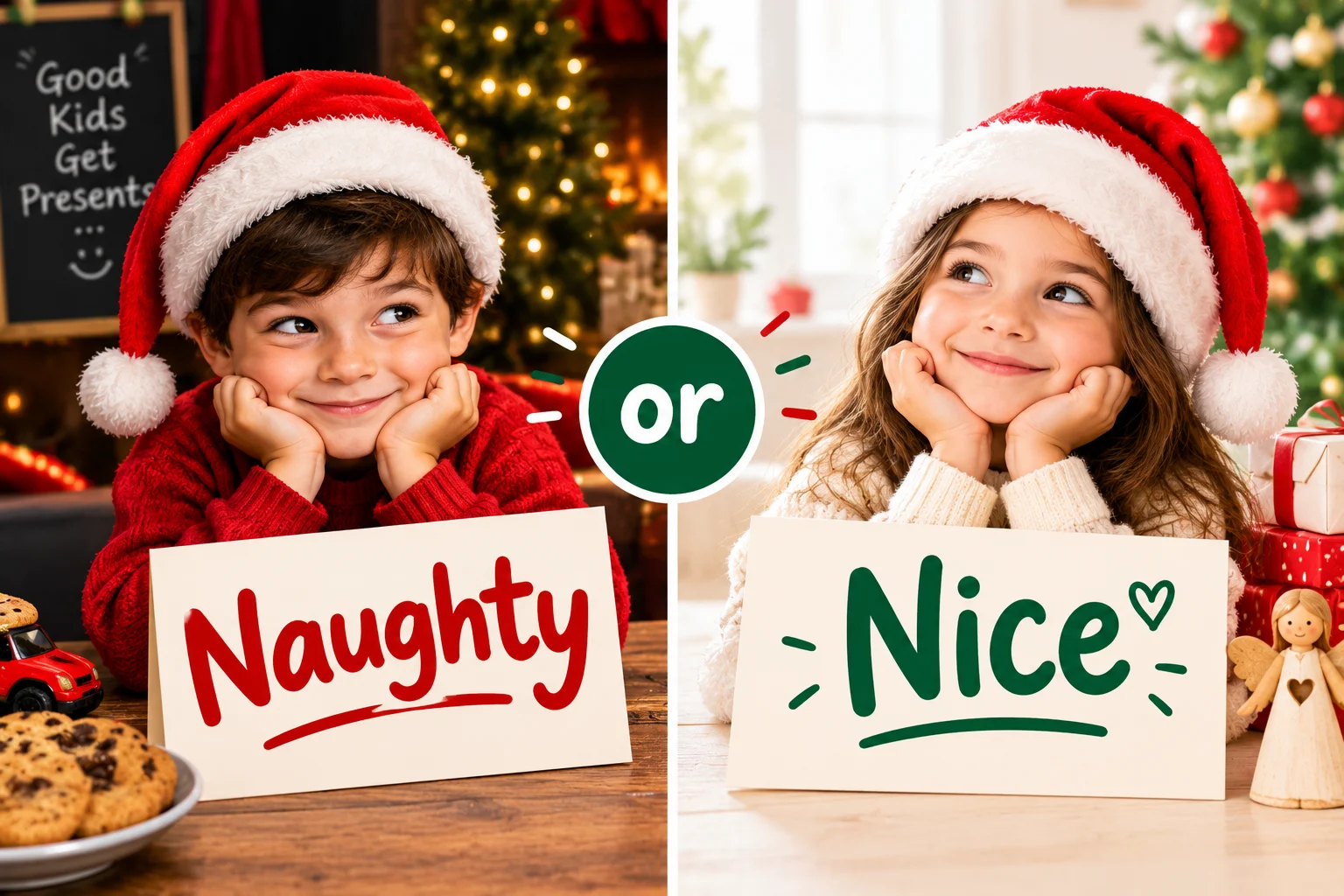
Naughty or nice is a phrase used to describe whether someone has behaved badly or well. It is strongly linked to the Christmas tradition of Santa keeping a “naughty list” and a “nice list.”
Have you ever heard someone ask, “Have you been naughty or nice?” You may have heard it around Christmas, but the phrase is also used in everyday jokes and friendly conversations.
I first noticed how often people use this phrase when working with young English learners. Some students knew the phrase from Christmas songs and Santa stories. Yet, they were not always sure what naughty and nice meant on their own.
That confusion is easy to understand. Nice is a common word with many meanings. Naughty, on the other hand, often describes children who misbehave. Together, the words create a simple contrast: bad behavior or good behavior.
The phrase can sound serious, playful, teasing, or humorous. Its meaning depends on the situation.
So, if you have ever wondered whether naughty or nice is correct, what it means, or how to use it naturally, you are in the right place. Let’s make the meaning simple.
Naughty or Nice – Quick Answer
Naughty or nice asks whether a person has behaved badly or well.
- Naughty = behaving badly, especially in a playful or childish way.
- Nice = kind, good, pleasant, or well-behaved.
For example:
“Santa wants to know if you have been naughty or nice.”
Here, the speaker is asking whether the person has behaved well during the year.
The phrase is most famous during Christmas. Children are often told that Santa has a list of children who are “naughty” and another list of children who are “nice.”
However, the phrase can also be used outside Christmas.
“Were you naughty or nice while I was away?”
This could simply be a playful way to ask whether someone behaved well.
The Origin and Background of Naughty or Nice
The two words have different histories, but their use together became strongly connected with Santa Claus and Christmas traditions.
What Does “Naughty” Mean?
Naughty traditionally describes someone who behaves badly or disobeys rules.
It is often used for children:
“The naughty boy broke the toy.”
The word can also have a softer, playful meaning:
“You ate the last cookie? You’re naughty!”
In this case, the speaker may not be truly angry. The word adds humor.
What Does “Nice” Mean?
Nice can mean pleasant, kind, friendly, or good.
When talking about children’s behavior, it can mean well-behaved:
“She was very nice at school today.”
The modern Christmas idea turns these two words into opposites:
Naughty = bad behavior
Nice = good behavior
The phrase became popular through Christmas stories, songs, advertisements, cards, movies, and children’s traditions.
That is why many people instantly connect naughty or nice with Santa.
Naughty or Nice Explained — Key Differences
Although naughty and nice are opposites in this phrase, they do not have only one meaning.
| Term | Meaning | When to Use | Region/Context |
|---|---|---|---|
| Naughty | Badly behaved or disobedient | Talking about behavior | Common in everyday English |
| Nice | Kind, pleasant, or well-behaved | Talking about people or behavior | Common in all major English varieties |
| Naughty or nice | Badly behaved or well-behaved | Asking about someone’s behavior | Especially common around Christmas |
| Naughty list | A fictional list of people who misbehaved | Christmas/Santa context | Mainly cultural and playful |
| Nice list | A fictional list of people who behaved well | Christmas/Santa context | Mainly cultural and playful |
Example 1: Naughty
“The children were naughty during the class.”
The word suggests that the children did something wrong or did not follow the rules.
Example 2: Nice
“The children were nice to the new student.”
Here, nice means kind and friendly.
Example 3: Naughty or Nice
“Santa is checking his list to see who is naughty or nice.”
This is the classic Christmas use.
Is Naughty or Nice Only About Children?
No.
The phrase is often used for children, but adults can use it too.
For example:
“Have you been naughty or nice this year?”
An adult might say this jokingly to a friend.
You can also use it in advertising or social media:
“Our Christmas sale is here. Have you been naughty or nice?”
The phrase works because it is familiar and playful.
However, naughty can have different meanings in adult contexts. Sometimes it can suggest behavior that is mischievous, cheeky, or slightly improper.
Because of this, context matters.
Which Version or Approach Should You Use?
There is no spelling choice between naughty and nice. They are two different words with different meanings.
Use the phrase based on what you want to say.
For Christmas Writing
Use:
naughty or nice
This is the standard phrase.
“Santa knows if you have been naughty or nice.”
For Formal Writing
You may want a more precise phrase.
Instead of:
“The students were naughty.”
You could write:
“The students were disruptive.”
Or:
“The students did not follow the classroom rules.”
The word naughty can sound informal and child-focused.
For Friendly Conversation
Naughty works well when you want a playful tone.
“You finished the cake without sharing? Naughty!”
For Global English
Naughty or nice is widely understood by English speakers because of the global popularity of Christmas culture.
Still, if your audience is unfamiliar with the Christmas tradition, add context.
“According to the Christmas story, Santa keeps track of who has been naughty or nice.”
Common Mistakes with Naughty or Nice
The phrase looks simple, but learners sometimes use the words in the wrong way.
1. Using “naughty” to Mean Simply “Bad”
Mistake:
“The broken computer is naughty.”
Better:
“The broken computer is faulty.”
Why?
Naughty usually describes a person, especially their behavior. It does not normally describe a broken object.
2. Using “nice” for Every Positive Meaning
Mistake:
“She gave a nice solution to the problem.”
This is possible, but nice may be too vague in formal writing.
Better:
“She gave an effective solution to the problem.”
Choose a more exact word when precision matters.
3. Confusing Naughty With Evil
Naughty is usually much lighter than evil.
“The child was naughty.”
This suggests misbehavior.
“The villain was evil.”
This describes serious moral wrongdoing.
They are not interchangeable.
4. Assuming Nice Always Means Kind
Nice can mean several things.
“We had a nice dinner.”
Here, nice means enjoyable or pleasant.
“She is a nice person.”
Here, it may mean kind or pleasant.
Always check the context.
5. Changing “Naughty” to “Naught”
These words are completely different.
- Naughty = badly behaved
- Naught = zero or nothing
Example:
“The child was naughty.”
But:
“The score was naught.”
Naughty or Nice in Real-World Examples
1. Professional Email
A playful Christmas email might say:
Subject: Naughty or Nice?
“Before the holidays begin, let’s see who has been naughty or nice this year. Thank you for all your hard work!”
This is suitable for a friendly workplace message, especially during the holiday season.
For a serious business email, however, you would usually choose more professional language.
2. News Article
A light entertainment headline might read:
“Naughty or Nice? Christmas Characters Return to the Big Screen”
The phrase makes the headline playful and connects it to Christmas.
3. Social Media Post
“Christmas is almost here! 🎄 Have you been naughty or nice this year?”
This is a natural social media use.
The phrase works well because readers already understand its Christmas connection.
4. Formal Report
A formal report would usually avoid naughty.
Instead of:
“The children were naughty during the activity.”
A report could say:
“Several students did not follow the activity rules.”
This gives a clearer and more professional description.
Naughty or Nice — Data, Trends & Usage
The search intent behind naughty or nice is mainly informational. People may search the phrase because they want to understand its meaning, spelling, grammar, or Christmas connection.
Interest often becomes more relevant during the Christmas season, when people see the phrase in:
- Christmas cards
- Santa stories
- Holiday songs
- Children’s books
- Social media posts
- Christmas advertisements
- Movies and television shows
The phrase is also common in humorous content.
One reason it remains useful is its simplicity. Naughty and nice create an easy contrast that children can understand quickly.
The phrase also works well as a joke because people already know the cultural idea of Santa’s list.
For English learners, this makes naughty or nice an interesting example of how a common phrase can carry both a literal meaning and a strong cultural meaning.
Naughty or Nice: Standalone Comparison
| Term/Variant | Meaning | Region/Context | Best Used When |
|---|---|---|---|
| Naughty | Badly behaved or disobedient | Everyday English | Describing misbehavior |
| Nice | Kind, pleasant, or good | Everyday English | Describing positive behavior or qualities |
| Naughty or nice | Badly behaved or well-behaved | Christmas and casual speech | Asking about someone’s behavior |
| Naughty list | Fictional list of people who misbehaved | Santa/Christmas | Holiday stories and jokes |
| Nice list | Fictional list of people who behaved well | Santa/Christmas | Holiday stories and jokes |
| Naught | Zero or nothing | General English | Mathematical or old-fashioned contexts |
Frequently Asked Questions
Q: What does naughty or nice mean?
A: Naughty or nice means behaving badly or behaving well. It is strongly associated with the Christmas idea of Santa deciding who belongs on his naughty or nice list.
Q: Is naughty or nice grammatically correct?
A: Yes. Naughty or nice is a natural and correct English phrase. It joins two contrasting descriptions of behavior.
Q: Is naughty the opposite of nice?
A: In the Christmas phrase, yes. Naughty refers to bad behavior, while nice refers to good or well-behaved conduct. However, the two words have broader meanings in other situations.
Q: Is naughty or nice only used at Christmas?
A: No. It can be used at any time as a playful question about someone’s behavior. Still, Christmas is the context most strongly connected with the phrase.
Q: Is naughty appropriate in formal writing?
A: Usually, naughty is too informal or vague for serious formal writing. Words such as disruptive, disobedient, or inappropriate may be more precise, depending on the situation.
Q: Where does the phrase naughty or nice come from?
A: The phrase is connected with the Christmas tradition of Santa keeping track of children’s behavior. Stories and popular culture helped make the naughty-list and nice-list idea widely known.
Q: Can adults be called naughty?
A: Yes. Adults can be called naughty in a playful or teasing way. The exact meaning depends heavily on context and tone.
Q: What is the difference between naughty and mischievous?
A: Naughty often means badly behaved or disobedient. Mischievous usually suggests playful troublemaking and can sound less serious.
Q: What is the difference between naughty and bad?
A: Bad is a much broader word. Naughty usually refers to behavior that breaks rules or causes minor trouble, especially when talking about children.
Conclusion
Naughty or nice is a simple phrase with a strong cultural connection to Christmas. Naughty usually describes someone who behaves badly, while nice can describe someone who behaves well, acts kindly, or is pleasant.
The phrase is especially common when talking about Santa, Christmas, children, holiday jokes, and playful behavior. It can also appear in social media posts, advertisements, cards, and casual conversations.
Remember one simple idea:
Naughty = bad behavior.
Nice = good or pleasant behavior.
You should also consider the tone. Naughty is often playful when used with children or friends, but it may sound too informal for a serious report.
Now you know what naughty or nice means and how to use it naturally. Bookmark this guide, and the next time you see the phrase, you will know exactly what it means.