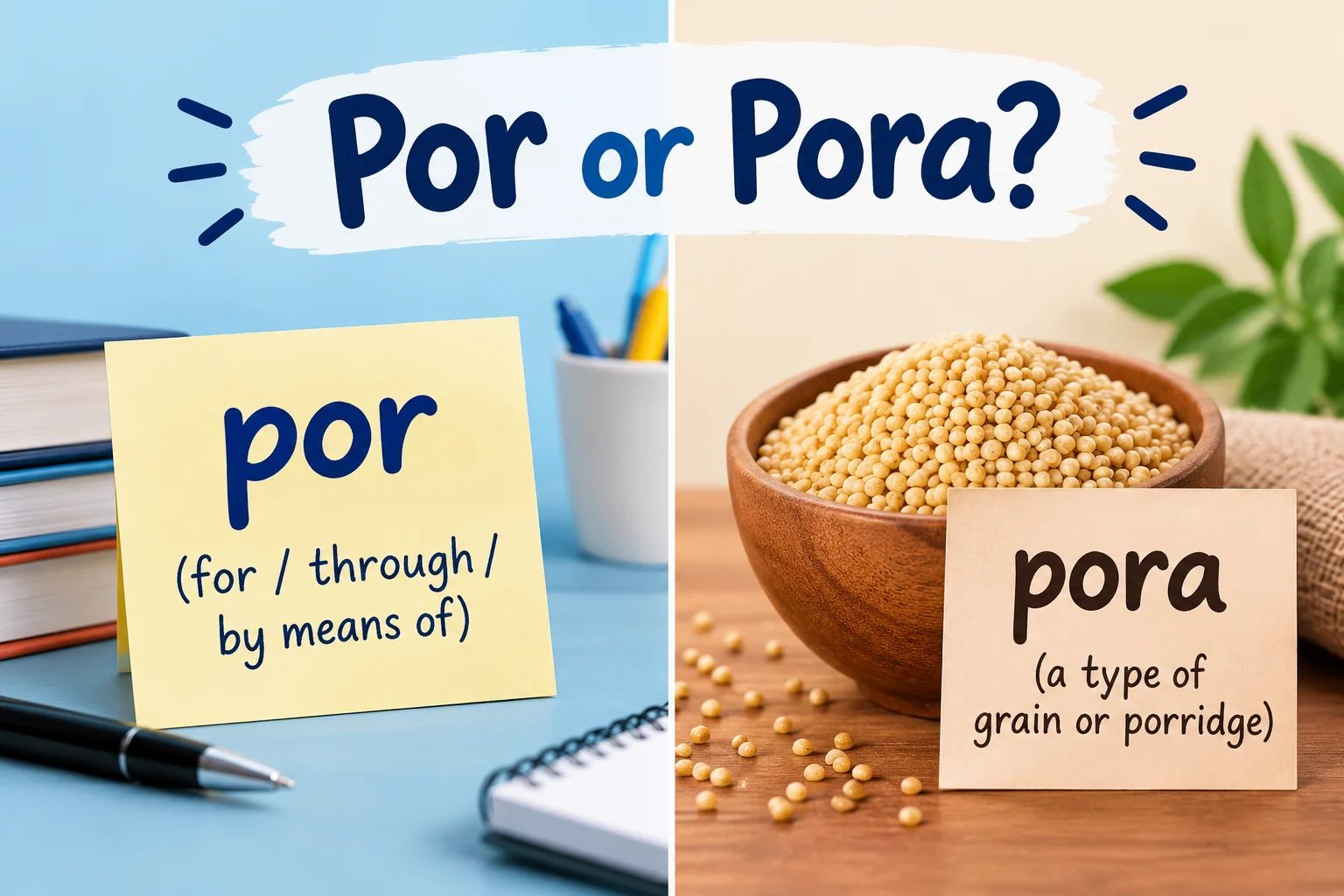
Por and para both often translate as “for” in English, but they are used in different situations. Por usually focuses on cause, exchange, movement, or duration, while para often shows purpose, destination, recipient, or a deadline.
One of the first things many English speakers notice when learning Spanish is a frustrating little problem: por or para?
Both words can mean “for.” That makes them easy to confuse. You might say “This gift is for Maria” and wonder whether Spanish needs por or para.
I have seen this mistake many times when helping English learners with Spanish grammar. The problem is not that students are careless. The problem is that English uses one common word where Spanish often uses two.
The good news is that you do not need to memorize hundreds of random sentences. Once you understand the basic idea behind each preposition, the choice becomes much easier.
Think of por as often answering questions like “because of what?” “through where?” “for how long?” or “in exchange for what?”
Think of para as often answering “for whom?” “for what purpose?” “where is it going?” or “by when?”
Let’s make por or para simple, practical, and easy to remember.
Por or Para – Quick Answer
Both por and para are Spanish prepositions. They can both be translated as “for,” but they do not have the same function.
Use por for ideas such as:
- Cause or reason: Lo hice por ti. — I did it because of you / for your sake.
- Duration: Estudié por dos horas. — I studied for two hours.
- Movement through an area: Caminamos por el parque. — We walked through the park.
- Exchange: Pagué diez dólares por el libro. — I paid ten dollars for the book.
- Means of communication: Te llamé por teléfono. — I called you by phone.
Use para for ideas such as:
- Purpose: Estudio para aprender. — I study in order to learn.
- Destination: Salimos para Madrid. — We leave for Madrid.
- Recipient: Este regalo es para Ana. — This gift is for Ana.
- Deadline: Es para mañana. — It is due for tomorrow.
- Intended use: Necesito una taza para café. — I need a cup for coffee.
A simple memory trick is:
Por = reason, route, exchange, duration.
Para = purpose, destination, recipient, deadline.
The Origin and Background of Por or Para
The words por and para are both deeply connected to the history of Spanish.
Spanish developed from Latin, and many Spanish prepositions have changed in form and meaning over centuries.
Por has roots connected to Latin forms such as pro and per. These older forms carried ideas related to movement, cause, agency, and position.
Para developed later from a combination involving por and a. Over time, it became a separate preposition with its own common functions.
This history helps explain why the two words can feel related.
They both deal with relationships between actions, people, places, time, and purpose. Yet modern Spanish uses them in different ways.
English learners often struggle because English has a broad word, for, that covers many of these meanings.
Compare:
“I bought this for Maria.”
“I did it for Maria.”
English uses the same preposition.
Spanish can distinguish the ideas:
Compré esto para María.
Lo hice por María.
The first focuses on the recipient. The second can suggest a reason, cause, or motivation.
Por or Para Explained — Key Differences
The easiest way to learn por or para is to group their uses.
| Term | Meaning | When to Use | Region/Context |
|---|---|---|---|
| Por | Cause or reason | Explaining why something happens | Standard Spanish |
| Por | Duration | Saying how long something lasts | Standard Spanish |
| Por | Movement through | Describing a route or area | Standard Spanish |
| Por | Exchange | Showing what is given or received | Standard Spanish |
| Por | Means | Showing how something is done or communicated | Standard Spanish |
| Para | Purpose | Explaining what something is intended to do | Standard Spanish |
| Para | Recipient | Showing who receives something | Standard Spanish |
| Para | Destination | Showing where someone or something is going | Standard Spanish |
| Para | Deadline | Showing when something must be ready | Standard Spanish |
| Para | Intended use | Showing what something is meant for | Standard Spanish |
Let’s look at the most useful patterns.
1. Por for Cause or Reason
Use por when you explain why something happened.
Lo hice por ti.
I did it for you.
The phrase can suggest motivation or reason.
Another example:
Gracias por tu ayuda.
Thanks for your help.
Here, por introduces the reason for the thanks.
2. Por for Duration
Use por to describe a period of time.
Estudié por tres horas.
I studied for three hours.
Vivimos allí por dos años.
We lived there for two years.
The focus is on how long an action lasted.
3. Por for Movement Through an Area
Use por when someone moves through, around, or along an area.
Caminamos por el parque.
We walked through the park.
Paseamos por la ciudad.
We walked around the city.
The idea is the route or area through which movement occurs.
4. Por for Exchange
Use por when one thing is exchanged for another.
Pagué veinte dólares por el libro.
I paid twenty dollars for the book.
Te cambio mi asiento por el tuyo.
I’ll exchange my seat for yours.
Think of por here as “in exchange for.”
5. Por for Means of Communication or Transport
Use por to describe a means or method.
Hablamos por teléfono.
We talked by phone.
Te envié el documento por correo electrónico.
I sent you the document by email.
You can think of this use as answering:
“By what means?”
6. Para for Purpose
Use para when something is done in order to achieve a goal.
Estudio para aprender español.
I study to learn Spanish.
Trabajo para ganar dinero.
I work to earn money.
A useful test is to ask:
“What is the purpose?”
If the answer gives a goal, para is often the right choice.
7. Para for a Recipient
Use para when something is intended for someone.
Este regalo es para María.
This gift is for Maria.
Compré flores para mi madre.
I bought flowers for my mother.
Here, para points toward the person who will receive something.
8. Para for Destination
Use para when talking about a destination.
Salimos para Madrid.
We leave for Madrid.
El tren sale para Barcelona.
The train leaves for Barcelona.
The idea is movement toward a destination.
9. Para for a Deadline
Use para when something must be completed by a certain time.
La tarea es para mañana.
The homework is due tomorrow.
Necesito el reportaje para el lunes.
I need the report by Monday.
Think:
“By what time?” → para
A Simple Memory Trick for Por or Para
If you keep mixing them up, try this shortcut.
Remember POR = C.R.E.W.
C — Cause
R — Route
E — Exchange
W — While / duration
Examples:
- Cause → Lo hice por ti.
- Route → Caminamos por el parque.
- Exchange → Pagué $10 por el libro.
- Duration → Trabajé por dos horas.
Remember PARA = P.D.R.D.
P — Purpose
D — Destination
R — Recipient
D — Deadline
Examples:
- Purpose → Estudio para aprender.
- Destination → Salimos para Madrid.
- Recipient → Es para Juan.
- Deadline → Es para mañana.
This is not a rule for every possible use. It is a learning shortcut that covers many everyday situations.
Which Version or Approach Should You Use?
There is no “correct version” between por and para. Both are correct Spanish words.
The right choice depends on what you want to express.
For English-Speaking Beginners
Start with the main patterns.
Use por for:
- Cause
- Duration
- Exchange
- Movement through an area
- Means
Use para for:
- Purpose
- Recipient
- Destination
- Deadline
- Intended use
For Formal Spanish
Both por and para are fully standard.
The key is not to replace them based on the English word “for.” Instead, identify the relationship in the Spanish sentence.
For Everyday Conversation
Focus on meaning rather than memorizing translations.
Ask yourself:
Is this about a reason, route, exchange, or duration?
Think por.
Is this about a purpose, destination, recipient, or deadline?
Think para.
Common Mistakes with Por or Para
Mistake 1: Translating “For” Directly
❌ Este regalo es por María.
If you mean the gift is intended for Maria:
✅ Este regalo es para María.
The recipient calls for para.
Mistake 2: Using Para for Duration
❌ Estudié para tres horas.
✅ Estudié por tres horas.
The phrase describes how long the action lasted, so use por.
Mistake 3: Using Por for a Goal
❌ Estudio por aprender español.
If you mean “I study in order to learn Spanish,” use:
✅ Estudio para aprender español.
The purpose calls for para.
Mistake 4: Confusing Destination With Route
Compare these:
Viajamos por España.
This means you traveled through or around Spain.
Viajamos para España.
This can express that Spain is the destination.
The difference is subtle but useful:
por = through/around
para = toward/destination
Mistake 5: Using Para for Exchange
❌ Pagué diez dólares para el libro.
When you mean the price paid in exchange for something:
✅ Pagué diez dólares por el libro.
Think:
money exchanged for an item → por
Por or Para in Real-World Examples
1. Professional Email
Necesito el documento para el viernes.
“I need the document by Friday.”
Here, para shows the deadline.
2. News Article
El tren pasó por la ciudad durante la mañana.
“The train passed through the city during the morning.”
Here, por shows the route or area through which the train moved.
3. Social Media Post
Gracias por todo el apoyo. ❤️
“Thanks for all the support.”
Here, por introduces the reason for the thanks.
4. Formal Report
El programa fue diseñado para mejorar el acceso a la educación.
“The program was designed to improve access to education.”
Here, para introduces the purpose.
5. Everyday Conversation
Este café es para ti.
“This coffee is for you.”
The coffee is intended for the listener, so para is used.
Por or Para — Data, Trends & Usage
The search intent behind “por or para” is strongly informational.
English-speaking Spanish learners often search this phrase because both words can translate to “for.” The main need is not a dictionary definition. It is a clear way to choose the correct preposition in a sentence.
The topic is especially useful for:
- Spanish beginners
- Students preparing for Spanish tests
- Travelers learning practical Spanish
- English speakers studying Spanish grammar
- Writers checking Spanish sentences
One reason this topic remains difficult is that translation alone does not work well.
For example:
“I bought it for you.”
“I did it for you.”
Both sentences use for in English, but Spanish may use different prepositions depending on the intended meaning.
That is why learning meaning and function is more useful than memorizing a single English translation.
Por or Para: Standalone Comparison Table
| Term/Variant | Meaning | Region/Context | Best Used When |
|---|---|---|---|
| Por | Because of | Standard Spanish | Giving a cause |
| Por | Through / around | Standard Spanish | Showing movement or route |
| Por | For a period of | Standard Spanish | Showing duration |
| Por | In exchange for | Standard Spanish | Describing an exchange |
| Por | By / through a method | Standard Spanish | Showing means |
| Para | In order to | Standard Spanish | Showing purpose |
| Para | Intended for | Standard Spanish | Showing a recipient |
| Para | Toward / for | Standard Spanish | Showing destination |
| Para | By a certain time | Standard Spanish | Showing a deadline |
| Para | Intended use | Standard Spanish | Showing what something is meant for |
Frequently Asked Questions About Por or Para
Q: What is the main difference between por and para?
A: Por often describes a cause, route, exchange, duration, or means. Para often describes a purpose, recipient, destination, deadline, or intended use.
Q: Does por mean “for” in Spanish?
A: Yes, por can translate as “for,” but it has many other meanings. For example, Gracias por tu ayuda means “Thanks for your help.”
Q: Does para also mean “for”?
A: Yes. Para is often used when something is intended for a person or has a purpose. For example, Este regalo es para Ana means “This gift is for Ana.”
Q: Should I use por or para with a time period?
A: Use por for duration. For example, Trabajé por tres horas means “I worked for three hours.”
Q: Should I use por or para for a deadline?
A: Use para for a deadline. For example, El trabajo es para el lunes means “The work is due Monday.”
Q: Is por or para used for a destination?
A: Para is commonly used when expressing a destination or direction toward a place. For example, Salimos para Madrid means “We leave for Madrid.”
Q: Can por and para ever both be possible in a sentence?
A: Yes, but changing the preposition can change the meaning. For example, Viajamos por España focuses on traveling through Spain, while Viajamos para España focuses on Spain as the destination.
Conclusion
Learning por or para can feel difficult at first because both words often translate to “for.” The trick is to stop translating word by word.
Instead, ask what the sentence means.
Choose por when the idea is often about cause, route, exchange, duration, or means. Think of movement, reason, or something happening because of something else.
Choose para when the idea is often about purpose, destination, recipient, deadline, or intended use. Think of a goal or something moving toward a result.
Remember the quick guide:
Por = cause, route, exchange, duration.
Para = purpose, destination, recipient, deadline.
These shortcuts will not cover every advanced Spanish construction, but they give beginners a strong starting point.
The more Spanish you read and hear, the more natural the choice will become. Bookmark this guide and use these examples whenever you second-guess por or para.