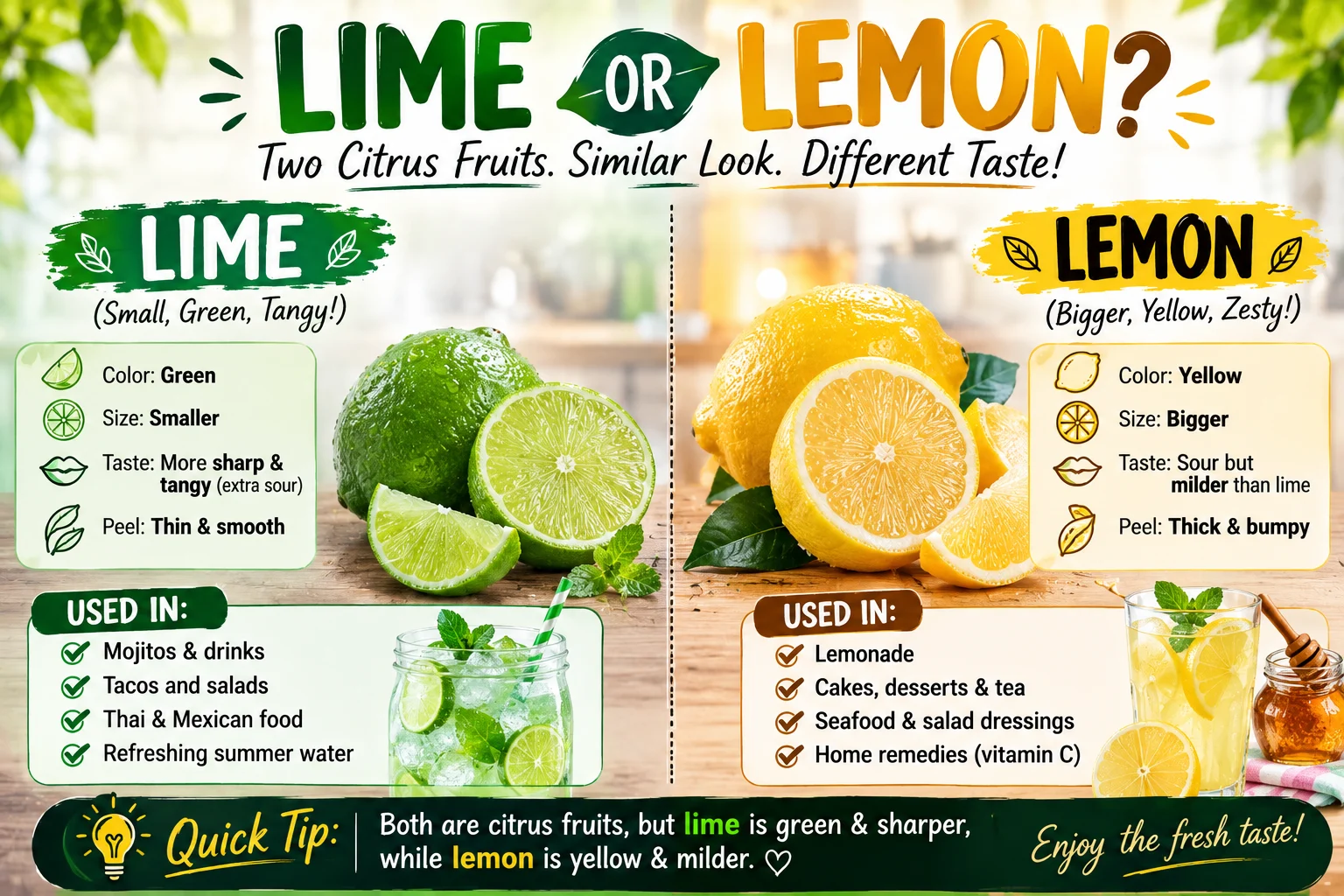
Lime and lemon are different citrus fruits. Lemons are usually larger, yellow, and milder, while limes are usually smaller, green, and more sharp or bitter.
Have you ever stood in a kitchen with a recipe asking for lime and wondered if you could use a lemon instead? I have faced this question many times while helping people with everyday English and food vocabulary. The two fruits look alike, taste similar, and are often used in the same kinds of dishes. That makes the confusion easy to understand.
But lime or lemon is not only a question about color. These fruits differ in size, taste, acidity, common uses, and even the way people talk about them in different places.
You may also hear someone say, “Just use a lemon.” Sometimes that works. Other times, it changes the flavor of the whole dish.
This guide makes the difference simple. You will learn what lime and lemon mean, where the words come from, how the fruits differ, when you can substitute one for the other, and how to use both words naturally in everyday English.
Lime or Lemon – Quick Answer
Lime and lemon are both citrus fruits, but they are not the same fruit.
A lemon is usually yellow when ripe. A lime is usually green, although some ripe limes can turn yellow.
Lemon
I added fresh lemon juice to the salad.
Lime
Squeeze some lime over the tacos.
Both fruits have a sour taste. However, their flavors are different.
Lemon usually has a bright, sharp, fresh taste.
Lime often has a stronger, more tangy flavor with a slightly bitter edge.
Simple rule
Think:
Lemon = usually yellow
Lime = usually green
Color is a useful clue, but it is not a perfect rule.
The Origin / Background of Lime and Lemon
The words lime and lemon have different histories.
The word lemon
The English word lemon came through several languages. Its history is linked to words used for citrus fruits in Middle Eastern and Mediterranean languages.
The lemon became widely known in Europe through trade and cultivation.
Today, lemon is one of the best-known citrus words in English.
You will see it in phrases such as:
- lemon juice
- lemon zest
- lemon tea
- lemon cake
- lemon water
- lemon flavor
The word can also have meanings beyond the fruit.
For example, in informal English, a lemon can describe something that does not work well, especially a poorly made vehicle.
He bought a used car, but it turned out to be a lemon.
The word lime
The English word lime also has a long history. It entered English through languages connected with Arabic and Persian trade routes.
The word has been used for different citrus fruits over time.
That history helps explain why lime can refer to more than one citrus species.
Why do people confuse them?
The confusion is natural.
Both fruits:
- Are citrus fruits
- Have green or yellow varieties
- Are sour
- Produce acidic juice
- Are used in drinks
- Are used in cooking
- Have fragrant peels
They can even look similar when cut open.
Still, lime and lemon are different fruits.
Lime or Lemon Explained — Key Differences
The easiest way to compare them is to look at their color, size, flavor, and common uses.
| Term | Meaning | When to Use | Region/Context |
|---|---|---|---|
| Lemon | A yellow citrus fruit with sour juice | Cooking, drinks, baking, sauces | Common worldwide |
| Lime | A small citrus fruit, often green, with sharp sour juice | Drinks, sauces, curries, marinades | Common worldwide |
| Lemon juice | Juice from a lemon | Baking, drinks, dressings | Global |
| Lime juice | Juice from a lime | Cocktails, sauces, marinades, cooking | Global |
| Lemon zest | Outer yellow peel of a lemon | Baking and cooking | Global |
| Lime zest | Outer green or yellow peel of a lime | Desserts and savory dishes | Global |
1. Lemon
Lemons are usually larger than limes.
A ripe lemon is normally yellow. Its juice has a strong sour taste and is common in cooking and baking.
You may use lemon in:
- Tea
- Cakes
- Salad dressings
- Fish dishes
- Sauces
- Lemonade
- Marinades
2. Lime
Limes are usually smaller and often green.
Their flavor can be more intense and slightly bitter than lemon.
Lime is common in:
- Tacos
- Curries
- Salsas
- Marinades
- Soft drinks
- Cocktails
- Asian dishes
3. Taste
This is where the difference becomes easy to notice.
Lemon often tastes bright, clean, and sharply sour.
Lime often tastes more intense, aromatic, and tangy.
The exact taste can change depending on the variety and how ripe the fruit is.
Which Version / Approach Should You Use?
The right choice depends on what you are doing.
For students
Use lemon when the fruit is yellow and the context clearly refers to lemon.
Use lime when the recipe, lesson, or description refers to the green citrus fruit.
Example:
The recipe needs the juice of one lime.
Do not replace the word just because both fruits are sour.
For cooks
Follow the recipe.
If a recipe asks for lime juice, use lime when possible. Lime has a distinct flavor that can change the final dish.
If you only have lemon, you can sometimes substitute it.
But the result may taste different.
For drink makers
Lime and lemon can both work in drinks.
However, they create different flavors.
Lemon is common in lemonade, tea, and many soft drinks.
Lime is common in sparkling drinks, mocktails, cocktails, and tropical-style beverages.
For global or neutral use
Use the exact fruit you mean.
If you mean the yellow fruit, say lemon.
If you mean the green citrus fruit, say lime.
This is clearer than using one word as a general name for both.
Lemon vs. Lime: Color, Size, and Shape
Color is one of the easiest clues.
Lemons
Lemons are commonly:
- Yellow when ripe
- Oval-shaped
- Larger than many common limes
- Slightly pointed at the ends
Limes
Limes are commonly:
- Green
- Smaller
- Round or oval
- Thin-skinned in some varieties
But there is an important detail.
Not every lime stays green when fully ripe.
Some limes can become yellow as they mature.
Likewise, some young lemons can have a greenish color.
So, do not rely on color alone.
Look at the fruit’s shape, size, texture, and context too.
Common Mistakes with Lime or Lemon
People make several common mistakes when using these words.
1. Treating lime and lemon as the same fruit
❌ Lime and lemon are the same thing.
✅ Lime and lemon are different citrus fruits.
Why?
They share many qualities, but they belong to different citrus groups and have different flavor profiles.
2. Assuming every green citrus fruit is a lime
❌ If it is green, it must be a lime.
✅ Green color alone does not prove that a fruit is a lime.
Why?
Some lemons can be green before they fully ripen.
3. Assuming lemon can always replace lime
❌ Lemon is always a perfect substitute for lime.
✅ Lemon can replace lime in some recipes, but the flavor will change.
Why?
Lime has a distinct aroma and flavor.
4. Using “lemon” for any sour citrus
❌ This drink contains lemon.
✅ This drink contains lime.
Why?
The word should match the fruit actually used.
5. Confusing “lime” the fruit with “lime” the mineral
The word lime has another meaning.
Lime can also refer to certain calcium-based materials used in construction and other industries.
So context matters.
Add fresh lime juice.
Here, lime means the fruit.
The workers used lime in the building material.
Here, lime refers to a mineral-based substance.
Lime or Lemon in Real-World Examples
1. Professional Email
Subject: Lemon and Lime Order
Please confirm that the kitchen order includes fresh lemons and limes for next week’s menu.
Both words are clear and correct.
2. News Headline
Lime and Lemon Prices Rise as Citrus Supply Changes
A news article about farming, food, or markets may use both words to distinguish the two fruits.
3. Social Media Post
Fresh lime on my tacos makes everything better. 🍋🟩
Or:
A little lemon in my tea is all I need this morning. 🍋
The correct word depends on the fruit.
4. Formal Document or Report
The study compared consumer preferences for lemon and lime flavors in bottled beverages.
This is a clear formal use.
5. Recipe
Add the juice of one lemon and the zest of one lime.
Here, using both words helps the reader understand that the recipe needs two different citrus fruits.
Can You Substitute Lemon for Lime?
Sometimes, yes.
But you should expect a flavor change.
When lemon can work
Lemon can often replace lime in:
- Salad dressings
- Marinades
- Some sauces
- Water
- Tea
- Simple desserts
When lime is better
Lime is often the better choice when its flavor is a key part of the dish.
Examples include:
- Guacamole
- Many Mexican-style dishes
- Certain Thai dishes
- Lime-based desserts
- Some cocktails
- Recipes designed around lime flavor
Can lime replace lemon?
Sometimes.
But the result may be more intense or aromatic.
For example, lime can give a cake or drink a stronger citrus character.
Best rule: If the recipe names a specific fruit, use that fruit when possible.
Lime or Lemon — Data, Trends & Usage
The search query “lime or lemon” usually has an informational and comparison-based intent.
People may want to know:
- What is the difference between lime and lemon?
- Can lime replace lemon?
- Which tastes better?
- Which fruit should I use in a recipe?
- Are lime and lemon the same?
- Which fruit is more acidic?
This topic also appears often in food, cooking, gardening, nutrition, drinks, and language searches.
Why does this matter?
The two fruits are used in many of the same ways.
That creates a common situation: you have one fruit at home, but your recipe asks for the other.
Knowing the difference helps you make a better choice.
It also helps you describe food accurately.
Search intent
The main intent is:
Informational → comparison → cooking advice → ingredient substitution
The reader usually wants a quick distinction first. Then they want practical information about taste and use.
Lime vs. Lemon: Standalone Comparison Table
| Term/Variant | Meaning | Region/Context | Best Used When |
|---|---|---|---|
| Lemon | Usually yellow citrus fruit | Global food and language use | Baking, tea, dressings, lemonade |
| Lime | Usually green citrus fruit | Global food and language use | Tacos, sauces, marinades, drinks |
| Lemon juice | Juice from lemon | Cooking and beverages | When a bright, sour flavor is needed |
| Lime juice | Juice from lime | Cooking and beverages | When a sharper, aromatic citrus flavor is needed |
| Lemon zest | Yellow outer peel | Baking and cooking | Adding lemon aroma |
| Lime zest | Outer peel of lime | Cooking and desserts | Adding a stronger lime aroma |
Lemon vs. Lime in Cooking
Choosing between the two can change a recipe.
Lemon works well with
- Fish
- Chicken
- Tea
- Cakes
- Cookies
- Salads
- Cream sauces
- Lemonade
Lime works well with
- Tacos
- Guacamole
- Salsa
- Curries
- Seafood
- Marinades
- Tropical drinks
- Lime desserts
This is not a strict rule.
Good cooks use both fruits in many creative ways.
The key is to understand their flavor difference.
Lemon vs. Lime in Drinks
Both fruits are popular in beverages.
Lemon
Lemon is strongly associated with:
- Lemonade
- Lemon tea
- Water with lemon
- Lemon-flavored drinks
Lime
Lime is often associated with:
- Lime soda
- Mocktails
- Cocktails
- Sparkling water
- Tropical drinks
You can often swap them in a simple drink.
Still, the final taste will not be identical.
FAQ: Lime or Lemon
Q: What is the difference between lime and lemon?
A: Both are citrus fruits, but they are different fruits. Lemons are usually yellow and larger, while limes are usually smaller and green.
Q: Which is more sour, lime or lemon?
A: Both can be very sour. The exact acidity varies by fruit, variety, and ripeness. Lime often tastes sharper and more intense, while lemon can taste brighter and cleaner.
Q: Can I use lime instead of lemon?
A: Sometimes, yes. Lime can work well in drinks, dressings, sauces, and some desserts, but it can give the recipe a stronger and different flavor.
Q: Can I use lemon instead of lime?
A: Yes, in many recipes. Lemon is often a practical substitute, but it will not taste exactly like lime.
Q: Are lime and lemon the same fruit?
A: No. They are different citrus fruits. They share some qualities, but their appearance, flavor, and common uses differ.
Q: Is lime always green and lemon always yellow?
A: No. Color is a useful clue, but it is not a perfect rule. Some limes become yellow as they ripen, and lemons can be green before they mature.
Q: Which is better for cooking, lime or lemon?
A: Neither is always better. Lemon works well in foods such as fish, cakes, and dressings, while lime is popular in sauces, marinades, tacos, and many Asian dishes.
Q: Is lime good for drinks?
A: Yes. Lime is widely used in soft drinks, sparkling water, mocktails, cocktails, and other beverages. Its sharp flavor can make drinks taste fresh and bright.
Q: Where do the words lime and lemon come from?
A: Both words have long histories and entered English through older languages connected with citrus trade and cultivation. They developed separately because they refer to different fruits.
Q: Can I use lemon and lime together?
A: Yes. Their flavors can work well together. Using both can give a dish or drink a more complex citrus taste.
Conclusion
The difference between lime or lemon is easy to understand once you look at their appearance, flavor, and common uses.
A lemon is usually yellow, oval, and slightly larger. It has a bright sour taste and is common in tea, lemonade, baking, sauces, salads, and fish dishes.
A lime is usually smaller and green. It often has a sharper, more aromatic flavor and is popular in drinks, marinades, tacos, sauces, curries, and many international dishes.
You can sometimes substitute one for the other. However, the taste will change. If a recipe depends strongly on lime or lemon flavor, it is best to use the fruit named in the recipe.
The easiest rule is simple:
Lemon = usually yellow and bright.
Lime = usually green and sharper.
Remember that color alone is not perfect. Some fruits change color as they ripen.
Now you know how lime and lemon differ and when to use each one. Bookmark this guide for your next recipe, and share it with someone who always mixes up these two citrus fruits.