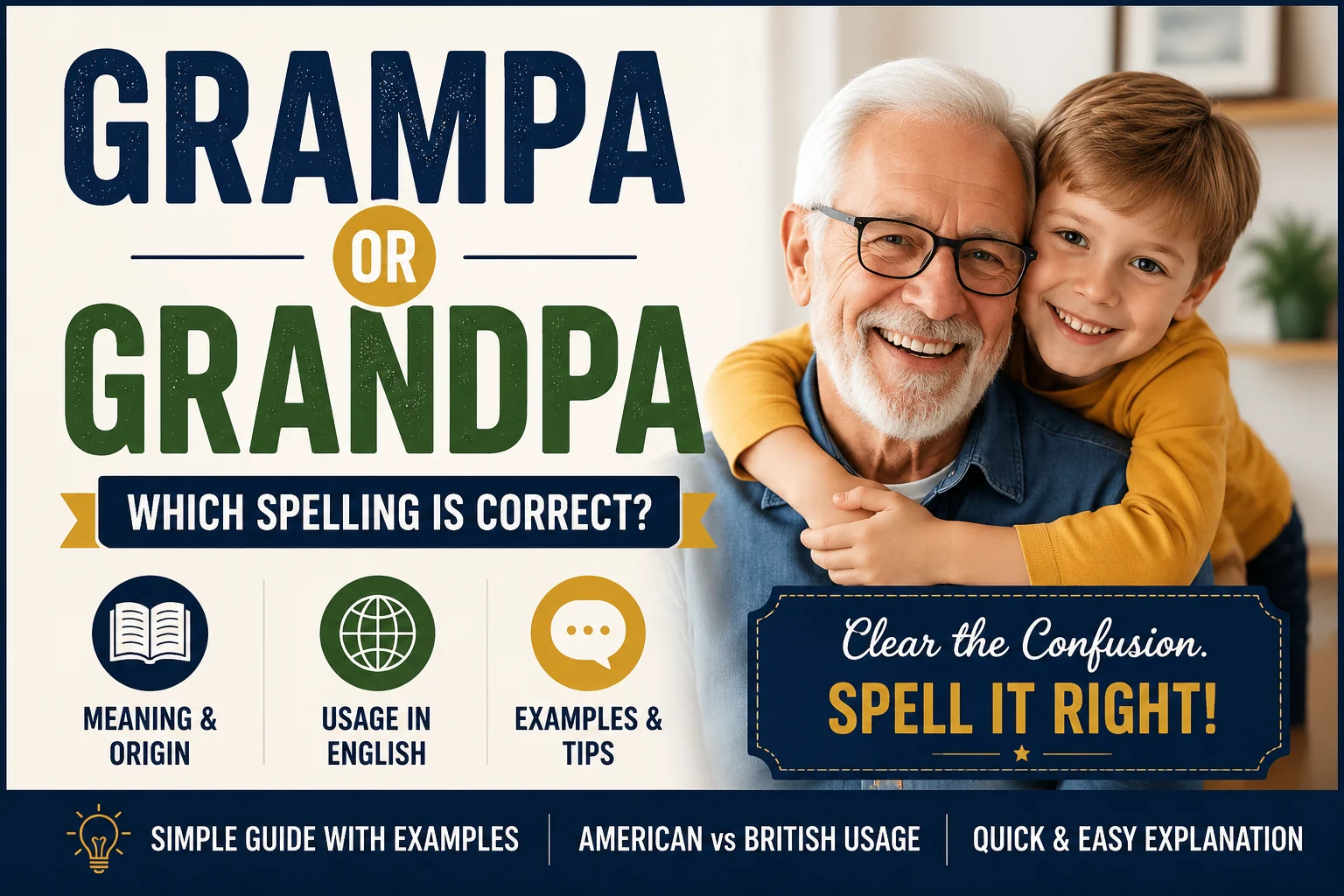
Grandpa is the standard and more common informal word for “grandfather.” Grampa is also used, but it is less common and more personal or informal.
Have you ever typed grampa and stopped to ask yourself, “Should this be grandpa?” You are not alone. This small spelling difference causes confusion because both forms are used by real English speakers.
When you talk about your grandfather, grandpa is the safest choice. It is the most common spelling in modern English. Grampa is also found in dictionaries and everyday writing, but it is less common.
The two words have the same basic meaning. Both are informal terms for a grandfather. The main difference is not meaning. It is usage, spelling, and frequency.
This can become even more confusing because family names often follow personal preference. One family may write Grandpa, while another may use Grampa. A child may even create a special spelling for a beloved grandparent.
So, which one should you use in your writing?
For most situations, choose grandpa. If you are writing dialogue, a family story, a card, or a personal message and someone prefers Grampa, that spelling can work too.
Let’s make the difference clear.
Grampa or Grandpa – Quick Answer
Grandpa is the more common spelling of the informal word for grandfather.
Grampa is an accepted variant, but it is much less common.
Simple Examples
My grandpa taught me how to fish.
I am visiting my grandpa this weekend.
You may also see:
My grampa taught me how to fish.
The meaning does not change.
The Quick Rule
If you are unsure, remember this:
- Grandpa → standard, common, and safest choice
- Grampa → informal variant, less common
- Grandfather → formal or neutral term
For school work, professional writing, and general English, grandpa is usually the better choice.
The Origin / Background of Grampa or Grandpa
The word grandpa is a shortened form of grandfather.
The word grandfather combines grand with father. The word grand came to be used to show a relationship one generation above a parent.
So:
father → grandfather
Over time, English speakers began shortening family terms.
For example:
- grandfather → grandpa
- grandmother → grandma
- mother → mom
- father → dad
These shorter forms are often called familiar or informal terms.
They are common in family speech because they sound warm and natural.
Why Does “Grampa” Exist?
English spelling often reflects pronunciation.
When people say grandpa quickly, the middle sounds can become less distinct. Some speakers hear or pronounce the word in a way that leads to the spelling grampa.
That spelling has appeared in informal writing for many years.
It can also be influenced by how children learn family words. A young child may hear grandpa and naturally write grampa because the pronunciation can sound close to “gram-pa.”
That does not mean the two words have different meanings.
Grandpa Is More Common
Although grampa is used, grandpa is the usual spelling.
You will find grandpa much more often in:
- Everyday writing
- Children’s books
- Family stories
- Greeting cards
- School writing
- Online conversations
- General American English
Grampa tends to appear more in personal, informal, or stylistic contexts.
Grampa or Grandpa Explained — Key Differences
The biggest point is simple: there is no major difference in meaning.
Both words mean grandfather.
The difference is mainly about which spelling you choose.
Grandpa
Grandpa is the standard informal form.
Example:
My grandpa lives near the lake.
It sounds natural and familiar.
You can use it when speaking about your grandfather or addressing him directly.
“Hi, Grandpa!”
Grampa
Grampa has the same basic meaning.
Example:
My grampa tells the funniest stories.
It can sound more personal because it is less common. A writer may also use it to reflect a character’s speech or a family’s preferred spelling.
Grandfather
Grandfather is the full word.
It is more neutral and can sound more formal.
Example:
My grandfather served in the army.
You would usually choose grandfather for formal documents, academic writing, or situations where an informal family term does not fit.
Comparison Table
| Term | Meaning | When to Use | Region/Context |
|---|---|---|---|
| Grandpa | Grandfather | Everyday and informal writing | Common English |
| Grampa | Grandfather | Personal and informal writing | Less common variant |
| Grandfather | Father’s or mother’s father | Formal or neutral writing | Standard English |
| Granddad | Grandfather | Informal family use | Especially common in British English |
| Grandad | Grandfather | Informal family use | British English and other varieties |
Which Version Should You Use?
Your best choice depends on the situation.
For Students → Use “Grandpa”
If you are writing a simple story or personal essay, grandpa is the safest informal spelling.
Example:
My grandpa always tells me stories about his childhood.
If your teacher asks for formal language, however, grandfather may be better.
For Formal Writing → Use “Grandfather”
A business letter or formal report usually does not need a word such as grandpa.
Instead, write:
My grandfather was born in 1945.
This sounds more neutral.
For Family Messages → Use the Family’s Choice
Family language is different.
If your family calls someone Grampa, there is no need to change it.
For example:
Happy birthday, Grampa!
The personal spelling can be part of the family’s identity.
For Children’s Stories → Either Can Work
Authors sometimes use family terms to make characters sound natural.
For example:
“Come here, Grandpa,” Mia said.
A writer could also use:
“Come here, Grampa,” Mia said.
Choose the form that fits the character and style.
For General Writing → Choose “Grandpa”
If you have no special reason to use grampa, choose grandpa.
It is more familiar to most readers.
Common Mistakes with Grampa or Grandpa
1. Thinking “Grampa” Is Always Wrong
Mistake:
“Grampa is not a real word.”
Correction:
Grampa is a recognized variant used as an informal term for grandfather.
However, grandpa is much more common.
2. Thinking Both Forms Are Equally Common
Mistake:
“Grandpa and grampa are used exactly the same amount.”
Correction:
Grandpa is far more common in general English.
Grampa is less common and often has a personal or informal feel.
3. Using “Grandpa” in Formal Documents
Mistake:
My grandpa was listed as a family member on the official form.
Better:
My grandfather was listed as a family member on the official form.
The word is not grammatically wrong. It is simply less formal.
4. Changing a Family’s Preferred Spelling
Mistake:
Happy birthday, Grandpa!
But the person has always used Grampa as his preferred family name.
Better:
Happy birthday, Grampa!
Names and family titles can be personal.
If a person prefers a particular spelling, respect it.
5. Confusing “Grandpa” With “Granddad”
These words have the same basic meaning.
However, different families and regions prefer different terms.
You may hear:
- Grandpa
- Grampa
- Granddad
- Grandad
- Grandfather
- Granddaddy
- Grandpapa
The choice often depends on family tradition, age, region, and personal preference.
Grampa or Grandpa in Real-World Examples
1. Professional Email
Family terms are uncommon in professional emails, but they may appear when you need to explain a personal situation.
Informal:
I need to leave early today because my grandpa has an appointment.
More formal:
I need to leave early today because my grandfather has an appointment.
The second version is usually better for a workplace email.
2. News Headline
A news story might use the formal word:
Local Grandfather Celebrates 100th Birthday
A lighter human-interest story might say:
Grandpa Turns 100 and Shares His Secret to a Long Life
The choice depends on the tone.
3. Social Media Post
Social media is more relaxed.
“Happy birthday to the best grandpa ever!”
If the family uses Grampa, you can write:
“Love you, Grampa! Thanks for always being there.”
Both work in a personal post.
4. Formal Document
Use grandfather in most formal documents.
“The applicant’s grandfather was born in Manchester.”
This is clear and neutral.
You would rarely need grampa in this type of writing.
5. Personal Story
“Every summer, my grandpa took me to the old farm.”
Here, grandpa sounds warm and natural.
You could also write:
“Every summer, my grampa took me to the old farm.”
That version may suggest a family or character preference.
Grampa or Grandpa — Data, Trends & Usage
The search intent behind grampa or grandpa is mainly informational and spelling-related.
People usually search the phrase because they want a quick answer to questions such as:
- Is grampa spelled correctly?
- Is grandpa the right spelling?
- Are grampa and grandpa the same?
- Which spelling should I use?
- Is grampa a real word?
- Is grandpa formal or informal?
Which Spelling Is More Common?
Grandpa is clearly the more common spelling in general English.
That makes it the best default for most readers.
Grampa still has a place, especially in informal family writing.
Why Does This Matter?
The difference is useful when you are writing for a broad audience.
A reader is more likely to recognize grandpa immediately.
If you use grampa, most readers will still understand it. But some may wonder whether it is a spelling mistake.
That is why grandpa is the safer choice when you want standard, familiar English.
Search Intent
This keyword has a strong spelling clarification intent.
The reader usually does not need a long history lesson. They want to know which form to use.
A useful answer should therefore give the direct rule first:
Grandpa is the common spelling. Grampa is an informal variant.
That simple distinction solves most of the confusion.
Standalone Comparison: Grampa vs. Grandpa
| Term/Variant | Meaning | Region/Context | Best Used When |
|---|---|---|---|
| Grandpa | Grandfather | General informal English | Most everyday situations |
| Grampa | Grandfather | Informal and personal | Family preference or character voice |
| Grandfather | Parent’s father | Formal and neutral English | School, work, and official writing |
| Granddad | Grandfather | Informal | Family and regional usage |
| Grandad | Grandfather | Common in British English | British family writing |
Frequently Asked Questions About Grampa or Grandpa
Q: What does “grandpa” mean?
A: Grandpa is an informal word for your grandfather, meaning your mother’s or father’s father. It is a common and friendly family term.
Q: How do you use “grandpa” correctly?
A: Use grandpa when talking about or speaking directly to your grandfather in an informal setting. For example: “My grandpa loves gardening.”
Q: Grampa vs. grandpa — what’s the difference?
A: Both mean grandfather. Grandpa is the more common spelling, while grampa is a less common informal variant.
Q: Is “grandpa” acceptable in formal writing?
A: It is grammatically correct, but it is informal. For formal writing, grandfather is usually the better choice.
Q: Which version is correct — grampa or grandpa?
A: Grandpa is the standard and more common choice. Grampa is also used as an informal variant, especially when it reflects personal or family preference.
Q: Where does the word “grandpa” come from?
A: Grandpa is a shortened form of grandfather. It developed as part of the family vocabulary used in everyday speech.
Q: Can “grampa” be used in a children’s book?
A: Yes. Grampa can work well in children’s books, dialogue, or personal stories. It can give a character or family a distinct voice.
Q: Is “grampa” a misspelling?
A: Not always. Grampa is an established informal variant. Still, grandpa is the more common spelling and is the safer choice for general writing.
Q: Is “grandpa” American or British English?
A: Grandpa is widely understood in both American and British English. British speakers may also use granddad or grandad.
Conclusion
When choosing between grampa or grandpa, you can keep the rule simple.
Grandpa is the more common and safer spelling for everyday English. It is friendly, natural, and widely understood.
Grampa is also used, but it is less common. It may appear in family writing, children’s speech, dialogue, or situations where a person or family prefers that spelling.
For formal writing, grandfather is usually the best option.
Think of the three forms this way:
- Grandpa = common and informal
- Grampa = less common and personal
- Grandfather = formal and neutral
There is no major difference in meaning between grandpa and grampa. The main difference is how common and familiar each spelling is.
So, if you are unsure, choose grandpa. If a family member prefers Grampa, use their preferred form.
Now you know exactly when to use grampa, grandpa, and grandfather. Bookmark this guide so you never second-guess the spelling again.