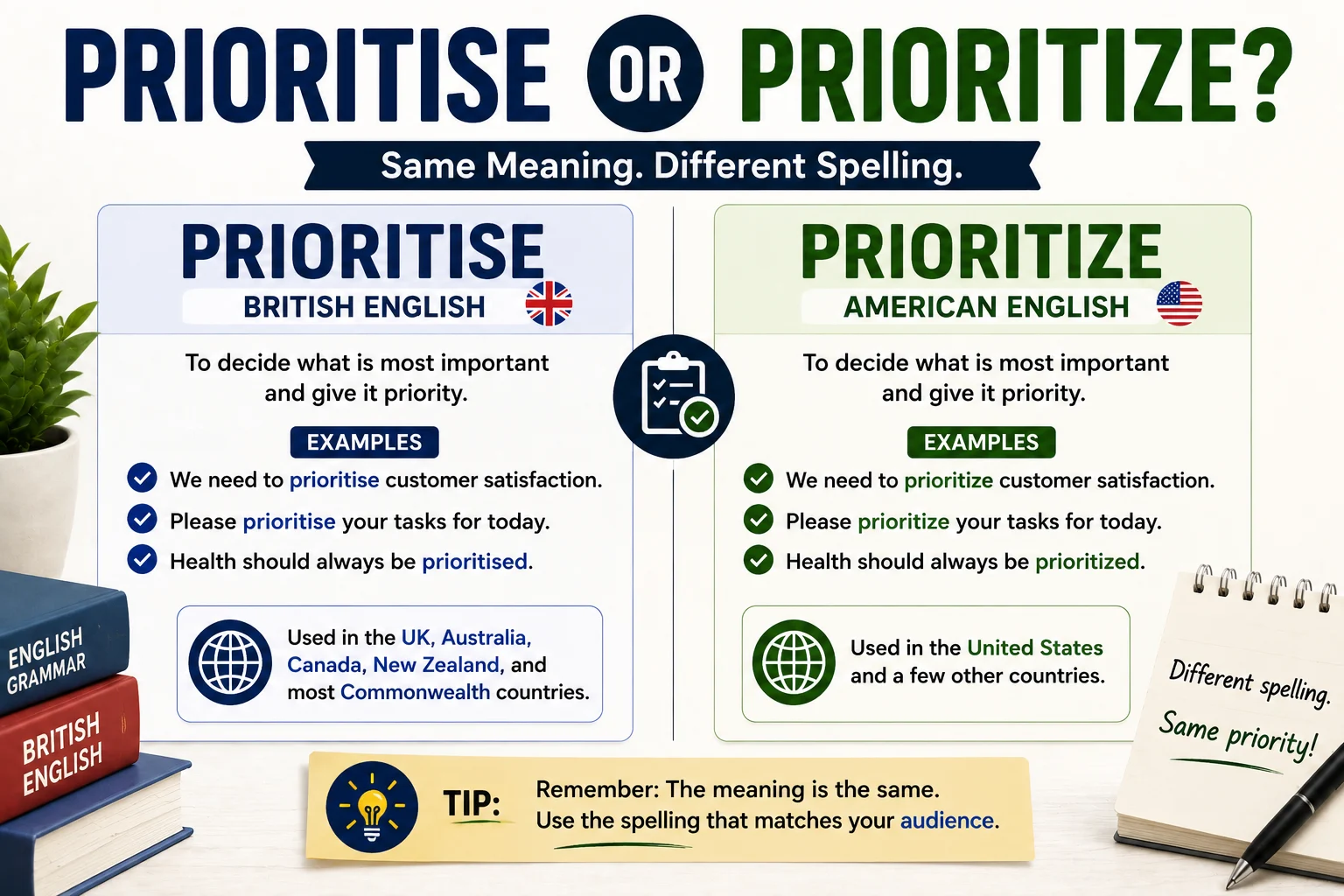
Prioritise is the British spelling, while prioritize is the American spelling. Both are correct; choose the spelling that matches your audience.
Have you ever typed prioritize and wondered if your teacher, editor, or reader would prefer prioritise? You are not alone. I have seen this small spelling difference confuse many English learners and writers. The good news is that you do not need to learn two different words.
Prioritise and prioritize have the same meaning. Both mean to decide what is most important and deal with it first. The only main difference is the spelling.
This difference comes from British and American English. British English often uses -ise, while American English usually uses -ize. You may see this pattern in words such as organise/organize, recognise/recognize, and realise/realize.
Knowing which form to use can make your writing look more polished. It can also help you avoid spelling mistakes in school, work, websites, and formal documents. Let us make the difference simple.
prioritise or prioritize – Quick Answer
Prioritise and prioritize mean the same thing.
They are both forms of the verb meaning to treat something as more important than other things.
- British English: prioritise
- American English: prioritize
Examples
British English:
We need to prioritise customer safety.
American English:
We need to prioritize customer safety.
The meaning does not change. Only the spelling changes.
What does “prioritize” mean?
To prioritize something means to put it higher on your list of things to do or consider.
For example:
I need to prioritize my homework tonight.
This means the homework is more important than some other tasks.
The Origin and Background of prioritise or prioritize
The word comes from priority, which means something that is more important than other things.
The noun priority comes from the Latin word prior, meaning earlier or former. The idea is simple: something that comes first is given greater importance.
English later formed the verb from priority. This gave us prioritize and prioritise.
Why are there two spellings?
The difference comes from English spelling traditions.
British English has traditionally used -ise in many words:
- prioritise
- organise
- recognise
- realise
- apologise
American English normally uses -ize:
- prioritize
- organize
- recognize
- realize
- apologize
There is one useful detail to remember. -ize is also found in some British English writing, especially in formal or academic styles. However, prioritise is very common in British English.
For most everyday writing, the safest rule is simple:
Use -ise for British English and -ize for American English.
prioritise or prioritize: Key Differences
The two forms have the same definition, pronunciation, and grammatical function.
The difference is mainly regional spelling.
| Term | Meaning | When to Use | Region/Context |
|---|---|---|---|
| prioritise | Treat as more important | British-style writing | UK and many Commonwealth contexts |
| prioritize | Treat as more important | American-style writing | United States |
| prioritised | Past form of prioritise | British English | UK/Commonwealth |
| prioritized | Past form of prioritize | American English | US |
| prioritising | Present participle | British English | UK/Commonwealth |
| prioritizing | Present participle | American English | US |
Example: present tense
We prioritise quality over speed.
We prioritize quality over speed.
Both sentences are correct.
Example: past tense
The team prioritised safety.
The team prioritized safety.
Again, both are correct.
Example: continuous form
She is prioritising her studies.
She is prioritizing her studies.
The grammar stays the same. The spelling changes.
Which Version Should You Use?
Your choice should depend on your audience and style guide.
For British English readers
Use prioritise.
This is a natural choice for:
- UK websites
- British schools
- UK businesses
- British newspapers
- Many Commonwealth audiences
Example:
Our company will prioritise customer service.
For American English readers
Use prioritize.
This is the standard choice for:
- US websites
- American schools
- US businesses
- American publications
- Most American professional writing
Example:
Our company will prioritize customer service.
For global audiences
Either form can work. The key is consistency.
If your website uses British spelling, use prioritise throughout.
If it uses American spelling, use prioritize throughout.
Do not switch between the two without a reason.
Common Mistakes with prioritise or prioritize
Small spelling differences can cause big confusion. Here are some common mistakes.
Mistake 1: Mixing British and American spelling
❌ We prioritize safety and organise the team.
This mixes two spelling systems.
✅ We prioritise safety and organise the team.
Or:
✅ We prioritize safety and organize the team.
Why? Your writing should normally follow one spelling style.
Mistake 2: Thinking prioritise is wrong
Some learners think prioritise is a spelling mistake because American English is more familiar to them.
❌ “Prioritise” is always wrong.
✅ Prioritise is correct in British English.
The spelling is not an error.
Mistake 3: Thinking prioritize is wrong
The opposite mistake also happens.
❌ “Prioritize” is incorrect English.
✅ Prioritize is standard American English.
It is widely used in American business, education, technology, and everyday writing.
Mistake 4: Changing the meaning
The spelling does not change the meaning.
❌ Prioritise means something different from prioritize.
✅ They mean the same thing.
The difference is mainly regional spelling.
Mistake 5: Using both forms in one document
If you choose British English, do not switch to American English halfway through your article.
For example, avoid:
We prioritise safety and prioritize customer needs.
Choose one style:
We prioritise safety and prioritise customer needs.
Or:
We prioritize safety and prioritize customer needs.
prioritise or prioritize in Real-World Examples
Seeing both forms in context makes the difference easier to remember.
1. Professional Email
British English:
Hi James,
We will prioritise the urgent requests first and review the remaining tasks tomorrow.
American English:
Hi James,
We will prioritize the urgent requests first and review the remaining tasks tomorrow.
Both sound professional.
2. News Article
British style:
The government plans to prioritise public safety in its new policy.
American style:
The government plans to prioritize public safety in its new policy.
The spelling depends on the publication’s English style.
3. Social Media Post
British English:
This week, I am learning to prioritise the tasks that matter most.
American English:
This week, I am learning to prioritize the tasks that matter most.
Both are natural.
4. Formal Report
British English:
The report recommends that the company prioritise employee safety.
American English:
The report recommends that the company prioritize employee safety.
The important point is to match the style used in the rest of the report.
prioritise or prioritize — Data, Trends & Usage
The search intent behind “prioritise or prioritize” is mainly informational. People usually search for the pair because they want to know which spelling is correct.
The confusion is easy to understand. English has many regional spelling differences. The -ise/-ize pattern is one of the most visible.
Readers are especially likely to meet this issue when:
- Writing for an international audience
- Applying for jobs
- Writing academic work
- Editing website content
- Using grammar or spelling tools
- Switching between British and American sources
Why does this matter?
Consistency can make your writing look more professional.
Imagine reading a report that uses prioritise, organize, recognise, and colour together. The mixed style may look unusual to some readers.
A consistent spelling system creates a smoother reading experience.
For SEO writers, this is also useful. You should understand both versions because people in different regions may search for different spellings.
However, do not force both spellings into your content. Write naturally for your target audience.
Standalone Comparison: prioritise vs prioritize
| Term/Variant | Meaning | Region/Context | Best Used When |
|---|---|---|---|
| prioritise | Give greater importance to something | British English | Writing for UK readers |
| prioritize | Give greater importance to something | American English | Writing for US readers |
| prioritised | Gave greater importance | British English | Past actions in UK English |
| prioritized | Gave greater importance | American English | Past actions in US English |
| prioritising | Giving greater importance | British English | Ongoing actions in UK English |
| prioritizing | Giving greater importance | American English | Ongoing actions in US English |
Easy memory trick
Think:
British = prioritise
American = prioritize
The s is commonly linked with British spelling.
The z is the standard American choice.
7 FAQs About prioritise or prioritize
Q: What does prioritise or prioritize mean?
Both words mean to decide that something is more important and should be dealt with first. They are different spellings of the same verb.
Q: Is prioritise correct English?
Yes. Prioritise is a correct spelling, especially in British English. It is widely used in the UK and other regions that follow British spelling.
Q: Is prioritize correct English?
Yes. Prioritize is the standard American spelling. It is also widely understood around the world.
Q: Which is correct, prioritise or prioritize?
Both are correct. Use prioritise for British English and prioritize for American English.
Q: Is prioritise or prioritize better for formal writing?
Both are suitable for formal writing. The best choice depends on your audience and the spelling style required by your school, company, publisher, or style guide.
Q: Do prioritise and prioritize sound different?
No. In normal English pronunciation, they are pronounced the same. The main difference is the written form.
Q: Can I use prioritize in British English?
Yes, -ize spellings can appear in British English, especially in some formal and academic styles. However, prioritise is a very common British form, so follow the style guide you are using.
prioritise or prioritize: Related Words
Learning related forms can make the spelling pattern easier.
British English
- prioritise — present form
- prioritised — past form
- prioritising — present participle
- prioritisation — noun
American English
- prioritize — present form
- prioritized — past form
- prioritizing — present participle
- prioritization — noun
Notice the same pattern:
-ise → -ised → -ising
and
-ize → -ized → -izing
Examples
We need to prioritise urgent work.
The manager prioritised the safety issue.
She is prioritising her studies.
American versions:
We need to prioritize urgent work.
The manager prioritized the safety issue.
She is prioritizing her studies.
How to Remember prioritise or prioritize
A simple memory method can save you from checking a dictionary every time.
If you write British English:
Remember:
prioritise → s
If you write American English:
Remember:
prioritize → z
You can use the same idea with other common words:
| British | American |
|---|---|
| organise | organize |
| recognise | recognize |
| realise | realize |
| apologise | apologize |
| prioritise | prioritize |
This pattern is not universal for every English word, but it is useful for many verbs with this spelling variation.
Final Recommendation
If your readers are mainly in the UK, choose prioritise.
If your readers are mainly in the US, choose prioritize.
If you are writing for a global audience, choose one style and use it consistently.
There is no need to worry that one version is “wrong.” Prioritise and prioritize have the same meaning. The difference comes from English spelling traditions.
The most useful lesson is not simply remembering one spelling. It is learning when to use each form. Once you know your audience, the choice becomes easy.
So, if you are writing a British English article, write:
We should prioritise quality.
For American English, write:
We should prioritize quality.
That small spelling choice can make your writing more consistent and polished. Bookmark this guide so you never second-guess prioritise or prioritize again.