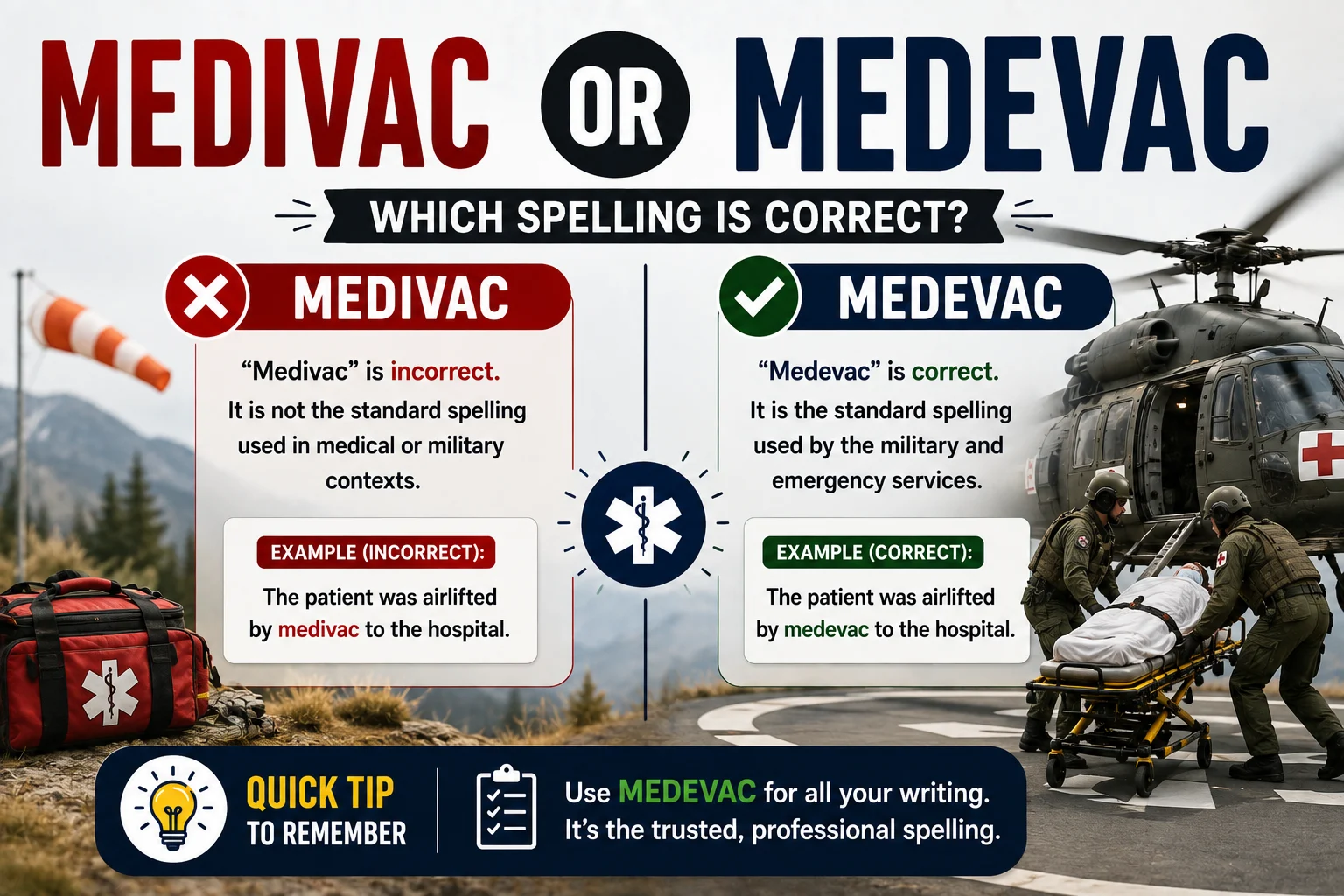
Medevac is the standard spelling for the emergency transport of a sick or injured person, especially by aircraft. Medivac is a less common variant, but medevac is the safer choice in formal writing.
Have you ever seen medivac and medevac and wondered which one belongs in your writing? You are not alone. This is a common spelling question because both forms appear in books, news reports, websites, and everyday speech.
The confusion makes sense. The word is a shortened form of medical evacuation, so it is easy to assume that medivac is the natural spelling. After all, the word contains the sound of “medical.” But English does not always form shortened words in the way we expect.
When I help learners with words like this, I often use one simple test: look at the form used most widely in standard English and remember the meaning behind it. That makes the choice much easier.
In this guide, you will learn the difference between medevac and medivac, where the words come from, how to use them, and which form is best for formal writing. By the end, you will not need to guess.
Medivac or Medevac – Quick Answer
The preferred spelling is medevac.
Medevac is a shortened form of medical evacuation. It refers to moving a sick or injured person to a medical facility for treatment.
Examples
- The injured climber was taken to the hospital by medevac.
- A medevac helicopter arrived at the accident site.
- The soldier needed a medevac after suffering a serious injury.
What about “medivac”?
Medivac is also used and can be found in real-world writing. However, it is less standard than medevac.
If you are writing an essay, report, article, application, or other formal text, choose medevac.
Easy rule to remember
Medical evacuation → medevac
Think of medevac as a short form built from medical evacuation.
The Origin and Background of Medivac or Medevac
To understand the spelling, it helps to look at the full phrase.
Medevac comes from medical evacuation.
The word is a shortened form, often called a blend or clipped term. The first part comes from medical, while the second part comes from evacuation.
The term became strongly associated with military operations, where wounded people often needed fast transport from dangerous areas to medical care.
Over time, medevac moved beyond military use. Today, it can describe emergency medical transport in many settings.
For example, you may hear the term in connection with:
- Mountain rescue
- Road accidents
- Remote areas
- Natural disasters
- Military operations
- Emergency helicopter services
- Offshore incidents
The spelling can look unusual because medevac does not copy the first few letters of medical exactly.
That is one reason people create the spelling medivac. The “i” seems to fit naturally with medical. Yet the established form is generally medevac.
Why does “medivac” appear?
English often develops spelling variations when people write a word based on how it sounds.
When someone hears medevac, they may connect it with medical and write medivac instead.
This is similar to many other spelling problems in English. A word can sound as if it should be spelled one way while its established written form is different.
Medivac or Medevac Explained — Key Differences
The two forms are closely related. They generally refer to the same idea: medical evacuation.
The main difference is their level of standard usage.
| Term | Meaning | When to Use | Region/Context |
|---|---|---|---|
| medevac | Medical evacuation or emergency medical transport | Preferred spelling | General and formal English |
| medivac | A variant spelling of medevac | Use only when the source or context specifically uses it | Less common usage |
| medical evacuation | Full term for moving someone to medical care | Best when maximum clarity is needed | Formal and professional writing |
1. Medevac
Medevac is the form you should normally use.
The patient was transported by medevac helicopter.
Here, medevac describes the emergency medical transport.
2. Medivac
Medivac can be found in some sources and organizations. It is understandable to most English speakers.
However, it is not usually the best choice when you want the safest standard spelling.
The patient was transported by medivac helicopter.
The sentence is understandable, but medevac is the better spelling for general formal use.
3. Medical evacuation
If your audience may not know the abbreviation, use the full phrase.
The team arranged an emergency medical evacuation.
This form is especially useful in formal documents where clarity matters more than brevity.
Which Version Should You Use?
Choosing between medivac and medevac is simple once you know your audience.
For students
Use medevac.
If you are writing a school assignment, exam answer, or research paper, medevac is the safest choice.
Example:
The injured hiker required a medevac to the nearest hospital.
For professional writers
Use medevac unless a specific organization or source uses another spelling.
This keeps your writing consistent with the more widely recognized form.
For journalists and bloggers
Medevac is usually the better choice.
It is short, clear, and familiar to readers who know the term.
For formal reports
Consider using medical evacuation the first time.
For example:
The rescue team requested a medical evacuation (medevac).
After that, you can use medevac.
For global or neutral writing
Use medevac.
If your readers may not know the term, write medical evacuation first and then introduce the shorter form.
Common Mistakes with Medivac or Medevac
Spelling mistakes often happen because the word is based on a longer phrase.
Here are some common errors to watch for.
Mistake 1: Writing “medivac” as the default form
Incorrect or less preferred:
The patient needed a medivac.
Better:
The patient needed a medevac.
The word is usually written medevac.
Mistake 2: Assuming “medical” must produce “medi-”
It is tempting to think:
medical + evacuation = medivac
But shortened words do not always preserve the exact spelling of their source words.
The established form is medevac.
Mistake 3: Using the word without knowing its meaning
A medevac is not simply any trip to a hospital.
It normally refers to the emergency evacuation or transport of a sick or injured person for medical care.
The context often involves urgent transport.
Mistake 4: Confusing medevac with an ordinary ambulance
An ambulance can provide medical transport.
A medevac can involve an ambulance, aircraft, helicopter, or another form of emergency transport, depending on the situation.
The key idea is the medical evacuation, not one specific vehicle.
Mistake 5: Using the abbreviation when the audience may not know it
In a specialist report, medevac may be perfectly clear.
For a general audience, this may be better:
The rescue team arranged an emergency medical evacuation (medevac).
This gives the reader the full meaning first.
Medivac or Medevac in Real-World Examples
Seeing the word in different settings can make the correct usage much easier to remember.
1. Professional Email
Subject: Emergency Medevac Request
The injured worker requires a medevac to the nearest medical facility. Please confirm the transport arrangements as soon as possible.
Here, medevac works well because the email concerns an urgent medical transport.
2. News Headline
Rescue Team Calls for Medevac After Mountain Accident
A headline uses medevac because the word is short and easy to recognize.
A news article might then explain the term:
Rescue officials requested a medical evacuation, or medevac, after the climber was injured.
3. Social Media Post
The rescue team reached the hiker quickly. A medevac was arranged because he needed urgent medical care.
The shorter form works well in social media because readers can understand it quickly.
4. Formal Report
The patient was stabilized at the scene before being transferred by medevac to a regional hospital.
For a formal report, medevac is concise and professional.
5. General-Audience Writing
The injured passenger was taken to a hospital by medical evacuation (medevac).
This version is helpful when readers may not know the abbreviation.
Medevac as a Noun, Verb, and Modifier
One useful point is that medevac can appear in more than one grammatical role.
Medevac as a noun
The patient required a medevac.
Here, medevac refers to the evacuation itself.
Medevac as a modifier
A medevac helicopter arrived at the scene.
Here, medevac helps describe the helicopter’s purpose.
Medevac as a verb
In some contexts, medevac is also used as a verb.
The injured worker was medevaced to a hospital.
This use is common in informal or specialized contexts.
For highly formal writing, however, transported by medical evacuation may be clearer.
Medivac or Medevac — Data, Trends & Usage
The search intent behind “medivac or medevac” is mainly informational.
People who search the phrase usually want a quick answer to one question:
Which spelling is correct?
The confusion often comes from pronunciation and the connection to the word medical.
Who is likely to search for this term?
The spelling question may interest:
- Students
- English learners
- Writers
- Editors
- Journalists
- Healthcare workers
- Emergency workers
- Military readers
- Bloggers
- People writing reports
Why does this matter?
A spelling choice can affect how professional your writing looks.
If you use medevac, most readers will recognize the standard term. If you use medivac, readers may still understand you, but some may see it as a spelling variant or mistake.
That makes medevac the stronger choice when you want clear, standard English.
Search intent
The main search intent is:
Informational → spelling clarification → correct usage
This is a classic “which spelling is correct?” query. A short answer helps, but examples are useful because the word can function in different ways.
Medevac vs. Medical Evacuation
One of the most useful distinctions is between the short form and the full phrase.
Medical evacuation is the complete term.
Medevac is the shorter form.
For example:
The team requested a medical evacuation.
Then:
The team requested a medevac.
Both sentences communicate the same basic idea.
The choice depends on your audience and the level of formality you want.
Quick tip
If you introduce the term for the first time:
medical evacuation (medevac)
Later, you can simply write:
medevac
This approach gives your reader both clarity and convenience.
Standalone Comparison Table: Medivac vs. Medevac
| Term/Variant | Meaning | Region/Context | Best Used When |
|---|---|---|---|
| Medevac | Medical evacuation or emergency medical transport | Standard English usage | Almost all general and formal writing |
| Medivac | Variant spelling of medevac | Less common usage | When following a specific source or established name |
| Medical evacuation | Full form of medevac | Professional and formal contexts | When clarity is the main goal |
| Medevac helicopter | Helicopter used for medical evacuation | Emergency and rescue contexts | When describing air medical transport |
Best overall choice: Medevac.
FAQ: Medivac or Medevac
Q: Is it “medivac” or “medevac”?
A: Medevac is the preferred spelling. It is a shortened form of medical evacuation. Medivac is a less common variant.
Q: What does medevac mean?
A: Medevac means medical evacuation. It usually refers to the urgent transport of a sick or injured person to a medical facility.
Q: Is medivac wrong?
A: Medivac is not meaningless, and the variant appears in real-world usage. However, medevac is the safer and more widely accepted spelling for general writing.
Q: Is medevac acceptable in formal writing?
A: Yes. Medevac is acceptable in formal writing when the audience understands the term. For maximum clarity, you can write medical evacuation (medevac) when introducing it.
Q: Is a medevac always a helicopter?
A: No. A medevac can involve different forms of transport. A helicopter is common in situations where speed or difficult terrain makes air transport useful.
Q: Where does the word medevac come from?
A: Medevac comes from medical evacuation. It developed as a shortened form and became widely associated with emergency and military medical transport.
Q: Can medevac be used as a verb?
A: Yes. You may see forms such as medevaced in informal or specialized writing. In very formal writing, transported by medical evacuation may sound clearer.
How to Remember the Correct Spelling
If you often forget whether to write medivac or medevac, use this simple memory trick:
Medical Evacuation → Medevac
Focus on the beginning of medical and the beginning of evacuation:
ME + DEVAC = MEDEVAC
You do not need to force the spelling to match medical exactly.
Another easy trick is to remember the phrase:
“Medevac means medical evacuation.”
Once you connect the abbreviation to the full phrase, the spelling becomes much easier.
Final Verdict: Medivac or Medevac?
The best choice is medevac.
Although medivac appears in some writing, medevac is the standard form you should normally choose. It comes from medical evacuation and is widely understood in emergency, military, rescue, and general contexts.
Remember these three points:
- Medevac is the preferred spelling.
- Medivac is a less common variant.
- Medical evacuation is the full form and is ideal when your audience may not know the abbreviation.
You do not need to overthink this spelling again. When you mean emergency medical evacuation, medevac is the safe choice.
The next time you write about a rescue helicopter, emergency transport, or an injured person being moved to medical care, choose medevac with confidence.
Bookmark this guide so you never second-guess “medivac or medevac” again.