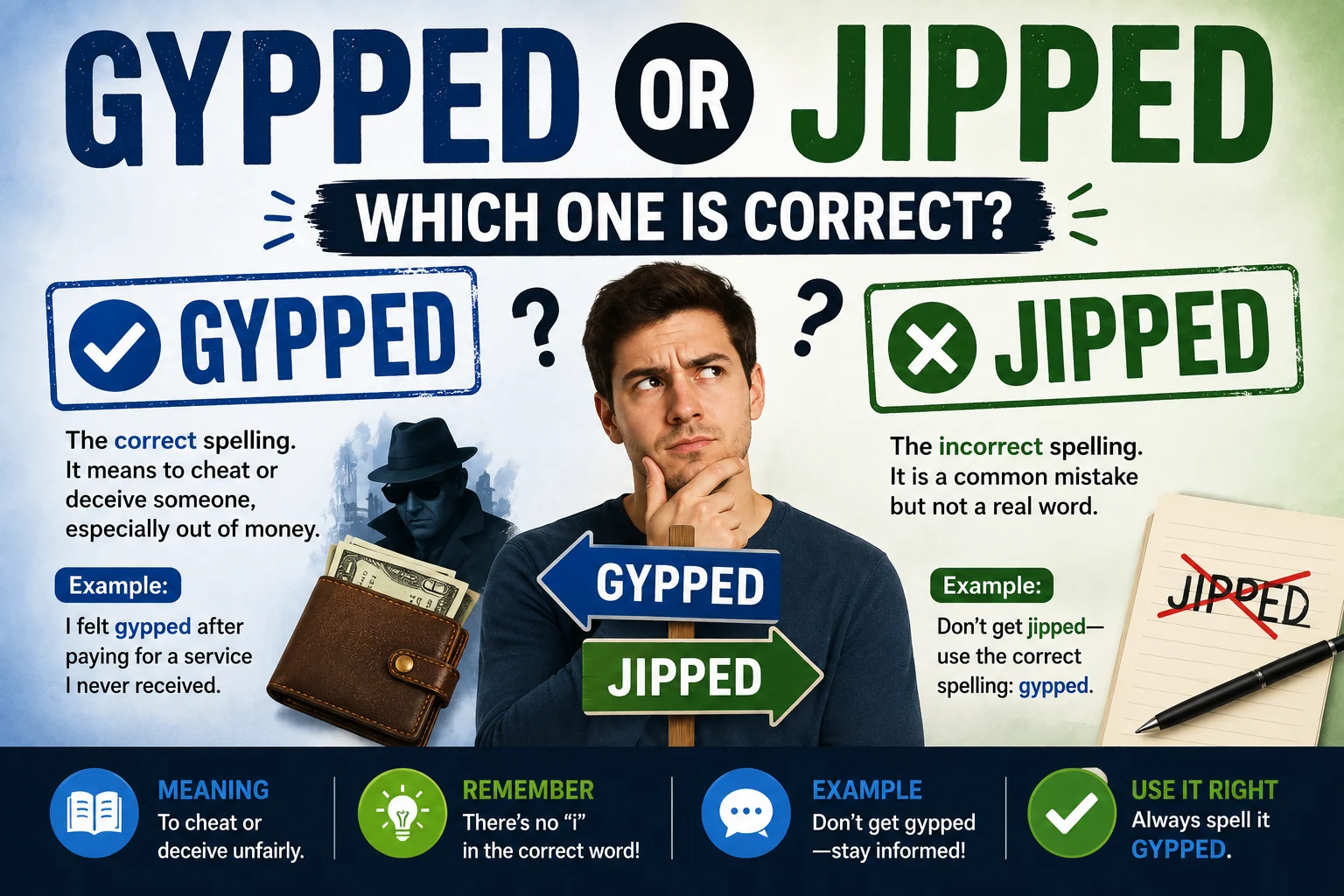
Jipped is an informal variant of gypped, but both are best avoided because the term is considered offensive; use words like cheated, ripped off, or scammed instead.
Have you ever wondered whether to write gypped or jipped? Many people search for these words because they hear them in everyday conversations but are unsure about the correct spelling or whether either word is appropriate to use. Since both spellings sound the same, it is easy to assume they are simply two acceptable versions of one word.
The truth is more complicated. While gypped is the traditional spelling found in many older dictionaries, jipped is a later spelling that some people use because it matches the pronunciation. However, both forms refer to the same expression and share the same historical origin.
Today, many dictionaries, editors, and style guides recommend avoiding both words because they are widely considered offensive. They are linked to a stereotype about the Romani people and may cause unintended offense. Instead, modern English offers many clear and respectful alternatives, such as cheated, scammed, ripped off, overcharged, or swindled.
This guide explains the difference between gypped or jipped, their history, common usage, and why choosing a neutral alternative is usually the best option.
Gypped or Jipped – Quick Answer
Both gypped and jipped refer to the same expression, meaning someone was cheated or treated unfairly.
However, neither word is generally recommended in modern English because both share the same origin and are widely regarded as offensive.
Instead, use clearer alternatives such as:
- cheated
- scammed
- ripped off
- overcharged
- swindled
Real-life examples
❌ I felt gypped after buying the ticket.
❌ I got jipped at the market.
✅ I felt cheated after buying the ticket.
✅ I got ripped off at the market.
The Origin of Gypped or Jipped
The word gypped developed from the word Gypsy, an older name used for the Romani people. For many years, the expression wrongly suggested that Romani people were dishonest or likely to cheat others.
Because the term is based on a negative stereotype about an ethnic group, many people now consider it offensive.
The spelling jipped appeared later because it reflects the way the word is commonly pronounced. Although it looks different, it has the same meaning and the same historical origin as gypped.
For this reason, changing the spelling does not remove the word’s historical connection or make it more appropriate.
British English vs American English Spelling
There is no meaningful British English versus American English spelling difference for this word.
Both gypped and jipped appear in English, but modern dictionaries and writing guides increasingly recommend avoiding both spellings in favor of neutral alternatives.
| Version | Spelling | Region | Example Sentence |
|---|---|---|---|
| Traditional spelling | Gypped | UK & US | Older writing may use this form, but it is generally avoided today. |
| Alternative spelling | Jipped | UK & US | Also discouraged because it has the same origin and meaning. |
Which Spelling Should You Use?
US audience
Avoid both gypped and jipped in professional or everyday writing. Choose cheated, scammed, or ripped off instead.
UK/Commonwealth audience
The same advice applies. Neutral alternatives are clearer, more respectful, and widely accepted.
Global audience
If you are writing for an international audience, avoid both spellings. Readers from different backgrounds may recognize the term as offensive, while neutral words communicate your meaning without causing confusion.
Common Mistakes with Gypped or Jipped
Many people believe jipped is simply a harmless spelling correction. It is not. Both spellings refer to the same expression.
| Incorrect Idea | Correct Information |
|---|---|
| Jipped is the polite spelling. | No. It has the same origin as gypped. |
| Gypped and jipped have different meanings. | No. They mean the same thing. |
| Either spelling is recommended in formal writing. | Modern writing generally avoids both. |
| There is no better alternative. | Use cheated, scammed, overcharged, or ripped off instead. |
Quick tip
If you mean someone was treated unfairly, choose a direct and respectful word such as cheated or scammed instead of gypped or jipped.
Gypped or Jipped in Everyday Examples
Since both gypped and jipped are widely considered offensive, modern writing usually replaces them with neutral words. Here are better ways to express the same idea.
Emails
- I think we were overcharged for this service.
- The customer felt cheated after receiving the wrong product.
News Headlines
- Tourists Report Being Scammed by Fake Ticket Sellers
- Police Warn Shoppers About Online Fraud
Social Media
- I got completely ripped off buying that phone.
- Watch out for fake websites—they can easily scam buyers.
Formal Writing
- The investigation found that several customers had been overcharged.
- The report described multiple cases of consumer fraud.
Gypped or Jipped – Google Trends & Usage
Many people search for gypped or jipped because they hear the expression in conversations, movies, or older books and want to know which spelling is correct. Others search because they have learned the word may be offensive and want to understand why.
Search interest also comes from writers, editors, and students checking whether the term is appropriate for modern English. Most language resources now explain the word’s history and recommend using neutral alternatives instead.
Today, words like cheated, scammed, ripped off, overcharged, and swindled are preferred because they clearly describe the situation without referring to an ethnic group.
Comparison Table
| Feature | Gypped | Jipped |
|---|---|---|
| Meaning | Cheated or treated unfairly | Same meaning |
| Pronunciation | Same | Same |
| Historical Origin | Same | Same |
| Recommended in Modern Writing | No | No |
| Widely Considered Offensive | Yes | Yes |
| Better Alternatives | Cheated, scammed, ripped off, overcharged | Cheated, scammed, ripped off, overcharged |
Frequently Asked Questions
1. Is gypped or jipped the correct spelling?
Both spellings refer to the same expression. Gypped is the older spelling, while jipped is a phonetic variation. Modern English generally recommends avoiding both.
2. Why are gypped and jipped considered offensive?
Both words come from a stereotype about the Romani people. Because of this history, many people consider the expression disrespectful.
3. Is jipped more acceptable than gypped?
No. Although the spelling is different, jipped has the same meaning and origin as gypped.
4. What words should I use instead of gypped or jipped?
Good alternatives include cheated, scammed, ripped off, overcharged, and swindled. These words are clear and appropriate in modern English.
5. Do dictionaries include gypped and jipped?
Some dictionaries list them because they appear in English, but many also include usage notes explaining that the terms are offensive or should be avoided.
6. Can I use gypped or jipped in formal writing?
No. In professional, academic, business, and public writing, it is better to choose a neutral alternative.
Conclusion
If you have been wondering whether to use gypped or jipped, the most helpful answer is that neither term is recommended in modern English. Although both spellings refer to the same expression, they share a historical connection to a negative stereotype about the Romani people. Because of this, many readers may find either form offensive, even if no harm is intended.
Fortunately, English offers many better choices. Words such as cheated, scammed, ripped off, overcharged, and swindled communicate the same idea clearly while avoiding language that may offend others.
When writing emails, articles, social media posts, or professional documents, choosing respectful and precise language helps your message reach a wider audience. By understanding the history behind gypped and jipped, you can make informed word choices and communicate with greater clarity and consideration.