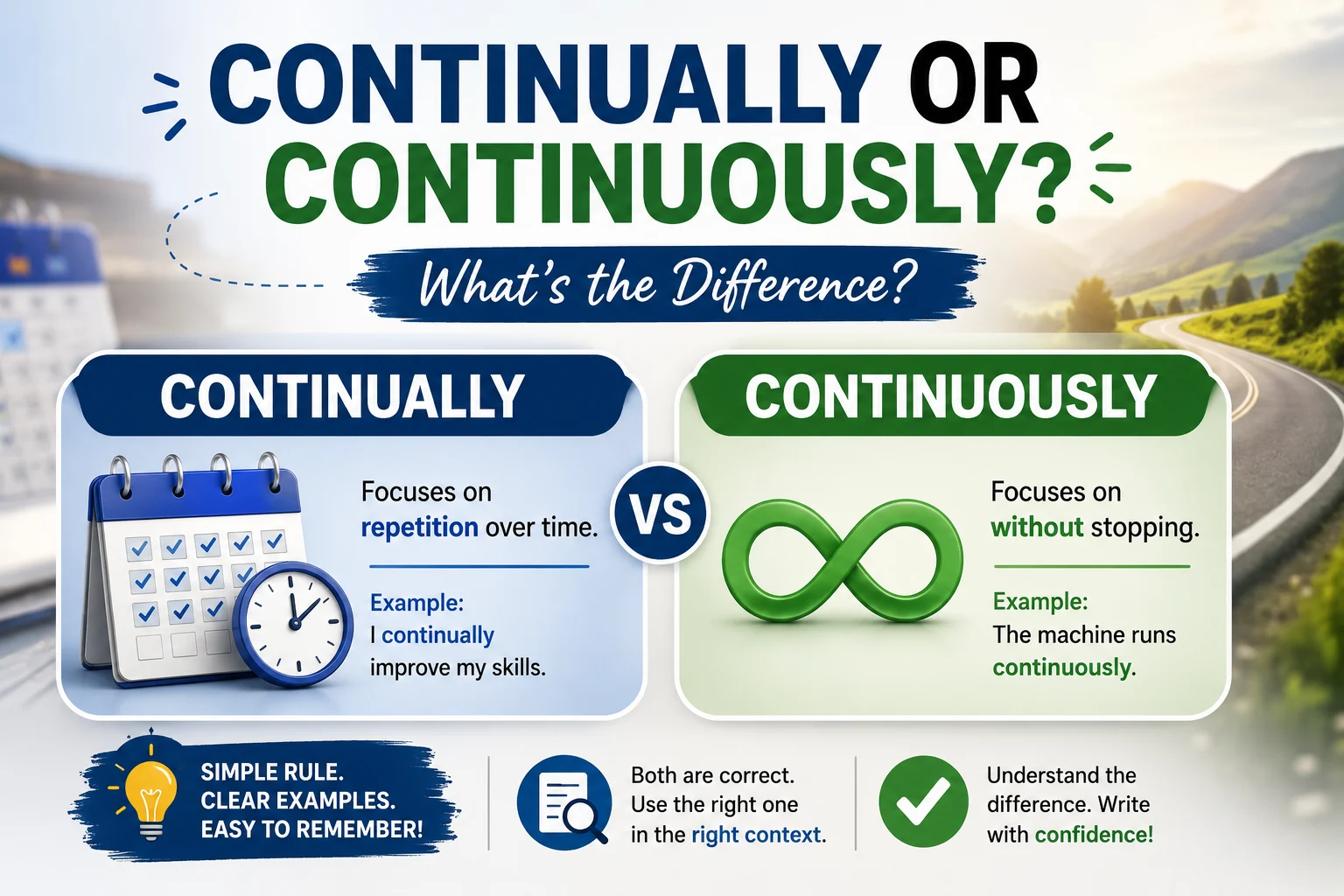
Continually means something happens repeatedly with breaks, while continuously means it happens without stopping or interruption.
Have you ever wondered whether to use continually or continuously? These two words look almost the same and both relate to something happening over time. Because of this, many students, writers, and English learners use them interchangeably. However, they do not always mean the same thing.
Understanding the difference between continually or continuously can make your writing clearer and more accurate. While both words describe repeated actions, one usually means something happens with breaks, while the other describes something that happens without stopping. This small difference matters in emails, school assignments, business writing, and everyday conversations.
The good news is that both words are correct. The key is knowing when each one fits the situation. In this guide, you’ll learn the meaning of each word, where they came from, how they are used in British and American English, common mistakes to avoid, and practical examples to help you choose the right word with confidence.
Continually or Continuously – Quick Answer
Both continually and continuously are correct, but they have different meanings.
- Continually means something happens again and again, with short breaks between each occurrence.
- Continuously means something happens without any interruption.
Real-life examples
- The baby cried continually throughout the evening. (The crying stopped and started.)
- The machine ran continuously for 24 hours. (It never stopped.)
- It rained continuously all night.
The Origin of Continually or Continuously
Both words come from the Latin word continuus, meaning “joined together” or “unbroken.”
Over time, English developed two related words with slightly different meanings.
Continually became the preferred word for actions that happen repeatedly over a period of time, usually with pauses.
Continuously came to describe actions or events that continue without stopping at all.
Although they share the same origin, modern English uses them differently to express whether interruptions exist.
British English vs American English Spelling
There is no spelling difference between British English and American English.
Both countries use continually and continuously with the same spellings. The difference is based on meaning, not region.
| Version | Spelling | Region | Example Sentence |
|---|---|---|---|
| Standard English | Continually | UK & US | She continually checked her phone during the meeting. |
| Standard English | Continuously | UK & US | The river flowed continuously all year. |
Which Spelling Should You Use?
US audience
Use continually when something happens repeatedly with breaks. Use continuously when something never stops.
UK/Commonwealth audience
The same rule applies throughout the UK, Australia, Canada, New Zealand, and other Commonwealth countries.
Global/SEO audience
If your content compares the two words, mention continually or continuously early in the article. After that, use each word only where its meaning is correct.
Common Mistakes with Continually or Continuously
Many writers confuse these words because they look similar.
| Incorrect | Correct |
|---|---|
| The engine ran continually for 12 hours without stopping. | The engine ran continuously for 12 hours without stopping. |
| She continuously knocked on the door every few minutes. | She continually knocked on the door every few minutes. |
| The alarm rang continuously throughout the day with pauses. | The alarm rang continually throughout the day with pauses. |
| Water flowed continually without interruption. | Water flowed continuously without interruption. |
Quick tip
If there are breaks, choose continually. If there are no breaks, choose continuously.
Continually or Continuously in Everyday Examples
Understanding the difference becomes easier when you see both words in real-life situations.
Emails
- Our team continually improves the project based on customer feedback.
- The security cameras record continuously throughout the day.
News Headlines
- Heavy Rain Falls Continuously for Several Hours
- City Faces Continually Rising Traffic Problems
Social Media
- My phone keeps buzzing continually today!
- The waterfall flows continuously all year long.
Formal Writing
- The researchers continually reviewed the collected data during the study.
- The monitoring system operated continuously without interruption.
Continually or Continuously – Google Trends & Usage
Many people search for continually or continuously because the words are similar in spelling and meaning. Students, professionals, and English learners often want to know which word is correct in a specific sentence.
Continuously appears more often in technical, scientific, engineering, and manufacturing content because it describes something that never stops. It is common when discussing machines, systems, rivers, or ongoing processes.
Continually is frequently used in everyday communication, business writing, education, and news articles to describe actions that happen repeatedly over time with short pauses.
People around the world search for both words because choosing the correct one improves writing clarity and avoids common grammar mistakes.
Comparison Table
| Feature | Continually | Continuously |
|---|---|---|
| Meaning | Repeatedly with breaks | Without stopping |
| Interruptions | Yes | No |
| Everyday Use | Very common | Common |
| Technical Writing | Less common | Very common |
| Formal Writing | Yes | Yes |
| Correct English | Yes | Yes |
Frequently Asked Questions
1. Is continually or continuously correct?
Both are correct. Use continually for repeated actions with breaks and continuously for actions that never stop.
2. What is the difference between continually and continuously?
Continually means happening again and again. Continuously means happening without interruption.
3. Can continually and continuously be used interchangeably?
Sometimes people understand either word, but they have different meanings. Choosing the correct one makes your writing more accurate.
4. Is there a British or American English difference?
No. Both British English and American English use the same spellings and meanings.
5. Which word is better for formal writing?
Both are suitable. Choose the word that matches the meaning of your sentence.
6. How can I remember the difference?
Think of continually as “repeatedly” and continuously as “non-stop.” If there are pauses, use continually. If there are no pauses, use continuously.
Conclusion
Knowing the difference between continually and continuously can make your writing clearer and more professional. Although the two words are closely related, they describe different kinds of actions. Continually refers to something that happens again and again with breaks in between, while continuously describes something that happens without stopping.
This distinction is useful in school assignments, business emails, news articles, and everyday conversations. Using the correct word helps readers understand exactly what you mean and prevents unnecessary confusion.
Whenever you are unsure, ask yourself one simple question: Did the action stop at any point? If the answer is yes, choose continually. If the answer is no, choose continuously. Following this simple rule will help you write confidently and accurately in any situation.