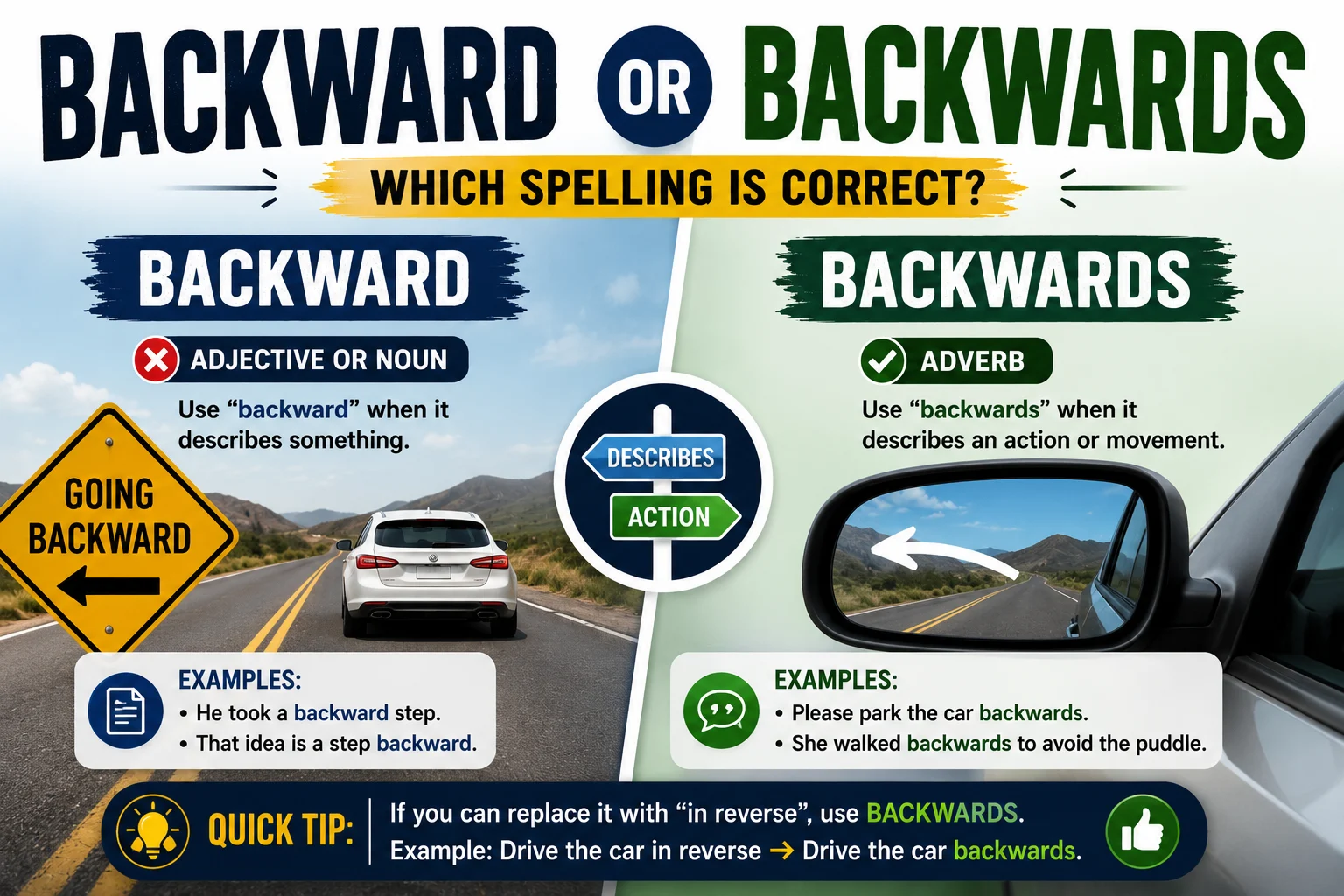
“Backward” and “backwards” are both correct, but “backward” is more common in American English, while “backwards” is preferred in British English.
Have you ever stopped while writing and wondered whether to use backward or backwards? You are not alone. These two words look almost identical, and many English learners and native speakers are unsure which one is correct. The good news is that both words are correct, but their usage depends on the type of English you are writing and, sometimes, the style guide you follow.
The confusion happens because American English and British English have different preferences. In most cases, backward is more common in American English, while backwards is preferred in British English. However, both words mean the same thing: moving toward the back, facing the opposite direction, or going in reverse.
In this guide, you’ll learn the difference between backward or backwards, their history, regional usage, common mistakes, and everyday examples. By the end, you’ll know which form fits your audience and how to use it correctly in emails, articles, school assignments, and professional writing.
Backward or Backwards – Quick Answer
Quick Answer:
- Backward is more common in American English.
- Backwards is more common in British English.
- Both words are correct and have the same meaning.
Examples
- The car rolled backward down the hill. (American English)
- The car rolled backwards down the hill. (British English)
- Don’t look backward when moving forward.
The Origin of Backward or Backwards
The word backward comes from the Old English word bæc, meaning “back.” The suffix -ward means “toward a direction.”
Later, the adverbial -s ending became common in British English, creating backwards. Similar word pairs include toward/towards, forward/forwards, and afterward/afterwards.
Today, both forms are accepted in standard English, although regional preferences remain.
British English vs American English Spelling
The main difference is regional preference rather than meaning.
| Version | Spelling | Region | Example Sentence |
|---|---|---|---|
| American English | Backward | United States | He took one step backward. |
| British English | Backwards | United Kingdom, Australia, New Zealand | She looked backwards before crossing the road. |
Both spellings are correct, but choosing the one your audience expects makes your writing more natural.
Which Spelling Should You Use?
US Audience
Use backward. It is the preferred spelling in American English and is commonly used in schools, newspapers, and business writing.
UK/Commonwealth Audience
Use backwards. It is the more natural choice in British English and other Commonwealth countries.
Global/SEO Audience
Either spelling is correct. If your audience is worldwide, stay consistent throughout your article. Choose one form and avoid switching between them.
Common Mistakes with Backward or Backwards
Many writers mix American and British spellings in the same document.
| Incorrect | Correct |
|---|---|
| He stepped backwards. (US style guide) | He stepped backward. |
| She moved backward. (UK style preference) | She moved backwards. |
| The article uses both spellings randomly. | Choose one spelling and use it consistently. |
Easy Tip:
- Backward = American English
- Backwards = British English
Backward or Backwards in Everyday Examples
Emails
“Please move one step backward so everyone can fit in the photo.”
News Headlines
“Truck Rolls Backward on Steep Hill.”
Social Media
“I’m trying to walk backwards without falling!”
Formal Writing
“The machine automatically moves backward during the calibration process.”
Backward or Backwards – Google Trends & Usage
Searches for backward or backwards are common because both forms are correct. Many users simply want to know which spelling matches their audience.
Backward appears more often in American publications, educational materials, and business documents.
Backwards is more common in British newspapers, books, and everyday writing throughout the UK and many Commonwealth countries.
Neither spelling is wrong. The key is choosing the one that matches your audience and using it consistently.
Comparison Table
| Feature | Backward | Backwards |
|---|---|---|
| Meaning | Moving toward the back | Moving toward the back |
| Correct Spelling | Yes | Yes |
| American English | Preferred | Less common |
| British English | Accepted | Preferred |
| Part of Speech | Adjective, Adverb | Mainly Adverb |
| Formal Writing | Common in US | Common in UK |
FAQs
Is it backward or backwards?
Both are correct. Backward is preferred in American English, while backwards is more common in British English.
Is backwards wrong?
No. It is the standard form in British English.
Which spelling is used in the United States?
American English generally prefers backward.
Which spelling is used in the United Kingdom?
British English usually prefers backwards.
Do backward and backwards have different meanings?
No. They have the same meaning but different regional preferences.
Can I use both spellings in one article?
It is best to choose one spelling and use it consistently throughout your writing.
Conclusion
The difference between backward or backwards is mainly one of regional preference, not meaning. Both spellings are correct and both describe movement toward the back, facing the opposite direction, or going in reverse. The important thing is knowing which version your audience expects.
If you’re writing for an American audience, backward is usually the better choice. If your readers are in the United Kingdom or other Commonwealth countries, backwards is more natural. For international websites or blogs, either spelling works as long as you stay consistent.
A simple way to remember the rule is this: Backward is the American favorite, while backwards is the British favorite. Following this guideline will help your writing look polished, professional, and easy to understand wherever your audience is located.