Have you ever wondered whether you should write donut or doughnut? You are not alone. Many people see both spellings on menus, food packages, social media, and in recipes. This often creates confusion because both words seem correct.
The good news is that both donut and doughnut refer to the same sweet, round pastry. The difference is mainly about spelling, region, and style. Some companies prefer the shorter spelling, while dictionaries usually list the longer spelling as the traditional form.
In this guide, you’ll learn the meaning of each spelling, where they came from, when to use them, and which version is best for your audience. We’ll also look at common mistakes, real-life examples, comparison tables, and frequently asked questions. By the end, you’ll know exactly when to write donut and when doughnut is the better choice.
Donut or Doughnut – Quick Answer
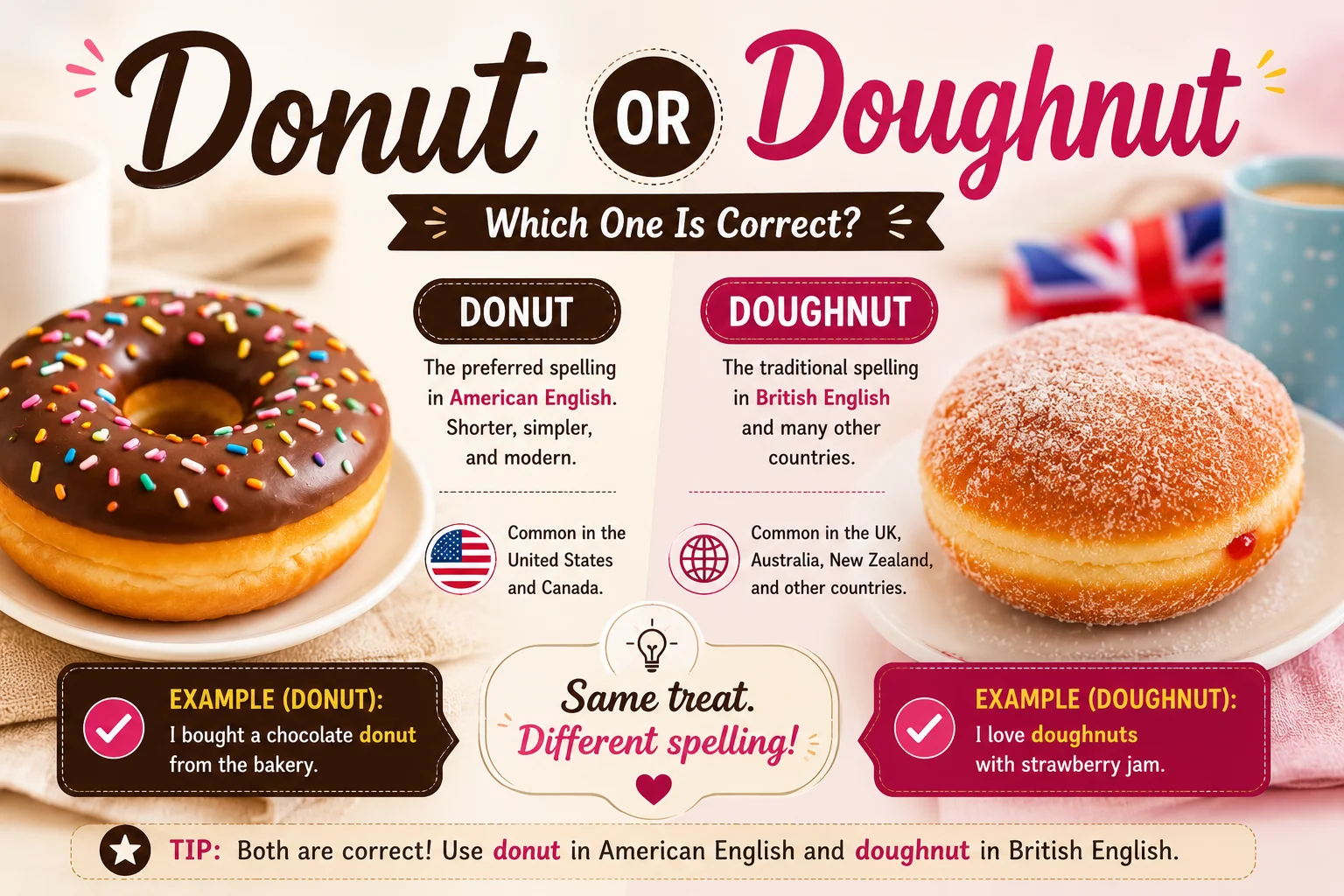
Both donut and doughnut are correct.
- Doughnut is the traditional spelling and is more common in British English.
- Donut is the simplified spelling and is widely used in American English, especially in branding and everyday writing.
Real-Life Examples
- I bought a chocolate donut on my way to work.
- She made fresh doughnuts for breakfast.
- The bakery sells both glazed donuts and filled doughnuts.
The Origin of Donut or Doughnut
The word doughnut first appeared in English many years ago. It combines two words:
- Dough – the mixture used to make bread or pastries.
- Nut – early doughnuts were often shaped like small nuts or balls.
Over time, Americans began shortening the spelling to donut. The shorter version became popular because it was easier to write and fit well in advertising.
Today:
- Doughnut remains the traditional dictionary spelling.
- Donut is accepted as a modern alternative, especially in North America.
British English vs American English Spelling
The biggest difference is regional preference.
| Version | Spelling | Region | Example Sentence |
|---|---|---|---|
| Traditional | Doughnut | UK, Australia, New Zealand, Canada (often) | I had a jam doughnut for breakfast. |
| Simplified | Donut | United States | I ordered a glazed donut with coffee. |
Key Point
- British English usually prefers doughnut.
- American English often prefers donut, especially in everyday use and marketing.
Which Spelling Should You Use?
For a US Audience
Choose donut.
Readers in the United States are familiar with this spelling because it appears in restaurants, advertisements, and daily conversation.
For a UK or Commonwealth Audience
Choose doughnut.
It matches standard British spelling and is commonly used in books, recipes, and newspapers.
For a Global or SEO Audience
Either spelling is correct.
If your audience is worldwide:
- Use the version your readers expect.
- Mention both spellings early in your content to help readers from different regions.
Common Mistakes with Donut or Doughnut
Many writers make simple spelling mistakes.
| Incorrect | Correct |
|---|---|
| dougnut | doughnut |
| doughnut (for US branding) | donut |
| donught | doughnut |
| dohnut | donut |
Other Common Mistakes
- Mixing both spellings in the same article without reason.
- Assuming one spelling is always wrong.
- Using British spelling for American branding or vice versa.
Donut or Doughnut in Everyday Examples
Emails
I’ll bring fresh donuts to tomorrow’s meeting.
The bakery delivered our doughnuts this morning.
News Headlines
Local Shop Gives Away Free Donuts
Traditional Doughnuts Return for Village Festival
Social Media
These strawberry donuts look amazing!
Homemade doughnuts are worth every minute.
Formal Writing
The café specializes in handmade doughnuts using local ingredients.
Donut or Doughnut – Google Trends & Usage
Both spellings are widely searched online.
In the United States, donut is generally more popular because many famous brands and restaurants use it.
In the United Kingdom and several Commonwealth countries, doughnut is still the preferred spelling in newspapers, recipes, and educational materials.
Search engines understand that both words have the same meaning. However, using the spelling that matches your audience can improve readability and create a better user experience.
Donut vs Doughnut Comparison Table
| Feature | Donut | Doughnut |
|---|---|---|
| Meaning | Sweet fried pastry | Sweet fried pastry |
| Correct? | Yes | Yes |
| Traditional spelling | No | Yes |
| Simplified spelling | Yes | No |
| Common in the US | Yes | Sometimes |
| Common in the UK | Less common | Yes |
| Used in branding | Very common | Less common |
| Best for American audience | ✅ Yes | Acceptable |
| Best for British audience | Acceptable | ✅ Yes |
Frequently Asked Questions
Is donut or doughnut correct?
Yes. Both spellings are correct and refer to the same food.
Why do Americans write donut?
Americans often prefer shorter spellings, and many popular food brands helped make donut common.
Why is doughnut the traditional spelling?
The word originally combined dough and nut, creating the traditional spelling doughnut.
Which spelling do dictionaries prefer?
Most dictionaries list doughnut as the original spelling while also accepting donut.
Should I use donut in formal writing?
If you are writing for an American audience, donut is usually acceptable. For British or formal international writing, doughnut is often preferred.
Does Google understand both spellings?
Yes. Search engines recognize that donut and doughnut have the same meaning.
Are donut and doughnut different foods?
No. They describe the same type of sweet fried pastry.
Conclusion
Choosing between donut or doughnut is easier once you know your audience. Both spellings are correct, and neither changes the meaning of the delicious treat. The traditional spelling, doughnut, is still the standard choice in British English and many formal publications. The shorter spelling, donut, has become very popular in American English thanks to everyday use and well-known food brands.
If you’re writing for readers in the United States, donut will usually feel more natural. If your audience is in the United Kingdom or other Commonwealth countries, doughnut is generally the better option. For websites with an international audience, mentioning both spellings early in the article helps readers understand that they are simply regional variations of the same word.
The most important rule is to stay consistent throughout your writing. Pick one spelling that matches your audience and use it everywhere. With that simple approach, you’ll never have to wonder about donut or doughnut again.