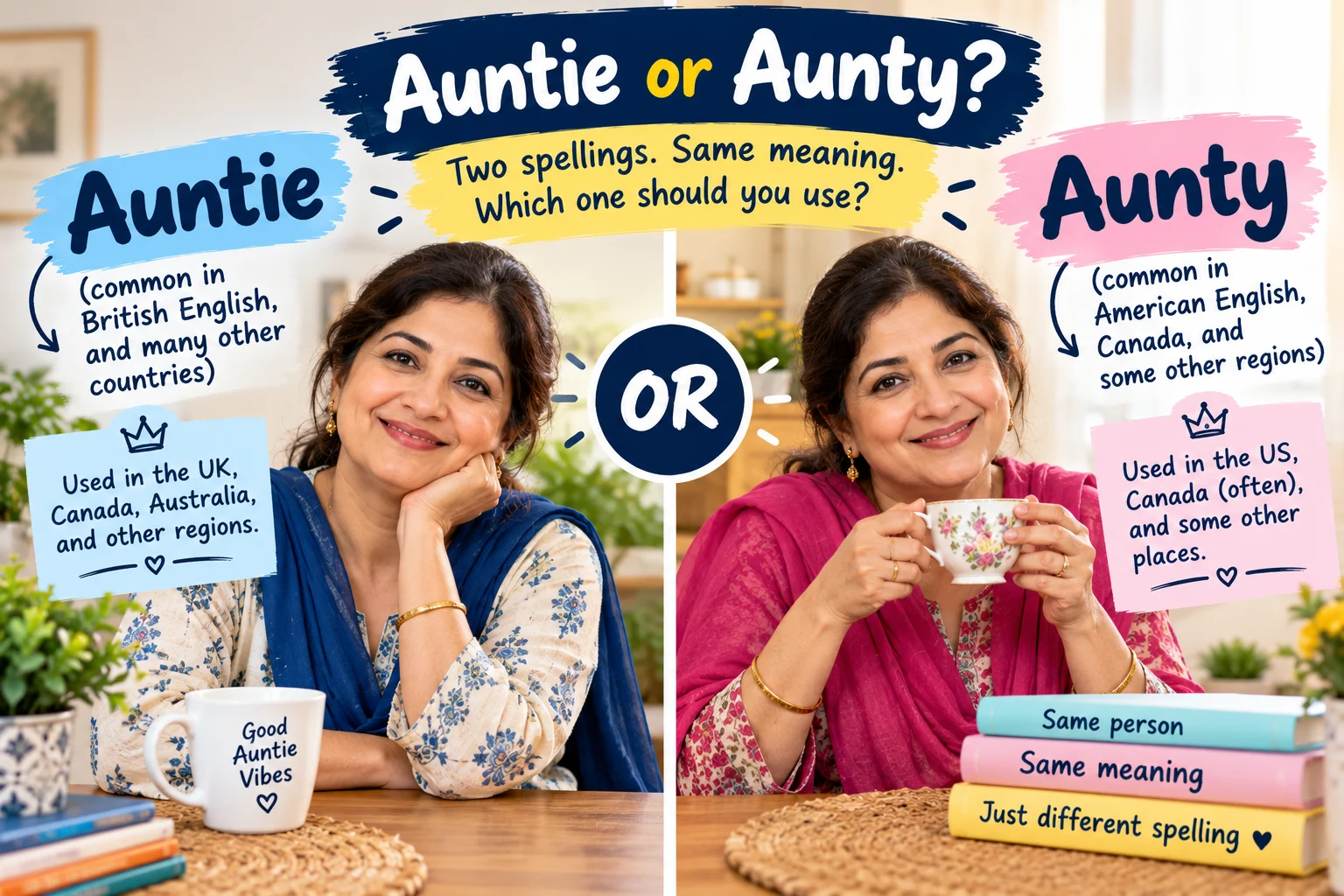
Auntie and aunty are both correct spellings of the informal word for an aunt or an older woman treated like family. Auntie is more common in American and British English, while aunty is especially common in British-influenced varieties of English.
Have you ever typed “auntie or aunty” and stopped because both spellings looked right? You are not alone. This is one of those small English questions that can make even confident writers pause.
I have seen students, parents, and everyday writers switch between auntie and aunty without knowing whether one is wrong. The confusion is easy to understand. Both words sound almost the same, both have the same basic meaning, and both appear in real English.
The good news is simple: neither spelling is automatically wrong.
The choice often depends on regional preference, family style, and personal choice. In some places, auntie is more familiar. In others, aunty feels more natural.
There is also a small difference in how the word is used. It can mean your actual aunt, but it can also be a warm way to address an older woman you know.
So, which spelling should you use? The answer depends on your audience and the kind of writing you are doing. Let’s make the choice easy.
Auntie or Aunty – Quick Answer
Auntie and aunty are informal forms of aunt.
They can refer to:
- Your mother’s or father’s sister
- Your uncle’s wife
- An older female relative
- A familiar older woman
- A woman who has a close, family-like relationship with a child
Examples
My auntie is visiting us this weekend.
Aunty Sara gave me some advice.
Both sentences can be correct.
The main difference is spelling preference, not meaning.
The Origin and Background of Auntie or Aunty
The basic word aunt comes from an old French word related to Latin amita, meaning a father’s sister.
English later developed friendly and informal forms of family words. Just as we have:
- aunt → auntie
- uncle → uncle or uncy in some informal contexts
- grandmother → granny
- mother → mommy/mummy
The ending -ie often creates a warm or familiar form.
That is how auntie developed as a friendly form of aunt.
The spelling aunty uses -y instead of -ie. This kind of spelling variation is common in English.
Compare:
- auntie / aunty
- sweetie / sweety
- mommy / mummy
- granny / grannie
Not every pair has exactly the same meaning or usage, but the spelling pattern shows why English can produce regional variants.
Why Are There Two Spellings?
English has developed in many countries and communities.
A word may become popular in one region with one spelling and appear with another spelling elsewhere.
The difference between auntie and aunty is a good example.
Both forms represent the same spoken idea. The spelling is often shaped by local English habits.
Family preference also matters.
One family may always write:
Auntie Maria
Another may write:
Aunty Maria
Neither family is necessarily making a spelling mistake.
Auntie or Aunty Explained — Key Differences
| Term | Meaning | When to Use | Region/Context |
|---|---|---|---|
| aunt | Female relative | Formal or neutral contexts | Standard English |
| auntie | Friendly form of aunt | Informal and affectionate use | Common in British and American English |
| aunty | Friendly form of aunt | Informal and affectionate use | Common in British-influenced varieties |
| Auntie | Name/title used for a woman | Direct address or name-like use | Informal |
| Aunty | Name/title used for a woman | Direct address or name-like use | Informal |
Auntie
Auntie is widely understood in English.
For example:
Auntie Jane is coming for dinner.
It can sound warm, friendly, and affectionate.
You may also see it used by children:
My auntie bought me a new book.
Aunty
Aunty has the same basic meaning.
For example:
Aunty Jane is coming for dinner.
It is especially familiar in several varieties of English influenced by British usage, including English used in parts of South Asia, Africa, and other regions.
In some communities, aunty can also be used for a woman who is not a blood relative.
For example:
Aunty helped me cross the road.
The word can express respect, warmth, or familiarity.
Auntie vs. Aunty: Is One More Correct?
No.
Both auntie and aunty are accepted informal forms.
However, they do not have exactly the same popularity everywhere.
If you are writing for an international audience, auntie may be the more widely familiar choice.
If you are writing in a community where aunty is the normal spelling, there is no need to change it.
The most important rule is consistency.
If you choose Auntie, keep using Auntie.
If a person’s preferred name is Aunty, keep that spelling.
Which Version Should You Use?
Your audience can help you choose.
For American readers
Auntie is generally the safer choice.
Example:
My auntie lives in California.
You can also simply use aunt, especially in neutral or formal writing.
For British readers
Auntie is also familiar and widely used.
Example:
Auntie is coming over this afternoon.
For South Asian English
Aunty is very common.
It may be used not only for a relative but also for an older woman in a family or community.
For example:
Aunty, could you please help me?
This usage can be natural and respectful in the local context.
For formal writing
Use aunt.
For example:
My aunt lives in London.
This is more neutral than auntie or aunty.
For personal messages
Use whichever form feels natural.
Happy birthday, Auntie!
or
Happy birthday, Aunty!
Both work.
Common Mistakes with Auntie or Aunty
1. Thinking “aunty” is always wrong
Mistake:
Aunty is incorrect English.
Correction:
Aunty is an accepted informal spelling.
It is widely used in several English varieties.
2. Thinking “auntie” is only for children
Mistake:
Adults should never say auntie.
Correction:
Adults can use auntie in informal and affectionate contexts.
The word is not limited to children’s speech.
3. Using a familiar form in formal writing
Less formal:
My auntie attended the meeting.
More formal:
My aunt attended the meeting.
Both can be grammatically correct, but aunt is more neutral.
4. Changing someone’s preferred spelling
If someone’s family uses Aunty, do not automatically change it to Auntie.
For example, if a person signs messages as:
Aunty Fatima
keep that spelling when addressing her.
Names and personal titles can reflect individual or cultural preference.
5. Mixing spellings in the same document
Less consistent:
My Auntie lives nearby. Aunty also visits us every Sunday.
If both references mean the same person, choose one spelling and keep it consistent.
Auntie or Aunty in Real-World Examples
1. Professional Email
If you are writing a formal email, aunt is usually better:
Dear Ms. Khan, I am writing to confirm that my aunt will attend the event.
If the relationship is informal, you might write:
Hi Auntie, I hope you’re doing well.
The tone determines the best choice.
2. News Article
A news article would usually use the neutral word aunt:
The woman said her aunt had helped her during the emergency.
A newspaper normally does not need the affectionate form.
3. Social Media Post
Informal social media allows both:
Happy birthday to my amazing Auntie! ❤️
Or:
Happy birthday, Aunty! You mean so much to me. ❤️
Both sound natural.
4. Formal Document
Use aunt in official writing:
Emergency contact: Maria Khan, aunt of the student.
The formal context makes aunt the better choice.
5. Direct Address
You can use either form as a friendly title:
Auntie, can you help me?
or
Aunty, can you help me?
Your regional and family preference will guide the choice.
Auntie or Aunty — Data, Trends & Usage
The search “auntie or aunty” is mainly informational.
People usually want to know:
- Which spelling is correct?
- Is aunty a real word?
- Is auntie more correct?
- Which spelling should I use?
- Is the spelling different in British and American English?
- Can I use the word for an older woman who is not my relative?
The question also has a strong cultural side.
In some communities, aunty is more than a spelling choice. It can be a respectful way to address an older woman. This is especially common in parts of South Asia and other communities where English has developed alongside local family and social customs.
That means a dictionary-style answer alone may not solve the reader’s problem.
The best answer is:
Both are correct informal forms, but local usage and personal preference often decide which one sounds natural.
Auntie or Aunty: Standalone Comparison
| Term/Variant | Meaning | Region/Context | Best Used When |
|---|---|---|---|
| aunt | Female relative | Standard English | Formal or neutral writing |
| auntie | Informal form of aunt | Widely used | Friendly family contexts |
| aunty | Informal form of aunt | Common in several British-influenced varieties | Friendly or respectful contexts |
| Auntie | Affectionate title/name | Informal | Direct address |
| Aunty | Affectionate title/name | Informal, often cultural | Direct address |
Auntie vs. Aunt: What Is the Difference?
The difference is mainly tone.
Aunt is neutral.
My aunt lives nearby.
Auntie is warmer and more personal.
My auntie lives nearby.
The same is true for aunty.
My aunty lives nearby.
If you are writing an academic essay, report, or official form, aunt is usually the best option.
If you are writing a personal message, story, card, or social post, auntie or aunty can sound more natural.
Can You Use Auntie for Someone Who Is Not Your Aunt?
Yes, depending on the culture and context.
People sometimes use auntie or aunty for an older woman who is a family friend or a respected member of the community.
For example:
Aunty, could you please pass me the book?
The speaker may not be saying that the woman is a biological aunt.
The word can communicate respect, affection, or closeness.
However, this use varies by culture. It may sound natural in one community and unusual in another.
FAQs About Auntie or Aunty
Q: What does auntie or aunty mean?
A: Auntie and aunty are informal forms of aunt. They can refer to an aunt or, in some cultures, an older woman treated with family-like respect.
Q: Which is correct, auntie or aunty?
A: Both are correct. The choice often depends on regional usage, family preference, and personal style.
Q: Is “aunty” proper English?
A: Yes. Aunty is a recognized informal form used in several varieties of English. It is especially common in some British-influenced communities.
Q: Is “auntie” more correct than “aunty”?
A: No. Neither spelling is universally more correct. Auntie may be more familiar to some readers, while aunty may be more natural in other regions.
Q: Should I use aunt or auntie in formal writing?
A: Aunt is usually better for formal writing because it is neutral. Auntie and aunty are more informal and personal.
Q: Can I call an older woman aunty?
A: Yes, if that form is normal in your culture or community. In some places, aunty is a respectful way to address an older woman who is not a blood relative.
Q: Where does the word auntie come from?
A: Auntie developed as an affectionate form of aunt. The spelling uses the common -ie ending found in many informal English words.
Conclusion
The choice between auntie or aunty is easier than it looks.
Both spellings are correct informal forms of aunt. The main difference is not meaning but regional and personal preference.
Use aunt when you want a neutral or formal word. Choose auntie when you want a warm, familiar tone. Choose aunty when that spelling is natural in your family, culture, or local variety of English.
There is no need to worry that aunty is automatically wrong. It is a genuine and widely used form. At the same time, auntie is also perfectly acceptable and familiar to readers in many English-speaking communities.
The best rule is simple: follow your audience and stay consistent.
If you are writing formally, aunt is the safest choice. For personal and friendly writing, auntie and aunty both work.
Now you know exactly when to use auntie or aunty. Bookmark this guide and share it with someone who has been wondering about these two spellings.