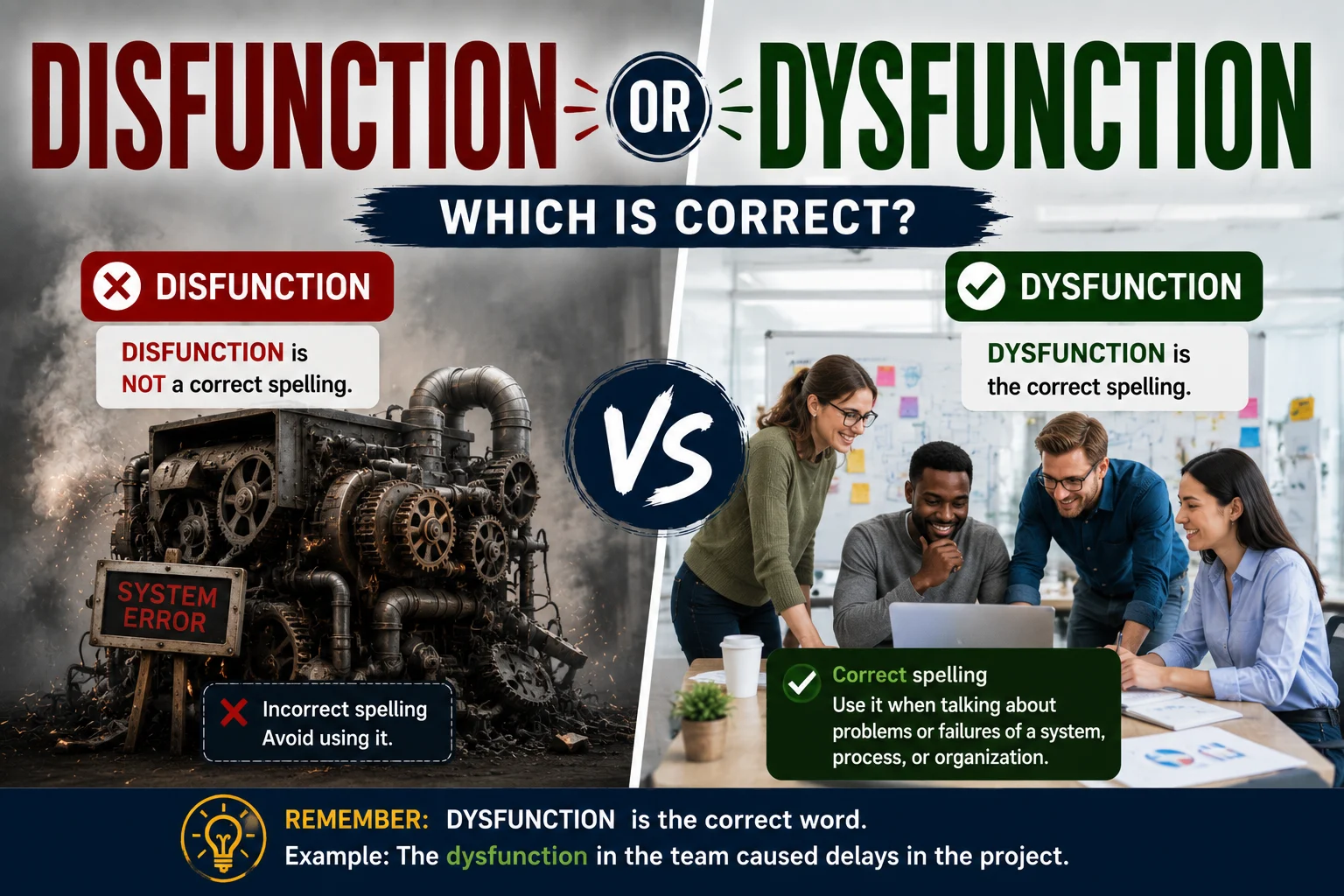
Dysfunction is the correct spelling, while disfunction is a common misspelling—dysfunction means impaired or abnormal functioning of a person, system, or organ.
Have you ever wondered whether disfunction or dysfunction is the correct spelling? You are not alone. Many students, writers, professionals, and English learners search for this question because the two words look almost the same. A single letter can make the difference between a correct English word and a spelling mistake.
The simple answer is that dysfunction is the correct spelling. Disfunction is a common misspelling and is not accepted in standard English dictionaries. The confusion often happens because many English words begin with the prefix dis-, such as disagree or disconnect. However, dysfunction uses the prefix dys-, which has a different meaning and origin.
Whether you are writing a school assignment, a business email, a medical report, or a blog post, using the correct spelling helps your writing appear clear and professional. In this guide, you will learn the meaning of dysfunction, its history, spelling rules, common mistakes, everyday examples, and tips to help you remember the correct form with confidence.
Disfunction or Dysfunction – Quick Answer
The correct spelling is dysfunction.
Dysfunction means that something is not working properly or is not functioning as it should.
Disfunction is incorrect and should not be used in standard English.
Examples
- The machine stopped because of an electrical dysfunction.
- Doctors diagnosed a heart dysfunction.
- Poor communication caused a dysfunction in the team.
The Origin of Disfunction or Dysfunction
The word dysfunction comes from the Greek prefix dys-, which means bad, abnormal, or difficult. It combines with the word function, meaning how something works.
The prefix dys- appears in many English words, including:
- Dysfunction
- Dyslexia
- Dysplasia
- Dyspepsia
People often write disfunction because they are familiar with the prefix dis-, which means not, opposite of, or apart. However, that is not the correct prefix for this word.
British English vs American English Spelling
There is no spelling difference between British and American English.
Both use dysfunction.
| Version | Spelling | Region | Example Sentence |
|---|---|---|---|
| Standard English | Dysfunction | United States | The software showed signs of dysfunction. |
| Standard English | Dysfunction | United Kingdom | Family dysfunction affected the children. |
| Incorrect Form | Disfunction | Not used | This spelling is incorrect. |
Which Spelling Should You Use?
US Audience
Always use dysfunction.
UK/Commonwealth Audience
Always use dysfunction.
Global/SEO Audience
Whether you are writing for an international audience, publishing online, or creating academic content, dysfunction is the correct spelling. Avoid disfunction, as it may reduce your writing’s credibility.
Common Mistakes with Disfunction or Dysfunction
Many writers replace dys- with dis- because the prefix dis- is more common in English.
Incorrect vs Correct
❌ The patient suffers from heart disfunction.
✅ The patient suffers from heart dysfunction.
❌ The company’s disfunction delayed the project.
✅ The company’s dysfunction delayed the project.
❌ Team disfunction caused many problems.
✅ Team dysfunction caused many problems.
Tips to Remember
- Dys- means abnormal or impaired.
- Think of other words like dyslexia and dyspepsia.
- Never replace dys- with dis- in dysfunction.
Disfunction or Dysfunction in Everyday Examples
Emails
The report identified a system dysfunction that requires immediate attention.
News Headlines
Experts investigate power grid dysfunction after service disruptions.
Social Media
Poor planning can lead to team dysfunction.
Formal Writing
Organizational dysfunction reduced overall productivity.
Disfunction or Dysfunction – Google Trends & Usage
Many people search for disfunction or dysfunction because the incorrect spelling is easy to type. The prefix dis- appears in many common English words, leading people to assume it should also be used here.
In general, dysfunction appears in dictionaries, medical textbooks, business articles, psychology resources, and academic writing. Searches for disfunction usually come from users checking whether it is a correct spelling. Across English-speaking countries, dysfunction is the accepted and recommended form.
Comparison Table
| Feature | Disfunction | Dysfunction |
|---|---|---|
| Correct spelling | ❌ No | ✅ Yes |
| Dictionary word | ❌ No | ✅ Yes |
| Used in US English | ❌ No | ✅ Yes |
| Used in UK English | ❌ No | ✅ Yes |
| Suitable for formal writing | ❌ No | ✅ Yes |
| Used in medical writing | ❌ No | ✅ Yes |
| SEO-friendly spelling | ❌ No | ✅ Yes |
FAQs
Is disfunction or dysfunction correct?
Dysfunction is correct. Disfunction is a spelling mistake.
Why is dysfunction spelled with “dys”?
Because it comes from the Greek prefix dys-, meaning abnormal, difficult, or impaired.
Is disfunction a real English word?
No. Standard English dictionaries do not recognize disfunction.
Does British English use disfunction?
No. Both British and American English use dysfunction.
Can dysfunction describe people and systems?
Yes. It can describe problems in the body, families, organizations, machines, or systems.
How can I remember the correct spelling?
Think of words like dyslexia or dyspepsia. They all begin with the same dys- prefix.
Conclusion
Knowing the difference between disfunction or dysfunction is easy once you understand the word’s origin. Dysfunction is the only correct spelling and is accepted in dictionaries, schools, workplaces, and professional writing. It describes a condition in which something does not work properly, whether it is a machine, a body part, a family, or an organization.
The spelling disfunction is a common mistake caused by confusion with the familiar prefix dis-. However, this word uses the Greek prefix dys-, which means abnormal or impaired. Remembering this simple rule will help you avoid spelling errors and write with greater confidence.
Whenever you are unsure, choose dysfunction. It is correct in both British and American English and is appropriate for academic, medical, business, and everyday writing. Using the right spelling ensures your message is clear, accurate, and professinal.