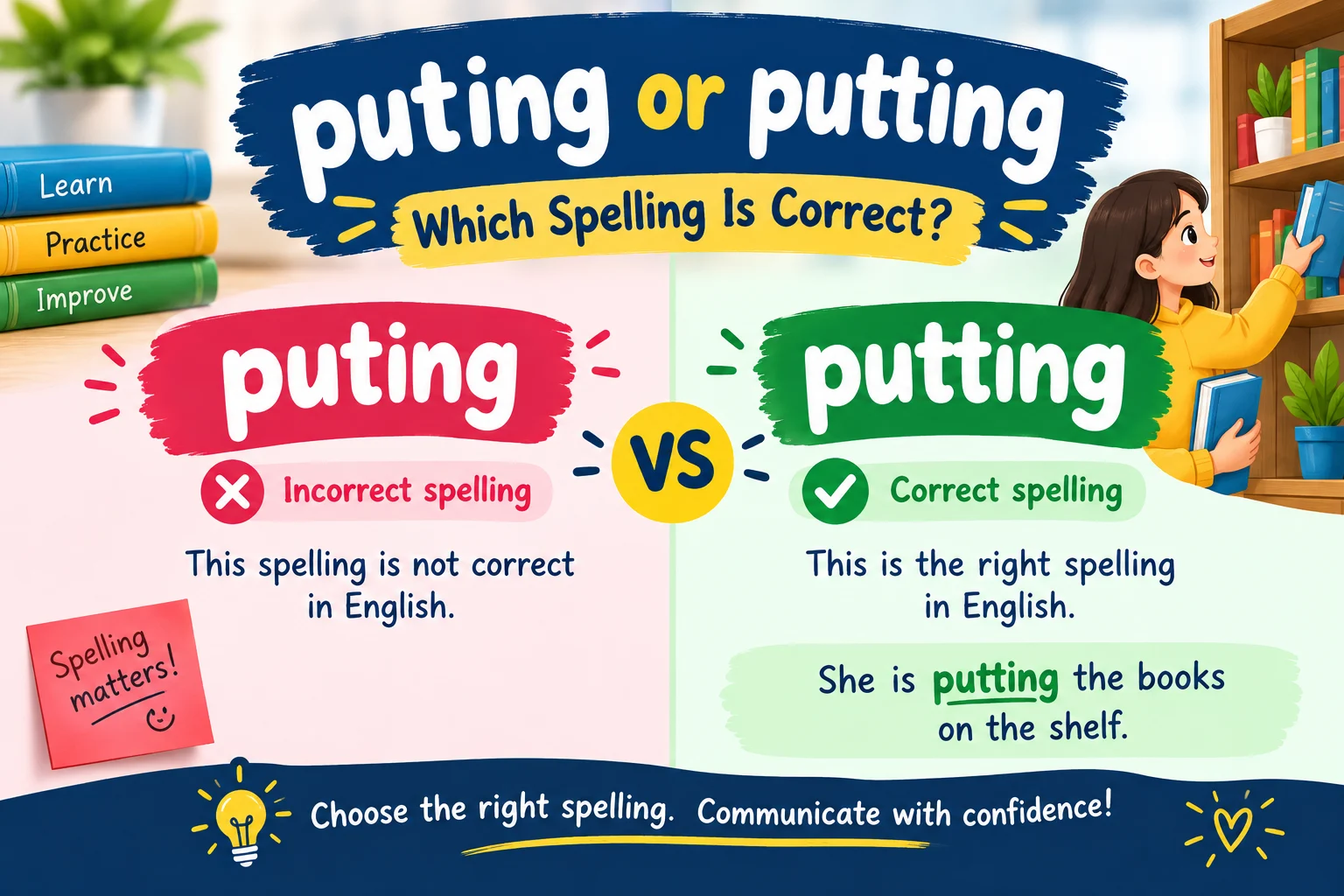
Putting is the correct spelling. Puting is a misspelling. Use putting when you mean placing, setting, or moving something into a particular position.
Have you ever typed “puting” and wondered if you forgot a letter? You are not alone. This is a common spelling mistake because the base word put looks so short and simple.
The correct word is putting, with two t’s. The extra t can feel strange at first, especially when you know that many English verbs do not double their final consonant.
I have seen this kind of mistake many times in everyday writing. It can appear in school assignments, emails, text messages, social media posts, and even business content. The problem often comes from trying to add -ing to put without changing its final letter.
The good news is that the rule is easy to remember. Put + ing = putting.
In this guide, you will learn why putting has two t’s, what the word means, how to use it correctly, and which common mistakes to avoid. Once you understand the pattern, you will not need to guess again.
Puting or Putting – Quick Answer
Putting is the correct spelling of the present participle and gerund form of put.
Puting is incorrect in standard English.
Correct:
She is putting the books on the table.
Incorrect:
She is puting the books on the table.
The key point is simple:
put + -ing = putting
The final t is doubled before -ing.
The Origin and Background of Putting
The word put is very old.
It has been part of English for many centuries. Its exact early history is not fully certain, but the verb has long been used to describe placing or moving something into a position.
Today, put is one of the most common verbs in English.
You can use it in many ways:
- Put the cup on the table.
- Put your phone away.
- Put the key in the drawer.
- Put your name on the form.
- Put some sugar in the coffee.
When we add -ing to put, the spelling becomes putting.
This follows an important English spelling pattern.
The word put ends in t. When -ing is added, the final consonant is doubled:
put → putting
This may seem unusual, but put is a special case worth remembering.
The same pattern appears in a few other short verbs:
sit → sitting
run → running
get → getting
stop → stopping
The doubled consonant helps preserve the pronunciation and follows established English spelling patterns.
Puting or Putting Explained — Key Differences
There is actually no meaning difference between puting and putting.
The issue is spelling.
| Term | Meaning | When to Use | Region/Context |
|---|---|---|---|
| putting | Placing or moving something into a position | Use in all standard English writing | British, American, Australian, Canadian, and other English varieties |
| puting | No standard English meaning | Do not use as the spelling of putting | Common spelling error |
Putting
Putting is the present participle and gerund form of put.
It can describe an action that is happening now:
He is putting his shoes on.
It can also work as a gerund:
Putting things away keeps the room tidy.
In both cases, putting is spelled with two t’s.
Puting
Puting is not the standard spelling.
You may see it in:
- Typing errors
- Informal online posts
- Search queries
- Student writing
- Comments and messages
However, seeing puting online does not make it correct.
If you are writing an essay, email, report, article, application, or professional message, use putting.
Why Does Putting Have Two T’s?
This is the part that confuses many learners.
You may think:
put + ing = puting
That seems logical.
But English spelling does not always work by simply attaching a suffix.
In putting, the final t is doubled:
put → putt → putting
The spelling rule is linked to the doubling of a final consonant before a suffix that begins with a vowel, especially in short words with certain sound patterns.
You do not need to memorize every technical rule to spell putting correctly.
Instead, remember this useful pattern:
Short verbs often double the final consonant before -ing
Examples include:
- run → running
- sit → sitting
- swim → swimming
- stop → stopping
- get → getting
- put → putting
However, not every verb doubles its final consonant.
For example:
open → opening
clean → cleaning
help → helping
So, when you learn a new verb, it can help to learn its -ing form too.
Which Version Should You Use?
There is no regional choice here.
Whether you use American English, British English, Canadian English, or Australian English, the standard spelling is putting.
For students
Use putting in:
- Essays
- Homework
- Exams
- School projects
- Academic assignments
Example:
The researcher is putting the results into a table.
For professional writers
Use putting in:
- Emails
- Reports
- Articles
- Business documents
- Presentations
Example:
We are putting together a new proposal.
For social media and casual writing
You should still use putting.
Example:
I am putting together my weekend plans!
For global English
Putting is the clear choice.
Unlike some spelling pairs such as color/colour or traveling/travelling, there is no standard British-versus-American spelling difference here.
So you do not need to choose between regional forms.
Just remember:
Putting = correct
Puting = incorrect
Common Mistakes with Puting or Putting
The most common mistakes are easy to fix.
Mistake 1: Writing “puting”
❌ She is puting the food on the table.
✅ She is putting the food on the table.
The mistake happens because writers add -ing without doubling the final t.
Mistake 2: Using one t in the middle of a sentence
❌ I am puting my clothes away.
✅ I am putting my clothes away.
Always check the middle of the word.
Putting has two consecutive t’s.
Mistake 3: Writing three t’s
Some writers know the letter must be doubled but accidentally add too many.
❌ She is puttt ing the book away.
✅ She is putting the book away.
You need two t’s, not three.
The correct spelling is:
p-u-t-t-i-n-g
Mistake 4: Confusing put and putting
Put and putting are both correct, but they serve different grammatical roles.
Please put the keys here.
She is putting the keys here.
Use put as the base or simple form.
Use putting when you need the -ing form.
Mistake 5: Forgetting that “put” stays the same in some forms
The verb put is unusual because its basic form, past form, and past participle are all put.
I put the book on the desk yesterday.
I have put the book on the desk.
But the -ing form is different:
I am putting the book on the desk.
This can make the verb confusing for English learners.
Putting in Real-World Examples
Seeing the word in different settings makes the spelling easier to remember.
Professional Email
Subject: Putting the Report Together
Hi Sarah,
I am putting the final sections of the report together. I will send you the completed version tomorrow.
Here, putting describes an action that is in progress.
News Headline or Article
City Is Putting New Safety Measures in Place
The headline uses putting because the city is taking action and placing new measures into effect.
Another example:
The company is putting more resources into employee training.
Again, putting is the correct form.
Social Media Post
Putting together my goals for the new month! 📚✨
The word works naturally in casual online writing.
Another example:
I love putting together simple meals at home.
Formal Document or Report
The department is putting new procedures in place to improve service quality.
The spelling remains putting in formal writing.
There is no reason to change it based on the level of formality.
Putting: Different Meanings and Uses
The word putting can appear in many expressions.
1. Placing something
She is putting the keys on the desk.
Here, it means placing something somewhere.
2. Moving something into a condition
He is putting the machine into standby mode.
It means moving the machine into a particular state.
3. Taking action
The team is putting a new plan into action.
Here, putting means making something happen or making it active.
4. Spending or investing
They are putting more money into the project.
Here, it means investing or using money for a purpose.
5. Expressing something
She had trouble putting her feelings into words.
Here, putting means expressing an idea or feeling.
6. Golf
Putting also has a special meaning in golf.
He is putting for the final hole.
In golf, putting means hitting the ball with a putter on the green.
The spelling is still putting.
Puting or Putting — Data, Trends & Usage
The search “puting or putting” has a clear informational purpose.
Most people searching for this phrase want a fast spelling answer. They may be writing an email, school assignment, social media post, or other piece of English text.
The confusion comes from the short base verb put.
When learners see:
put + ing
they may naturally create:
puting
But standard English uses:
putting
The double t is part of the established spelling.
This is also why related searches often involve other -ing forms. English learners frequently need help deciding when a final consonant should be doubled.
The useful lesson goes beyond this one word.
When adding -ing, do not always attach the suffix mechanically. Check whether the verb follows a consonant-doubling pattern.
For put, there is one simple answer:
put → putting
Learning this small pattern can help you avoid similar spelling mistakes in future writing.
Puting vs Putting: Quick Comparison Table
| Term/Variant | Meaning | Region/Context | Best Used When |
|---|---|---|---|
| putting | The correct -ing form of put | Standard English | Always use this form when adding -ing to put |
| puting | Incorrect spelling | Nonstandard/error | Do not use in standard English |
| put | Base verb and also its simple past/past participle | Standard English | Use for the base form and certain past constructions |
| putter/putting | Golf-related terms | Sports context | Use putting when describing the golf action |
Putting in Academic and Professional Writing
Spelling errors can distract readers.
That is why putting is especially important in formal writing.
Consider these sentences:
❌ The study is puting too much focus on one factor.
✅ The study is putting too much focus on one factor.
The second sentence looks polished and professional.
You may also see common expressions such as:
- putting forward an idea
- putting a plan into action
- putting pressure on
- putting together a report
- putting something into practice
- putting the results into context
All of these use putting with two t’s.
Frequently Asked Questions
Q: Is puting or putting correct?
A: Putting is correct. Puting is a misspelling and should not be used in standard English.
Q: Why does putting have two t’s?
A: The final t in put is doubled when the -ing ending is added. Therefore, the correct spelling is putting, not puting.
Q: How do you spell putting?
A: Spell it p-u-t-t-i-n-g. The word contains two t’s in the middle.
Q: What does putting mean?
A: Putting is the -ing form of put. It can mean placing something somewhere, moving something into a state, taking action, expressing something, or performing a golf stroke.
Q: Is puting ever correct in English?
A: Puting is not the standard spelling of the verb put plus -ing. In normal English writing, use putting.
Q: Is putting correct in formal writing?
A: Yes. Putting is the standard spelling and is correct in academic, professional, formal, and informal writing.
Q: Is putting the same in British and American English?
A: Yes. Both major varieties use putting. There is no standard British-American spelling difference between putting and puting.
Q: What is the difference between put and putting?
A: Put is the base form of the verb, while putting is its present participle and gerund form. For example, “Please put the book here” and “She is putting the book here.”
Conclusion
The answer to puting or putting is clear: putting is the correct spelling.
The word putting is the -ing form of put. When you add -ing, the final t is doubled.
So remember:
put → putting
Not:
put → puting
This spelling stays the same in British, American, Canadian, and other standard forms of English. You should use putting in school work, professional emails, reports, social media posts, and everyday writing.
The word can also have several meanings. It can describe placing something, taking action, expressing an idea, investing effort, or playing a golf shot.
If you remember only one thing, remember the two t’s.
Putting = correct.
Puting = incorrect.
Now you know exactly how to spell and use putting. Bookmark this guide, and the next time you type the word, you will not need to second-guess it.