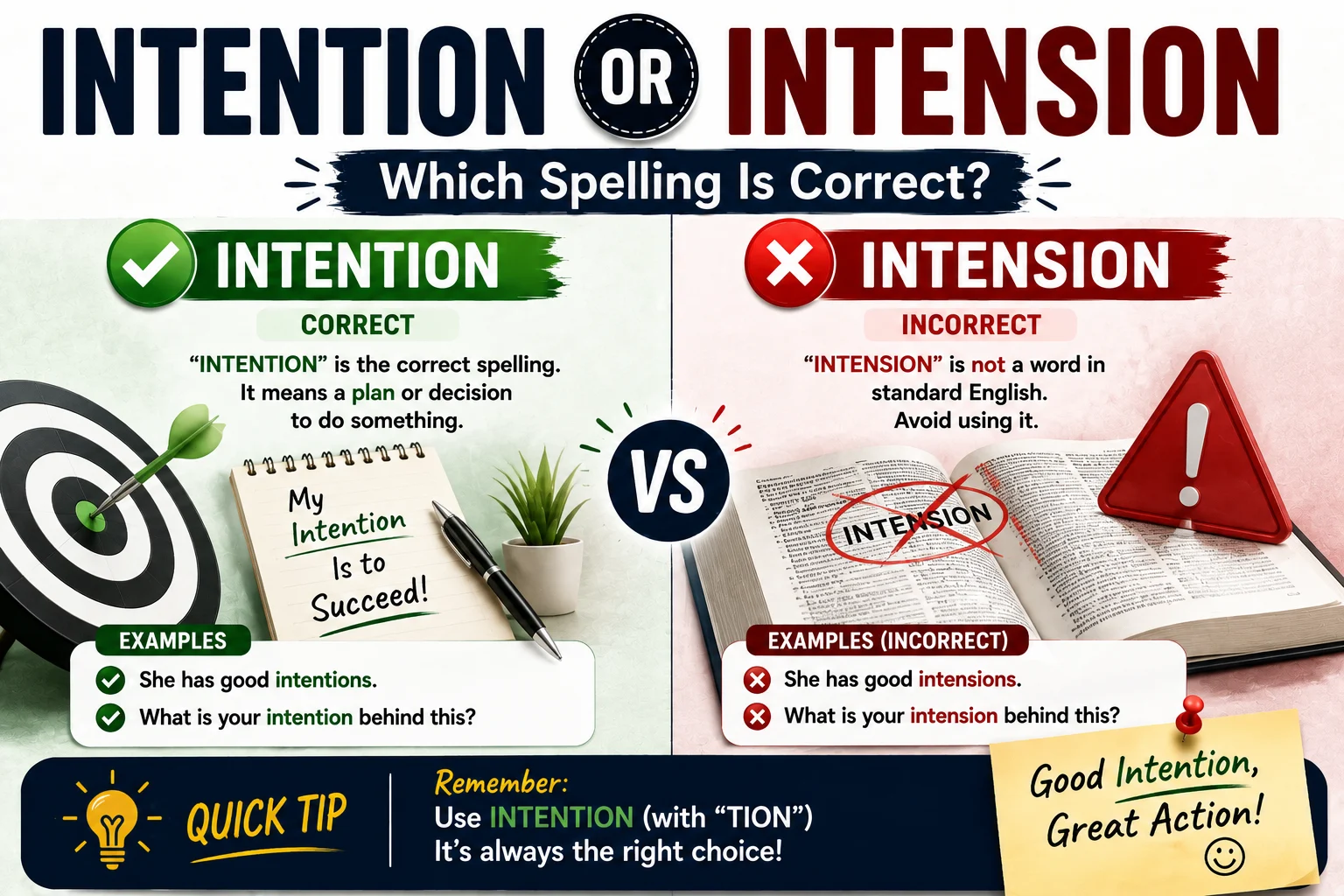
Intention means a plan, purpose, or aim behind an action. Intension is a different, much less common word used mainly in logic and philosophy to describe the qualities or attributes that define a concept.
Have you ever typed a sentence and stopped because you could not decide between intention and intension? I have seen this small spelling difference cause big confusion in student essays, emails, and formal writing. The two words look almost identical, but they do not mean the same thing.
The good news is that the choice is simple once you know what each word does.
If you mean a purpose, plan, or reason for doing something, you almost always need intention. For example, you might say, “My intention was to help.” Here, the word describes your purpose.
Intension, on the other hand, has a special meaning. It appears mainly in logic, philosophy, linguistics, and semantics. It refers to the qualities or properties that make up the meaning of a concept.
That one extra s can change the meaning completely. So, before you choose a word, let us look at the difference in a clear and practical way.
Intention or Intension – Quick Answer
Intention is the correct word when you mean someone’s purpose, plan, aim, or reason for doing something.
Her intention was to finish the project early.
Intension is a technical term. It refers to the qualities or characteristics that define a concept or term.
The intension of a term includes the properties that define it.
For everyday English, intention is the word you will normally need.
Simple examples
- My intention was to call you yesterday.
- He had no intention of causing trouble.
- The intension of a concept may be studied in formal logic.
A useful memory trick is:
Intention = intent or purpose.
Intension = technical meaning or defining qualities.
The Origin / Background of Intention and Intension
The confusion between these words is easy to understand. They look and sound very similar. They also come from related Latin roots.
Where does “intention” come from?
Intention comes from the Latin word intentio, meaning a stretching, purpose, or aim. It is related to the Latin verb intendere, which means to stretch toward, direct, or aim at.
Over time, English developed the word intention to describe a purpose or plan.
Today, you might say:
“Her intention was to become a teacher.”
The word tells us what she planned or wanted to do.
Where does “intension” come from?
Intension also has a Latin background. It developed as a technical term connected with the idea of directing or stretching inward.
Its modern use is mainly found in areas such as:
- Logic
- Philosophy
- Linguistics
- Semantics
- Formal language studies
In these fields, intension refers to the properties or characteristics that form the meaning of a concept.
That is why you rarely see intension in casual conversation.
Why do people confuse them?
The main reason is simple: the words are nearly identical in spelling and pronunciation.
Compare them:
- intention
- intension
Only one letter changes.
Yet their meanings are quite different. This is similar to other English word pairs where a tiny spelling difference creates a different word.
Intention or Intension Explained — Key Differences
The easiest way to understand these words is to focus on their jobs.
What does “intention” mean?
Intention is a noun that means a purpose, plan, aim, or desired result.
You use it when talking about what someone plans or wants to do.
Examples:
My intention is to study tonight.
She had no intention of leaving early.
What was your intention when you sent that message?
The word is common in everyday English.
What does “intension” mean?
Intension is a specialized noun.
In logic and semantics, it refers to the set of qualities, attributes, or characteristics that define a concept or word.
For example, imagine the concept triangle.
Its intension could include properties such as:
- A geometric shape
- Three sides
- Three angles
- A closed figure
These properties help define what the concept means.
This is very different from saying:
“My intention is to draw a triangle.”
Here, intention means your purpose.
A simple comparison
| Term | Meaning | When to Use | Region/Context |
|---|---|---|---|
| Intention | Purpose, plan, or aim | Everyday writing and speech | General English |
| Intension | Defining qualities of a concept | Technical discussions of meaning | Logic, philosophy, linguistics |
The safest rule is simple:
If you mean “purpose,” choose intention.
Which Version Should You Use?
For most readers, the answer is easy: use intention.
For students → use “intention”
If you are writing an essay, assignment, application, or school project, intention will almost always be correct.
Examples:
My intention is to improve my English.
The writer’s intention was to inform readers.
For professional writers → use “intention”
Emails, reports, business documents, and general articles normally use intention.
For example:
Our intention is to improve customer service.
You do not need the technical word intension unless your subject requires it.
For philosophy or linguistics → “intension” may be correct
If you are discussing concepts, meanings, definitions, or formal logic, you may need intension.
For example:
The intension of a term describes the properties associated with that concept.
This is a specialized use. It is not a replacement for intention.
For global or general English → choose “intention”
If your audience includes non-native English speakers, intention is much safer when you mean purpose or aim.
Common Mistakes With Intention or Intension
These words are easy to mix up. Here are some common mistakes.
| Incorrect | Correct | Why? |
|---|---|---|
| My intension was to help. | My intention was to help. | The sentence refers to a purpose. |
| She had no intension of leaving. | She had no intention of leaving. | The word means a plan or desire. |
| His intension was good. | His intention was good. | “Purpose” is the intended meaning. |
| The intention of the term describes its defining properties. | The intension of the term describes its defining properties. | This is a technical meaning-related use. |
| What was your intension? | What was your intention? | The question asks about someone’s purpose. |
Mistake 1: Using “intension” for purpose
This is the most common error.
❌ My intension was to help you.
✅ My intention was to help you.
The sentence is about a person’s purpose, so intention is correct.
Mistake 2: Assuming “intension” is a spelling mistake
Intension is a real English word.
It is not simply a misspelling of intention.
The problem is that many people use it in places where intention is needed.
Mistake 3: Using “intention” in technical definitions
In some academic subjects, intension has a specific meaning.
For example:
The intension of a concept consists of its defining properties.
Replacing intension with intention can change the meaning.
Mistake 4: Confusing intention with “intent”
Intent and intention are closely related.
For example:
His intent was to help.
His intention was to help.
Both can describe purpose. However, intention is often more natural in everyday sentences.
Intention or Intension in Real-World Examples
Knowing the definition is useful. Seeing the words in context is even better.
1. Professional email
My intention is to complete the report by Friday.
This is correct because the writer is describing a plan or purpose.
Another example:
I had no intention of causing any delay.
Again, the word refers to purpose.
2. News article
The minister said his intention was to improve public services.
News writing often discusses people’s plans, aims, and motives. Therefore, intention is the natural choice.
3. Social media post
My intention was only to make people laugh!
This is a normal everyday use.
You would not normally write:
My intension was only to make people laugh.
4. Formal report
The intention of the policy is to reduce unnecessary costs.
This is also correct. The sentence describes the purpose of the policy.
5. Academic writing
Here, either word may appear, depending on the subject.
General academic writing:
The author’s intention was to persuade the reader.
Technical semantics:
The intension of the term refers to its defining characteristics.
The context tells you which word you need.
Intention vs. Intension: A Simple Memory Trick
Still unsure?
Use this quick test.
Ask yourself: “Do I mean purpose?”
If the answer is yes, use:
INTENTION
My intention was to apologize.
Ask yourself: “Am I talking about the defining properties of a concept?”
If the answer is yes, you may need:
INTENSION
The intension of the term includes several defining features.
For most everyday situations, you can stop after the first question.
Purpose = intention.
That one rule will solve most spelling and usage questions.
Standalone Comparison Table
| Term/Variant | Meaning | Region/Context | Best Used When |
|---|---|---|---|
| Intention | A purpose, plan, aim, or desired action | General English | Talking about what someone plans or wants to do |
| Intension | The defining properties or qualities of a concept | Logic, philosophy, linguistics | Discussing technical meaning or conceptual definitions |
Compare these two sentences
My intention is to learn French.
Here, intention means a plan or aim.
The intension of the term is based on its defining properties.
Here, intension is a technical term about meaning.
The difference becomes clear when you focus on context.
Intention or Intension — Data, Trends & Usage
The search intent behind “intention or intension” is mainly informational.
People usually search for this pair because they have seen one spelling and are unsure which one belongs in their sentence.
For most general English users, intention is far more relevant. It appears in everyday conversations, school writing, business communication, psychology, law, literature, and general articles.
Intension has a much narrower audience. It is most useful in specialist fields that study language, concepts, logic, and meaning.
This difference matters because English learners often assume that a rare word is simply an alternative spelling of a common word. That is not always true.
In this case, intension is a genuine word, but its use is highly specialized.
So, if you are writing a normal sentence about someone’s plan or purpose, do not overthink it.
Choose intention.
Frequently Asked Questions
Q: What does intention mean?
A: Intention means a purpose, plan, aim, or reason for doing something. For example, “My intention was to help” means helping was my purpose.
Q: What does intension mean?
A: Intension is a technical term used mainly in logic, philosophy, linguistics, and semantics. It refers to the qualities or properties that define a concept.
Q: Which is correct, intention or intension?
A: Both are correct words, but they have different meanings. Use intention for a purpose or plan, and intension for its specialized technical meaning.
Q: Is intension a spelling mistake?
A: No. Intension is a real word. However, it is uncommon in everyday English, so many people only need intention.
Q: Is intention acceptable in formal writing?
A: Yes. Intention is completely acceptable in formal writing. You can use it in essays, reports, emails, applications, and professional documents.
Q: What is the difference between intention and intent?
A: Both words can refer to a purpose or aim. Intention is very common in everyday English, while intent can sound more formal or direct in some contexts.
Q: Can I use intension in an academic paper?
A: Yes, but only when its technical meaning fits your subject. If you mean someone’s purpose or aim, use intention, even in academic writing.
Q: How can I remember the difference between intention and intension?
A: Remember this simple rule: intention = purpose. Intension = defining qualities of a concept. If you are talking about what someone plans to do, choose intention.
Conclusion
The difference between intention or intension looks small, but the meanings are quite different.
Intention is the word you will use most of the time. It means a purpose, plan, aim, or reason for doing something. You can use it in everyday speech, schoolwork, emails, reports, and formal writing.
Intension is a real word too. However, it has a much narrower use. It belongs mainly to logic, philosophy, linguistics, and semantics, where it describes the defining qualities or properties of a concept.
The easiest rule is worth remembering:
Purpose = intention.
If you are talking about what someone plans or wants to do, choose intention. Save intension for technical discussions where its special meaning is needed.
Now you know the difference. Bookmark this guide so you never second-guess intention or intension again.