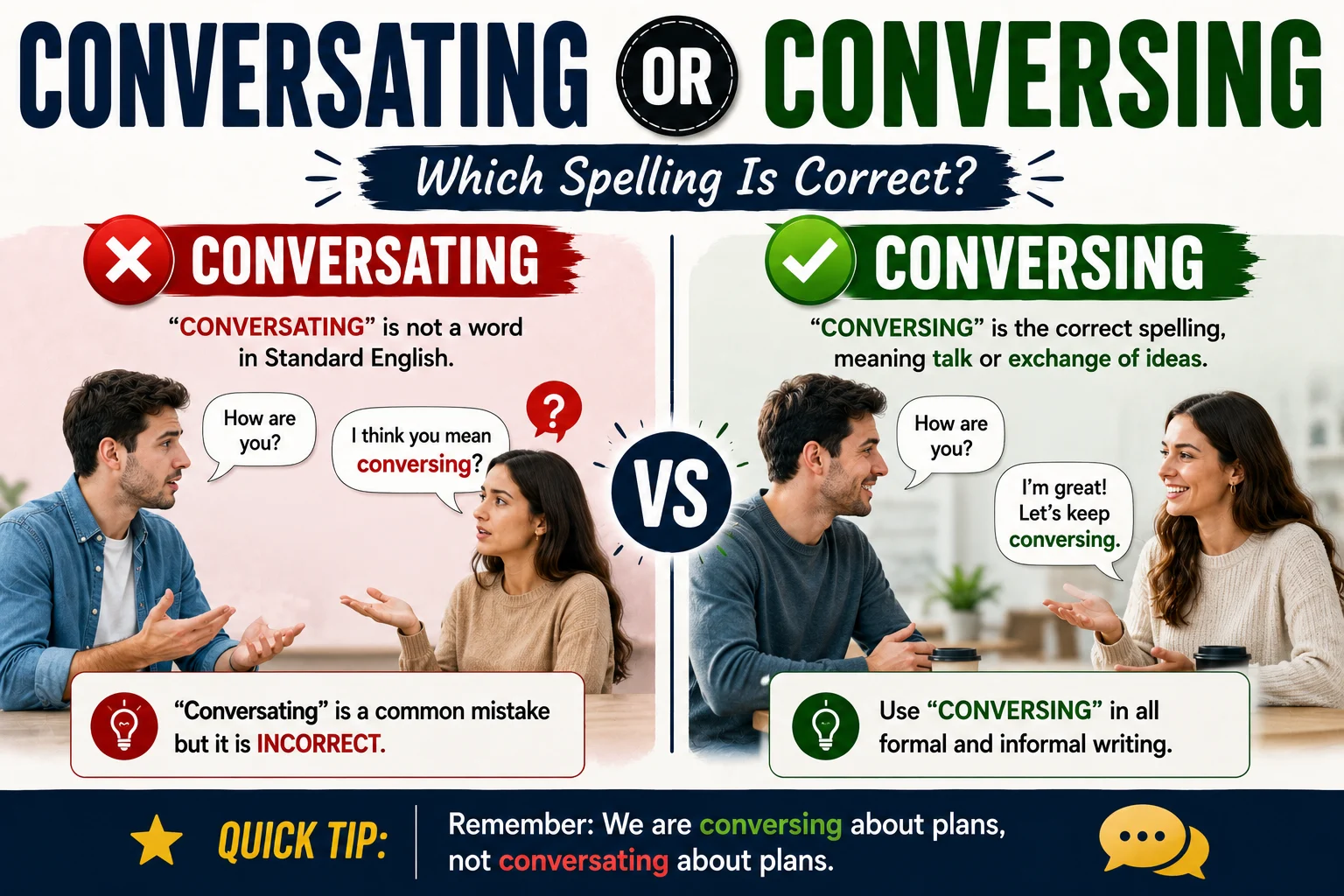
Conversating and conversing both relate to having a conversation, but conversing is the standard and widely accepted form. For formal and most everyday writing, use conversing.
Have you ever typed a sentence, stopped, and wondered, “Is conversating even a real word?”
I have seen this question many times while helping learners improve their English. The confusion is easy to understand. Conversation is the noun, so it may seem natural to turn it into a verb by adding -ing. That gives us conversating.
But English does not always work that way.
The standard verb is converse. Its -ing form is conversing. Major dictionaries define converse as talking with someone or having a conversation. Cambridge labels the verb as formal and gives examples such as “conversing with her.” (Cambridge Dictionary)
That does not mean you will never hear conversating. People do use it in informal speech and online communication. However, it is much less suitable when you want clear, standard English.
So, which word should you choose? Let’s make the answer simple.
Conversating or Conversing – Quick Answer
Conversing is the standard form.
It comes from the verb converse:
- Converse = to talk with someone.
- Conversing = talking with someone.
- Conversation = a talk between people.
For example:
We were conversing about our plans.
She enjoys conversing with her friends.
Cambridge defines converse as “to have a conversation with someone” and lists conversing as its present participle. (Cambridge Dictionary)
What about “conversating”?
Conversating is found in real speech and informal writing, but it is not the usual standard choice. If you are writing an essay, email, report, application, or professional message, conversing is the safer option.
Simple rule
Use “conversing” when you mean talking or having a conversation.
The students were conversing quietly.
Not:
The students were conversating quietly.
The Origin and Background of Conversing
The easiest way to understand conversing is to start with its base word: converse.
The verb converse has a long history in English. It is connected to the idea of associating, spending time with others, and talking with them.
Over time, converse became a verb meaning to talk with someone.
That gives English a very useful word family:
| Word | Meaning |
|---|---|
| converse | to talk with someone |
| converses | talks with someone |
| conversed | talked with someone |
| conversing | talking with someone |
| conversation | a talk between people |
| conversational | related to conversation |
This pattern explains why conversing is the natural form.
You take the verb:
converse → conversing
The noun is different:
conversation
That difference can cause confusion for learners.
Why does “conversating” sound possible?
English has many verbs ending in -ate.
For example:
- communicate → communicating
- educate → educating
- operate → operating
- separate → separating
Because conversation ends in a similar sound, some speakers may naturally create conversate and then conversating.
However, the standard verb is converse, not conversate.
So the correct verb pattern is:
converse → conversed → conversing
Conversating or Conversing Explained — Key Differences
The biggest difference is standard usage.
Conversing
Conversing is the present participle of converse.
It means talking with someone.
Examples:
The two teachers were conversing after class.
I saw them conversing outside the office.
She enjoys conversing with people from different cultures.
The word can sound slightly formal. In casual English, talking or chatting is often more natural.
Conversating
Conversating is sometimes used to mean having a conversation.
You may hear it in casual speech or see it online. However, it is not the form you should choose for standard formal English.
If you want your writing to sound polished and clear, use conversing.
Quick comparison
| Term | Meaning | When to Use | Region/Context |
|---|---|---|---|
| Conversing | Talking with someone | Standard English | Formal and general use |
| Conversating | Having a conversation | Informal or nonstandard use | Some casual speech and online contexts |
| Talking | Speaking with someone | Everyday communication | Very common |
| Chatting | Talking in a relaxed way | Casual conversation | Informal |
| Communicating | Sharing information or ideas | Broader situations | Formal and general |
One useful point is that conversing does not always mean simply saying words.
A conversation normally involves an exchange between people. Cambridge describes a conversation as a talk in which people express thoughts and feelings, ask and answer questions, or exchange information. (Cambridge Dictionary)
Which Version Should You Use?
The best choice depends on your audience and purpose.
For students: use “conversing”
If you are writing:
- an English assignment
- an essay
- an exam answer
- a school project
- a university paper
choose conversing.
Example:
The students were conversing about the topic.
Even better for simple writing:
The students were talking about the topic.
For professional writing: use “conversing”
Professional writing needs words that readers will recognize easily.
Use:
The manager was conversing with the client.
However, speaking with or talking with may sound more natural in many business situations.
For example:
I was speaking with the client this morning.
This is usually more direct than:
I was conversing with the client this morning.
For casual conversation: use “talking” or “chatting”
If you are speaking with a friend, you do not need the formal-sounding conversing.
You can say:
We were talking all night.
Or:
We were chatting after dinner.
For global English: use “conversing”
If your goal is to choose the form that is most clearly accepted in standard English, choose conversing.
It is the established -ing form of converse. (Cambridge Dictionary)
Common Mistakes With Conversating or Conversing
Small mistakes can make otherwise good writing sound less natural. Here are the most common ones.
1. Using “conversating” in formal writing
Incorrect or less suitable:
The two researchers were conversating about the results.
Better:
The two researchers were conversing about the results.
Why?
The standard verb is converse, so its -ing form is conversing.
2. Treating “conversation” as the verb
Incorrect:
They were conversation about the problem.
Correct:
They were conversing about the problem.
Or:
They were having a conversation about the problem.
Why?
Conversation is a noun.
Converse is the verb.
3. Using “converse” without the right structure
The verb converse is normally used with with when you name the person.
Correct:
She conversed with her teacher.
Correct:
He was conversing with his friend.
The structure is:
converse + with + person
4. Using “conversing” when “talking” is clearer
This is not a grammar error.
It is a style issue.
We were conversing about the movie.
This is correct.
But:
We were talking about the movie.
sounds more natural in everyday English.
Use the simplest word that fits your situation.
5. Confusing “converse” with “conversation”
Remember this simple distinction:
Converse = verb
They converse every evening.
Conversation = noun
They had a long conversation.
Conversing = -ing form
They were conversing every evening.
Conversating or Conversing in Real-World Examples
Seeing the words in context makes the difference easier to remember.
1. Professional email
Recommended:
I enjoyed conversing with you about the new project. Please let me know if you have any further questions.
For a more natural business style, you could also write:
I enjoyed speaking with you about the new project.
2. News article
Recommended:
The two leaders were seen conversing before the meeting began.
The word works well here because the tone is more formal.
3. Social media post
Natural:
Had a great time talking with old friends today!
You could say:
Had a great time conversing with old friends today!
But talking sounds more relaxed.
Conversating may appear in social media posts, but it is better avoided if you want standard English.
4. Formal report
Recommended:
The participants spent several minutes conversing before the interview began.
This is clear and grammatically standard.
5. Everyday conversation
You might simply say:
I was talking to Sarah.
You do not need:
I was conversing with Sarah.
Both can work, but talking is more natural in ordinary speech.
Standalone Comparison Table
| Term/Variant | Meaning | Region/Context | Best Used When |
|---|---|---|---|
| Conversing | Talking with someone | Standard English | Formal and polished writing |
| Conversating | Talking or having a conversation | Informal/nonstandard usage | Best avoided in formal writing |
| Converse | To talk with someone | Standard English | Base verb |
| Conversation | A talk between people | Standard English | As a noun |
| Talking | Speaking with someone | Everyday English | Most casual situations |
| Chatting | Talking casually | Informal English | Friendly conversations |
| Communicating | Sharing information | Broad/formal | Work, study, and general communication |
Conversating or Conversing — Data, Trends & Usage
Searches for word pairs like “conversating or conversing” are mainly informational. People usually want to know which form is correct before using it in writing.
The confusion comes from a real language pattern. People recognize conversation and may assume that conversate should be its verb. Yet standard dictionaries use converse as the verb and conversing as its present participle. (Cambridge Dictionary)
There is also a useful usage insight here.
Conversing is correct, but it can sound more formal than talking. Cambridge marks converse as a formal verb. (Cambridge Dictionary)
That means your choice should depend on more than grammar.
Ask yourself:
Would “talking” sound more natural here?
If yes, use talking.
If you want a more formal word, conversing is a strong choice.
Search intent behind this keyword
Most people searching this phrase want one of three things:
- Spelling clarification — Which word is correct?
- Grammar help — Can I use conversating as a verb?
- Writing advice — Which word sounds best in formal English?
The practical answer is simple: choose conversing for standard English and formal writing.
Is “Conversating” Ever Used?
Yes, you may encounter it.
Language changes through everyday speech. Speakers sometimes create new forms that follow familiar patterns. Conversating is one such form that appears in informal use.
But frequency alone does not make a form the best choice for formal writing.
Think of it this way:
He was conversating with his friend.
You may understand the sentence.
But:
He was conversing with his friend.
uses the standard verb form.
And:
He was talking with his friend.
is even more natural in many everyday situations.
So you do not need to argue about whether people use conversating. The better question is:
Which word should you use when you want clear, standard English?
The answer is conversing.
Frequently Asked Questions
Q: Is conversating a correct word?
A: Conversating is used by some speakers, mainly in informal contexts. However, conversing is the standard form and is the better choice for formal and polished English.
Q: Which is correct, conversating or conversing?
A: Conversing is the standard choice. It is the present participle of converse, which means to talk with someone. (Cambridge Dictionary)
Q: What does conversing mean?
A: Conversing means talking with someone or having a conversation. For example, “The two friends were conversing after dinner.” (Cambridge Dictionary)
Q: Is conversing formal English?
A: Yes. Converse is generally treated as a formal verb. In casual situations, talking or chatting may sound more natural. (Cambridge Dictionary)
Q: Can I use conversating in an essay?
A: It is better to avoid it in an essay. Use conversing, talking, or having a conversation, depending on your meaning and the tone you want.
Q: What is the difference between conversing and talking?
A: Both can mean speaking with someone. Talking is much more common in everyday English, while conversing sounds more formal and can suggest an extended or thoughtful exchange.
Q: Is “converse with” correct?
A: Yes. Converse with someone is a standard structure. For example: “She enjoys conversing with her colleagues.” Cambridge also gives converse with as the normal pattern. (Cambridge Dictionary)
Final Verdict: Conversating or Conversing?
The choice is easy once you know the base verb.
Converse is the standard verb.
Its -ing form is conversing.
Conversating may appear in informal speech, but it is not the best choice when you need standard, polished English.
Remember these three forms:
- Converse = verb
- Conversing = present participle
- Conversation = noun
For everyday speech, talking is often the simplest choice.
For formal writing, conversing is safe and correct.
The key is not to let the noun conversation trick you into creating conversating. English words do not always form their related verbs in the way we expect.
Once you remember converse → conversing, this spelling and usage question becomes much easier.
Now you know exactly which form to use. Bookmark this guide so you never second-guess “conversating or conversing” again.