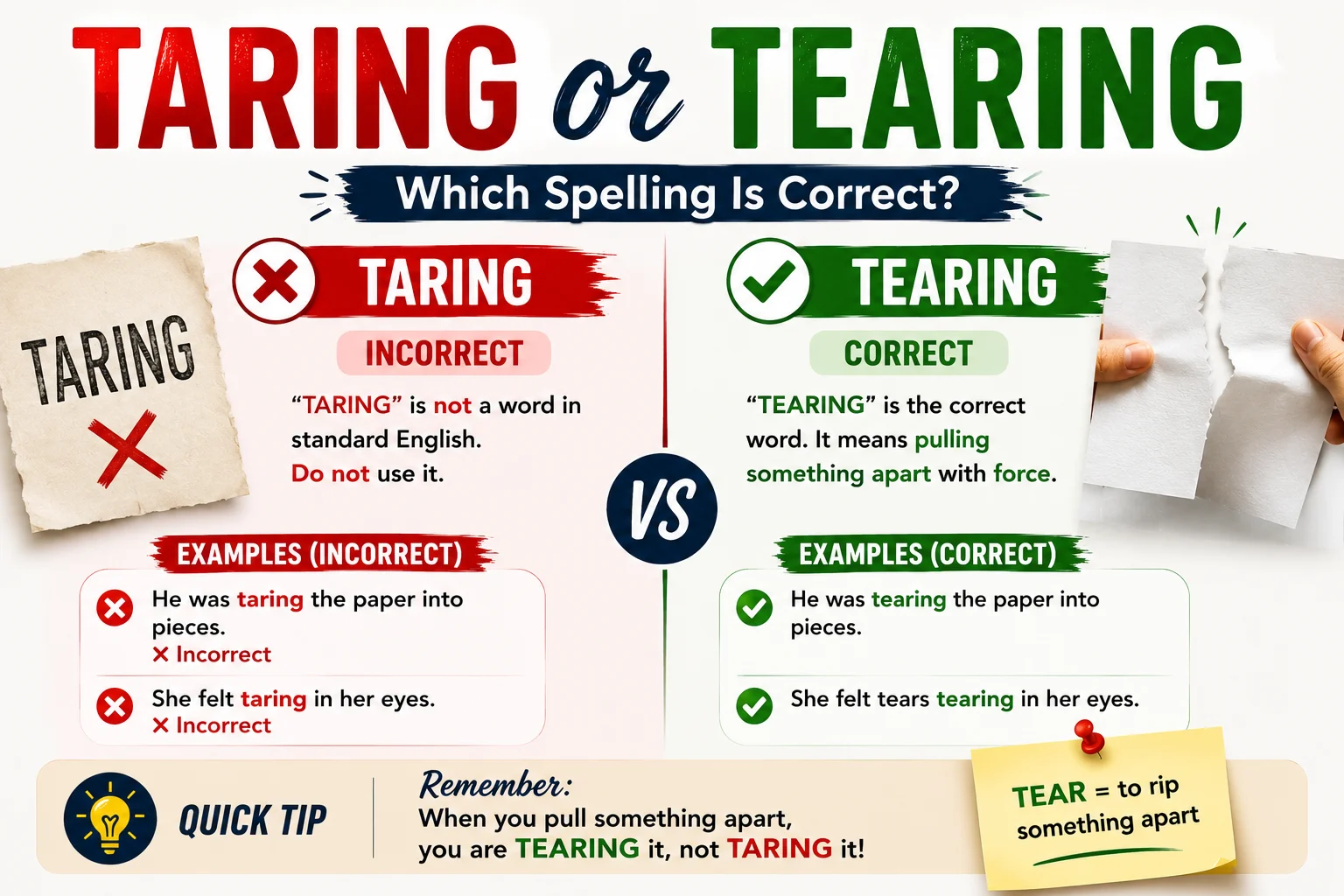
Taring is usually not the word you want. Tearing is the correct spelling when you mean ripping something apart or having tears in your eyes. Taring is a real word, but it has a specific meaning in weighing and is much less common.
Have you ever typed a sentence and stopped at “taring or tearing?” You are not alone. These words look almost identical, but they do not mean the same thing.
I have seen this kind of spelling mix-up many times when helping English learners with everyday writing. The problem is easy to understand. Both words contain the same letters, and both can sound similar in some forms. Yet one small letter can change the meaning completely.
If you want to talk about ripping paper, breaking fabric, or producing tears, the word you need is tearing. For example, you might say, “She is tearing the paper,” or “He was tearing up during the movie.”
Taring is also a correct English word. However, it belongs mainly to the world of weighing and measurement. It means setting a scale to account for the weight of a container.
So, which spelling should you use? Let’s make the difference simple.
Taring or Tearing – Quick Answer
Tearing is the correct choice when you mean:
- Ripping or pulling something apart
- Making a hole in something
- Producing tears from your eyes
- Becoming emotionally upset or tearful
Examples:
She is tearing the old letter.
The child was tearing up after hearing the news.
Taring is a different word. It is related to tare, which means the weight of an empty container or the process of adjusting a scale for that container.
Example:
The technician is taring the digital scale before weighing the product.
The simple rule
If you mean ripping or crying, use tearing.
If you mean adjusting a scale for the container’s weight, use taring.
The Origin and Background of Taring or Tearing
The confusion between taring and tearing comes from two different base words: tare and tear.
Where does “tearing” come from?
The verb tear has an old history in English. It comes from an Old English word related to the idea of pulling apart or breaking something by force.
Today, tear has several meanings.
It can mean to:
- Rip something
- Pull something apart
- Move very quickly in informal English
It can also connect to the noun tear, meaning the drop of liquid produced by the eyes.
This creates an extra spelling challenge because tear has two different common pronunciations:
- tear meaning rip → pronounced like “tair”
- tear from the eye → pronounced like “teer”
The present participle is tearing in both cases.
Where does “taring” come from?
Taring comes from the verb tare.
In measurement, a tare is the weight of a container that holds something being weighed.
For example, imagine a jar weighs 200 grams. You fill it with flour, and the total weight becomes 700 grams.
The flour weighs 500 grams.
A scale can be tared so that it ignores the 200-gram weight of the empty jar.
The verb form is:
tare → taring
That is why taring is a legitimate spelling. It simply has a much narrower use.
Taring or Tearing Explained — Key Differences
The easiest way to remember the difference is to look at the base words.
Tearing
Tearing comes from tear.
It usually means ripping, pulling apart, or crying.
Examples:
- Tearing the paper
- Tearing the shirt
- Tearing the envelope
- Tearing up during a sad movie
Taring
Taring comes from tare.
It relates to scales and weight.
Examples:
- Taring the kitchen scale
- Taring a laboratory balance
- Taring the weighing machine before adding ingredients
Comparison table
| Term | Meaning | When to Use | Region/Context |
|---|---|---|---|
| Tearing | Ripping or pulling apart | When something is being ripped | General English |
| Tearing | Producing tears | When someone is crying or becoming emotional | General English |
| Taring | Adjusting a scale for container weight | When weighing an item in a container | Measurement, science, cooking |
| Tare | Container weight or scale adjustment | As a noun or verb | Technical and everyday weighing |
The key point is simple: both spellings are correct, but they have different meanings.
Which Version Should You Use?
Your choice depends on what you want to say.
For everyday English → use “tearing”
If you are writing about normal daily events, tearing will be the word you need most often.
For example:
I was tearing the wrapping paper.
The dog is tearing the toy apart.
She started tearing up when she heard the song.
For cooking and weighing → use “taring”
Use taring when you are talking about a scale or balance.
For example:
Start by taring the scale.
The chef is taring the bowl before adding flour.
The laboratory assistant finished taring the balance.
For students and English learners
If you are unsure, ask yourself:
“Am I talking about ripping or tears?”
If yes, choose tearing.
If you are talking about a scale, container, or weight, choose taring.
Common Mistakes with Taring or Tearing
These words are easy to mix up. Here are some common mistakes.
| Mistake | Correction | Why? |
|---|---|---|
| She is taring the paper. | She is tearing the paper. | Paper is being ripped. |
| He was taring up during the movie. | He was tearing up during the movie. | The person is becoming emotional. |
| I am tearing the scale. | I am taring the scale. | A scale is adjusted for container weight. |
| She is taring her dress. | She is tearing her dress. | The dress is being ripped. |
| Tearing the bowl before adding flour. | Taring the bowl before adding flour. | The scale is being adjusted. |
Mistake 1: Using “taring” for ripping
❌ The boy is taring the paper.
✅ The boy is tearing the paper.
The paper is being ripped. Therefore, use tearing.
Mistake 2: Using “tearing” for a scale
❌ Tearing the scale before weighing the flour.
✅ Taring the scale before weighing the flour.
Here, the scale is being adjusted. The correct word is taring.
Mistake 3: Confusing “tearing” with “teared”
Another common error is writing teared when you mean the past tense of tear.
For example:
❌ She teared the paper.
✅ She tore the paper.
The verb forms are:
tear → tore → torn
The -ing form is:
tear → tearing
Taring or Tearing in Real-World Examples
Seeing these words in real sentences makes the difference much easier to remember.
1. Professional email
Subject: Scale Calibration
Please make sure the digital scale is tared before weighing each sample.
Here, tared relates to weighing.
Another example:
I noticed that the document was tearing along the edge.
Here, tearing means ripping.
2. News headline or article
Strong Winds Leave Roofs Tearing Apart
Here, tearing means being ripped or damaged.
A technical article might say:
Taring Scales Helps Improve Measurement Accuracy
Here, taring refers to adjusting a scale.
3. Social media post
My little brother is tearing the wrapping paper before his birthday!
This is a normal everyday use of tearing.
For a cooking post, you might see:
Remember to tare your bowl before adding the ingredients!
This uses the base form tare, not taring.
4. Formal document or report
The balance was tared before each measurement.
This is correct technical English.
You could also write:
The fabric showed signs of tearing after repeated use.
Again, the meaning tells you which spelling is right.
Taring or Tearing — Data, Trends & Usage
The two words are not equally common.
Tearing is far more common in general English because tear is an everyday verb. People use it when talking about clothes, paper, packaging, injuries, emotions, and many other situations.
Taring has a much narrower meaning. You are more likely to see it in:
- Cooking instructions
- Laboratory procedures
- Manufacturing
- Science
- Weight measurement
- Scale manuals
- Technical documents
This matters when you search for “taring or tearing.” The search is usually driven by spelling confusion rather than by a desire to learn about weighing.
That means most everyday writers who are unsure between the two probably need tearing.
A useful search-intent insight
If your sentence contains words such as paper, clothes, apart, crying, eyes, heart, or fabric, tearing is probably correct.
If it contains scale, weight, bowl, container, grams, balance, or measurement, taring may be correct.
Standalone Comparison Table
| Term/Variant | Meaning | Region/Context | Best Used When |
|---|---|---|---|
| Tearing | Ripping something | All major forms of English | Something is being ripped |
| Tearing | Producing tears | All major forms of English | Someone is crying or emotional |
| Taring | Adjusting a scale | Technical and measurement contexts | You remove container weight from a measurement |
| Tare | The weight of a container | Weighing and measurement | Talking about container weight |
| Tore | Past tense of tear | General English | Something was ripped in the past |
| Torn | Past participle of tear | General English | Used with have, has, had, or passive structures |
Tearing Has More Than One Meaning
One reason tearing can be confusing is that the word tear has more than one meaning.
Tearing = ripping
She is tearing the paper.
This means she is ripping the paper.
Tearing = crying
He was tearing up while watching the film.
This means he was becoming emotional and starting to produce tears.
Tearing = moving very fast
In informal English, tear can also mean moving quickly.
For example:
The car came tearing down the road.
Here, tearing does not mean ripping anything. It means moving very fast.
This is another useful meaning to know if you are learning English.
FAQs About Taring or Tearing
Q: Is “taring” a correct word?
A: Yes. Taring is a correct word. It comes from tare and is used mainly when adjusting a scale to account for the weight of a container.
Q: Is “tearing” the correct spelling for ripping?
A: Yes. Use tearing when you mean ripping or pulling something apart. For example, “She is tearing the paper.”
Q: What is the difference between taring and tearing?
A: Taring relates to weighing and scales. Tearing usually means ripping something or becoming tearful.
Q: Which is correct, “taring paper” or “tearing paper”?
A: Tearing paper is correct. You tear paper when you rip it. Taring does not have this meaning.
Q: Is “taring” acceptable in formal writing?
A: Yes, when the context is correct. It is a standard term in measurement and weighing. It would be wrong, however, if you use it when you mean ripping.
Q: Where does “taring” come from?
A: Taring comes from the verb tare. In weighing, tare refers to the weight of a container or the act of adjusting a scale to remove that weight from the measurement.
Q: Can I use “tearing” when talking about a weighing scale?
A: No. If you mean adjusting a scale before weighing something, use taring or taring the scale. For example, “Tare the bowl before adding the flour.”
Taring or Tearing: A Simple Memory Trick
Here is an easy way to remember the difference.
Think E for “E-motion”
Tearing can describe someone becoming emotional:
She was tearing up.
The E can remind you of emotion.
Think A for “Adjustment”
Taring involves a scale adjustment:
Taring the scale removes the container’s weight.
The A in taring can remind you of adjustment.
It is not a formal spelling rule. It is simply a quick memory trick.
Conclusion
The choice between taring or tearing becomes easy once you focus on meaning.
Use tearing when you mean ripping, pulling apart, crying, or moving quickly in an informal expression. It is the word you will use in most everyday situations. You might tear paper, tear a shirt, or tear up during an emotional moment.
Use taring when you are talking about weighing and adjusting a scale. It comes from tare, a term linked to the weight of a container.
There is one more form worth remembering: tear → tore → torn. So, “She tore the paper” is correct, while “She teared the paper” is not.
The best rule is simple: look at the meaning before choosing the spelling. If something is being ripped, choose tearing. If a scale is being adjusted, choose taring.
Bookmark this guide so you never second-guess “taring or tearing” again.