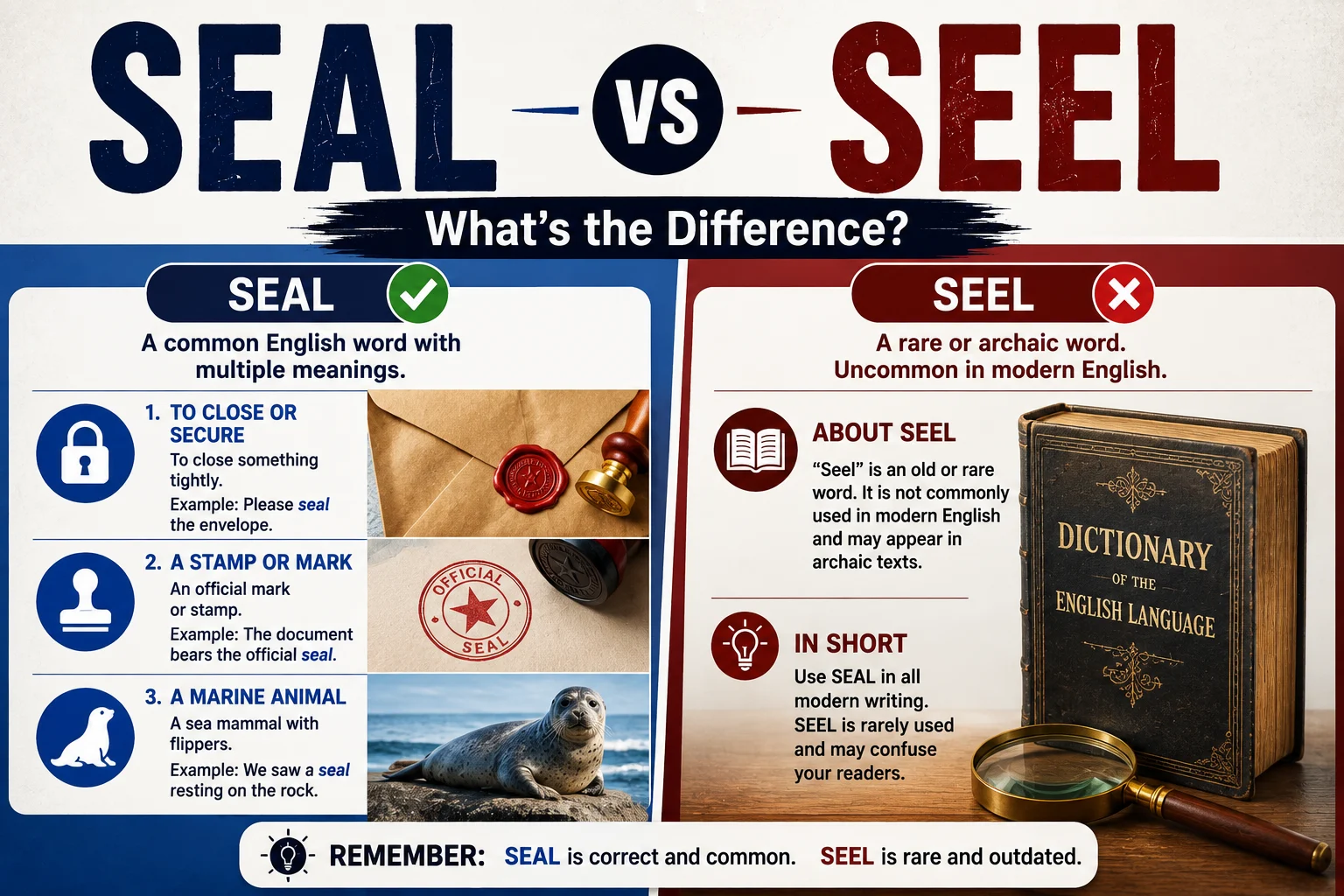
Seal is the correct standard English spelling for the word meaning to close something securely, an official mark, or a marine animal. Seel is not the normal spelling for these meanings.
Have you ever typed “seel” when you meant “seal”? It is an easy mistake to make. The two words look almost identical, and they sound the same in many accents.
As an English teacher, I often see learners pause over words like this. A single vowel can change a word from a common English term into a rare or specialized one. That can make spelling checks confusing.
The good news is that the everyday choice is simple: seal is the spelling you normally need.
You use seal when you talk about closing an envelope, making something airtight, referring to an official stamp, or naming the ocean animal. You may also see seal as a verb meaning to confirm or finalize something.
But what about seel? Is it always wrong? Not quite. Seel is a real but very uncommon English word. It has specialized historical meanings and is not a replacement for ordinary seal.
Understanding this small difference can help you avoid spelling mistakes in emails, schoolwork, reports, and everyday writing.
Seal or Seel – Quick Answer
Seal is the correct spelling for almost all common meanings.
It can mean:
- To close something tightly.
- An official mark or stamp.
- A marine mammal.
- To confirm or finalize something.
Examples
Please seal the envelope before sending it.
The company used its official seal on the document.
We saw a seal swimming near the boat.
Seel, by contrast, is a rare word. It is mainly found in older or specialized English.
So if you are wondering whether to write seal or seel, choose seal in normal modern English.
The Origin / Background of Seal or Seel
The confusion between seal and seel is easy to understand because English contains many words with similar sounds but different spellings.
The common word seal has a long history.
As a verb meaning to close or secure something, seal is connected to the idea of fastening something with a seal. The noun seal, meaning an official mark, comes through Old French and Latin roots associated with a mark or stamp.
The animal seal has a different historical path. It is related to Old English and Germanic words for the marine animal.
Over hundreds of years, these meanings settled into the spelling seal.
So Where Does “Seel” Come From?
Seel does exist in English, but it is uncommon.
One historical meaning of seel is connected with an old practice involving falconry. In this specialized use, the word referred to sewing or closing a bird’s eyelids.
Another seel appears in older or dialectal English with different meanings.
These uses are rare today.
That is why a dictionary may list seel even though your spell checker or teacher usually expects seal.
Why Do People Confuse Them?
There are three main reasons:
- They sound similar.
- They differ by only one letter.
- “Seel” looks like it could be a normal spelling of “seal.”
English has many words that create this kind of problem.
For example:
- piece / peace
- steel / steal
- meet / meat
- right / write
The important thing is to learn the meaning and spelling together.
Seal or Seel Explained — Key Differences and Variations
The simplest rule is this:
Use “seal” for normal modern English. Use “seel” only when you specifically mean the rare historical or specialized word.
| Term | Meaning | When to Use | Region/Context |
|---|---|---|---|
| seal | Close or secure something | Everyday writing | Modern English |
| seal | Official mark or stamp | Documents and organizations | Modern English |
| seal | Marine mammal | Animals and nature | Modern English |
| seal | Confirm or finalize something | Agreements and decisions | Modern English |
| seel | Rare historical verb related to falconry | Specialized or historical writing | Older English |
| seel | Rare or dialectal uses | Specific dictionary contexts | Uncommon |
Seal as a Verb
When seal is a verb, it often means to close something securely.
Please seal the box.
The package was sealed with tape.
It can also mean to make something final.
The agreement sealed the deal.
Seal as a Noun
As a noun, seal has several common meanings.
An Official Mark
The document carries the university seal.
A Marine Animal
A seal was resting on the beach.
A Tight Closure
The bottle has a strong seal.
The same spelling works for all these meanings.
Which Version Should You Use?
For almost every modern writing situation, use seal.
For Students
Choose seal.
If you are writing a school assignment, exam answer, or essay, seal is almost certainly the word you need.
For Professional Writers
Use seal for standard business and professional communication.
For example:
“Please seal the package before delivery.”
or:
“The contract was sealed yesterday.”
For Beginners and ESL Learners
Remember this simple rule:
Seal = common word
Seel = rare word
You do not need to memorize every historical meaning of seel to write good everyday English.
For Formal or Historical Writing
You may encounter seel in older texts, books about falconry, or historical dictionaries.
In that setting, do not automatically replace it with seal. Check the intended meaning first.
For Global English
Seal is the safest choice for standard international English when you mean the common word.
Common Mistakes with Seal or Seel
1. Writing “Seel the Envelope”
Mistake:
Please seel the envelope.
Correct:
Please seal the envelope.
The verb meaning “close securely” is seal.
2. Writing “A Seel at the Zoo”
Mistake:
We saw a seel at the zoo.
Correct:
We saw a seal at the zoo.
The marine animal is spelled seal.
3. Writing “Official Seel”
Mistake:
The letter has the official seel.
Correct:
The letter has the official seal.
An official mark or emblem is a seal.
4. Assuming “Seel” Is Always a Spelling Error
This mistake goes in the opposite direction.
Mistake:
“Seel” is never a real English word.
Correction:
Seel is a real but very uncommon word.
It appears in historical and specialized contexts. Therefore, calling it “completely incorrect” would be too broad.
5. Choosing by Sound Alone
Mistake:
“They sound alike, so either spelling is fine.”
Correction:
English spelling does not always follow pronunciation.
The meaning tells you which spelling to choose.
If you mean close, official mark, or marine animal, write seal.
Seal or Seel in Real-World Examples
1. Professional Email
Please seal the package securely before sending it to the client.
This is a normal and professional use of seal.
2. News Headline
Rescuers Save Injured Seal Near the Coast
Here, seal refers to the marine animal.
3. Social Media Post
“Look what we spotted today—a baby seal!”
This is a natural casual use.
4. Formal Document
“The agreement shall be considered final once both parties seal the contract.”
Here, seal means to finalize or formally confirm something.
5. Everyday Conversation
“Did you seal the envelope?”
“Yes, I sealed it.”
This is one of the easiest ways to remember the spelling.
Seal or Seel — Data, Trends & Usage
The search intent behind seal or seel is mainly informational.
People usually search for this pair because they want to know:
- Which spelling is correct?
- What does seal mean?
- Is seel a real word?
- How do you spell the animal?
- Should I write seal in formal English?
- Why does seel appear in some dictionaries?
The difference matters because seal is common while seel is highly specialized.
Which Word Is More Common?
Seal is overwhelmingly more common in modern English.
You encounter it in many areas:
- Business
- Education
- Wildlife
- Packaging
- Law
- Government
- Everyday conversation
- News
- Literature
Seel is much less common.
It is most likely to appear in historical texts, specialized dictionaries, or discussions of falconry and older English.
Why This Matters for Writers
Knowing that seel exists can prevent another kind of mistake: overcorrecting.
If you see seel in an old text, do not assume the writer simply misspelled seal. Context matters.
For normal modern writing, however, there is little reason to choose seel.
Standalone Comparison: Seal vs. Seel
| Term/Variant | Meaning | Region/Context | Best Used When |
|---|---|---|---|
| Seal | Close or secure | Modern English | Everyday and professional writing |
| Seal | Official mark | Modern English | Documents and institutions |
| Seal | Marine mammal | Modern English | Animals and nature |
| Seal | Confirm or finalize | Modern English | Agreements and decisions |
| Seel | Historical falconry term | Older/specialized English | Historical or technical contexts |
| Seel | Rare dialectal word | Limited contexts | Only when the intended meaning requires it |
The key difference is not simply spelling.
It is meaning and context.
Frequently Asked Questions About Seal or Seel
Q: What does seal mean?
A: Seal can mean to close something securely, an official mark, or a marine mammal. It can also mean to confirm or finalize something.
Q: How do you use seal correctly?
A: Use seal when you mean to close something, make something secure, refer to an official mark, or talk about the marine animal. For example: “Please seal the box.”
Q: Seal vs. seel — what’s the difference?
A: Seal is the common modern English word. Seel is a rare word with historical and specialized meanings, especially in older falconry language.
Q: Is seal acceptable in formal writing?
A: Yes. Seal is completely acceptable in formal writing when it has the correct meaning. You may see it in legal, business, academic, and government documents.
Q: Which spelling is correct — seal or seel?
A: Seal is correct for the common meanings. Seel is correct only in certain rare or historical uses.
Q: Where does the word seal come from?
A: The different meanings of seal have different historical roots. The word connected with an official mark and the verb meaning “close securely” developed through older European languages, while the animal name has Germanic roots.
Q: Can seel be used in modern English?
A: Yes, but it is very uncommon. You are most likely to see it in historical, literary, dialectal, or specialized writing. It is not a normal substitute for seal.
Q: How do you spell the animal, seal or seel?
A: The marine animal is spelled seal. For example: “We saw a seal near the shore.”
Q: Is “seel” a misspelling?
A: Not always. Seel is a real English word, but it has rare meanings. If you mean the animal, a closure, or an official mark, seal is the correct spelling.
Conclusion
The seal or seel question looks tricky, but the answer is simple for most writers.
Seal is the standard modern spelling. Use it when you mean to close something, secure something, confirm something, refer to an official mark, or name the marine animal.
Seel is different. It is a real English word, but it is rare. You may find it in historical writing or specialized discussions, especially those related to old falconry terms.
The easiest rule to remember is:
Seal is common. Seel is rare.
If you are writing an email, essay, report, article, or social media post, seal will almost always be the word you want.
Do not choose between the two based only on sound. Look at the meaning first.
Now you know exactly when to use seal or seel. Bookmark this guide and share it with anyone who has been unsure about this tricky spelling pair.